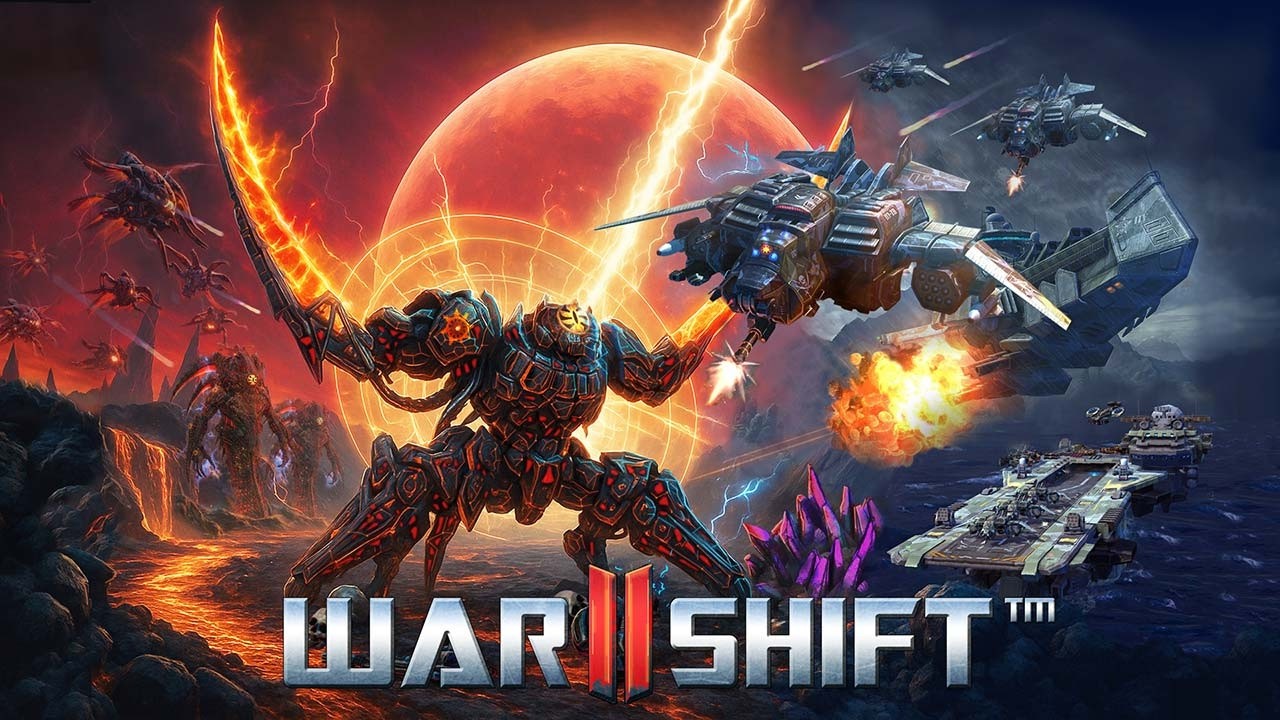
WARSHIFT 2 Review – RTS Action RPG Strategy Hybrid
Explore WARSHIFT 2, a sci-fi strategy game combining real-time army command, third-person combat, hero upgrades, and large-scale warfare.
WARSHIFT 2 blends real-time strategy, third-person action, and RPG progression with base building, resource management, hero customization, mechs, battleships, and futuristic battlefield control.
Ready to command the battlefield? Discover how WARSHIFT 2 combines strategy, action, and hero combat into one evolving war machine below.

WARSHIFT 2


WARSHIFT 2 Review – A Real-Time Strategy Action RPG Hybrid Built Around Commanding the Entire Battlefield An editorial analysis of Cyril Megem's sci-fi strategy game systems, hero progression, base management, and large-scale warfare
WARSHIFT 2 is a sci-fi strategy game developed and published by solo creator Cyril Megem, expanding the foundation established by the original WARSHIFT. The sequel focuses on combining real-time strategy management, third-person action combat, and RPG progression into a single battlefield system where players can command armies while directly controlling a hero unit.
The core idea behind WARSHIFT 2 gameplay is built around changing perspectives during active battles. Players can construct bases, manage resources, deploy troops, control mechs, battleships, aircraft carriers, and then enter combat personally through their hero. The game does not separate strategic planning and action combat into different experiences. Both layers operate together, requiring constant attention between army management and frontline decisions.
The identity of WARSHIFT 2 comes from this combination of systems. Base building, resource production, unit control, hero customization, and direct combat are designed to support one another rather than exist as isolated mechanics. The result is a real time strategy third person action RPG hybrid that approaches battlefield control from both a commander and soldier perspective.
As a WARSHIFT sequel, the game continues the independent development approach of Cyril Megem games, with the creator handling the design, programming, and artwork. Instead of following the structure of a traditional RTS release, WARSHIFT 2 focuses on expanding the interaction between strategic decision-making and direct player involvement.
Building Armies Starts With Strong Resource Management and Tactical Planning How WARSHIFT 2 base building and economic systems shape every battlefield decision
The strategic foundation of WARSHIFT 2 begins with base construction and resource management. Players are responsible for creating the infrastructure required to support military operations, including resource extraction, energy production, defensive structures, and unit creation. These systems form the backbone of every engagement because military strength depends on maintaining a stable economy.
WARSHIFT 2 base building and resource management follow the traditional principles of real-time strategy design, where early decisions influence later opportunities. Expanding too quickly can create vulnerable positions, while investing heavily in defence can slow access to advanced military technology. The player must constantly judge whether resources are better spent on expansion, protection, or offensive capability.
Unlike strategy games that focus only on controlling units after they are produced, WARSHIFT 2 places greater emphasis on the connection between economy and battlefield performance. Resources determine the ability to replace losses, deploy heavier units, and maintain pressure during longer conflicts.
This creates the familiar RTS balance between macro-management and tactical execution. The player must monitor the wider battlefield while ensuring that the systems behind the army continue functioning. A successful commander is not simply the one with the strongest units, but the one who can maintain the production network needed to keep those units active.
Switching Between Strategy Command and Third-Person Combat Changes the Battlefield WARSHIFT 2 gameplay connects large-scale decisions with direct hero control
The defining feature of WARSHIFT 2 is the ability to move between strategic command and direct third-person action during the same battle. Players can organise troop movements, manage military units, and control large-scale operations before taking direct control of a hero and entering the fight.
This structure changes the role of the player compared with a traditional RTS. Instead of remaining only above the battlefield, the commander can become an active combat participant. A hero can support a struggling frontline, attack important targets, or provide additional pressure during major engagements.
The challenge comes from knowing when direct involvement is useful and when strategic attention needs to return to the wider army. Spending too much time controlling a hero can reduce awareness of production, positioning, and incoming threats, while staying entirely in the command view ignores the advantages provided by personal combat abilities.
This approach places WARSHIFT 2 among action RTS hybrid games that attempt to combine the strategic workload of an RTS with the immediate decision-making of an action game. The result is a battlefield where success depends on managing both the overall military situation and the smaller moments that happen within it.
Hero Customization Adds RPG Progression to the Strategy Formula Weapons, upgrades, and abilities create different approaches to frontline combat
WARSHIFT 2 hero customization provides a progression system that separates the player's hero units from standard military forces. Heroes can be upgraded through weapons, support drones, turrets, and additional equipment options, allowing players to develop combat roles that match their preferred approach.
Each hero includes unique weapons and special abilities, creating different tactical possibilities during battles. These upgrades are not simply cosmetic additions. They influence how heroes contribute when fighting alongside the army and how they support larger strategic objectives.
WARSHIFT 2 hero progression and weapons upgrades work alongside the RTS systems rather than replacing them. Heroes provide additional battlefield influence, but they remain connected to the larger army structure. Strong character development still depends on effective resource management, unit coordination, and strategic planning.
The combination of character progression and army management gives WARSHIFT 2 similarities with RTS RPG games on PC, where long-term development systems are combined with broader tactical decisions. The player is not only improving a character but also developing a complete military strategy around that character's strengths.
Heavy Units and Advanced Warfare Expand the Scale of Every Battle Mechs, aircraft carriers, flying battleships, and orbital weapons define the larger conflicts
WARSHIFT 2 increases the scale of its conflicts through a wide range of heavy military units. Alongside traditional troops, players can command mechs, battleships, aircraft carriers, and flying battleships designed to influence large sections of the battlefield. These units represent the technological progression of the player's forces and provide additional strategic options beyond standard ground combat.
Aircraft carriers and flying battleships in WARSHIFT 2 introduce another layer of tactical planning because their value depends on preparation and timing. These units require a functioning economy and careful battlefield positioning to reach their full potential. Deploying powerful machinery without proper support can leave valuable resources exposed, while combining different unit types creates stronger military formations.
The inclusion of heavy units reinforces the game's focus on combined-arms warfare. Ground forces, aerial units, naval assets, and advanced machinery all contribute to controlling the battlefield. Instead of relying on one dominant unit type, players must consider how different forces interact and how each asset supports the wider army.
WARSHIFT 2 also includes orbital mass destruction weapons, adding another strategic option to its science fiction warfare systems. These abilities represent some of the game's largest-scale attacks and fit naturally within a sci-fi strategy game built around futuristic technology and planetary conflict.
A Biomechanical War Across Ground, Space, and Hostile Worlds The campaign setting connects futuristic warfare with a battle for humanity's survival
The story of WARSHIFT 2 takes place in a near-future conflict where humanity faces an aggressive biomechanical civilization determined to consume all forms of life. Players take the role of commanders defending frontier worlds while managing military operations against advanced enemy forces.
The setting provides the foundation for the game's focus on large-scale warfare. Robotic enemies, futuristic machines, and advanced military technology create the framework for battles that extend across multiple environments. The narrative supports the strategy systems by explaining the scale of the conflict and the need for constant adaptation.
WARSHIFT 2 includes battles across ground, air, water, volcanic regions, underwater locations, and outer space environments. This environmental variety supports different tactical situations and gives the game's military systems a wider range of scenarios to operate within.
The single-player campaigns include interactive training missions designed to introduce the game's combined strategy and action mechanics. Custom skirmishes against AI provide additional replay opportunities by allowing players to experiment with different armies, unit combinations, and battlefield approaches.
A Solo Developer Building a Different Kind of Strategy Game Cyril Megem's approach focuses on combining systems normally separated across genres
WARSHIFT 2 is developed entirely by Cyril Megem, who serves as the game's designer, programmer, and artist. This development approach places the project within a smaller group of independent strategy games created around a specific mechanical vision rather than a large studio production model.
The solo developer Cyril Megem WARSHIFT 2 project continues the direction established by the original WARSHIFT, expanding the relationship between strategic command, direct combat, and character progression. The game's structure reflects a focus on creating a connected system where each gameplay element supports the others.
Within the wider landscape of independent strategy development, WARSHIFT 2 represents an attempt to combine multiple genres that are traditionally designed separately. The game brings together RTS management, action combat, and RPG progression without removing the strategic responsibilities that define real-time strategy.
The result is a sequel built around refinement and expansion rather than a complete change in direction. WARSHIFT 2 develops the original concept through additional units, improved customisation systems, broader environments, and more detailed battlefield interactions.
WARSHIFT 2 Steam Release and PC Requirements The hardware needed to manage large-scale strategy battles and direct combat
Players researching WARSHIFT 2 Steam information should consider the game's hardware requirements before installation. The title is designed for Windows systems and uses DirectX 11, supporting the combination of large-scale unit management and third-person combat happening within the same battlefield.
The WARSHIFT 2 PC minimum and recommended requirements place the game within modern mid-range hardware expectations. The minimum specification requires Windows 10, an Intel Core i5-3570 or AMD FX-8350 processor, 16 GB RAM, an NVIDIA GeForce GTX 1070 or AMD Radeon RX 580 graphics card, DirectX 11 compatibility, and 15 GB of available storage.
Recommended specifications require Windows 10/11 64-bit, an Intel Core i7 or AMD Ryzen 5 3600 processor, 16 GB RAM, an NVIDIA GeForce RTX 3060 or AMD Radeon RX 6600 XT graphics card, DirectX 11 compatibility, and 25 GB of available storage.
These requirements reflect the game's design approach. WARSHIFT 2 is not only rendering a player-controlled character but also managing armies, structures, environmental effects, and large-scale military activity simultaneously.
Where WARSHIFT 2 Fits Among Strategy and Action Hybrids A focused experiment in combining army command, character control, and RPG progression
WARSHIFT 2 occupies a specialised position within modern strategy games because its main focus is the relationship between different layers of control. The game asks players to think like a commander while also acting as a frontline combat unit, creating a structure that differs from traditional RTS releases.
Its closest comparisons come from other genre hybrids that have attempted to merge strategic planning with direct participation. However, WARSHIFT 2 approaches the idea through real-time switching between army management and hero combat, placing equal importance on both sides of the experience.
The game's systems connect through a clear progression loop. Resources support production, production creates armies, armies create battlefield opportunities, and heroes influence critical moments through direct combat. Each part of the design feeds into the next rather than operating independently.
For players interested in action RTS hybrid games, WARSHIFT 2 provides an experience built around constant decision-making. It is a game where the question is not only what the army should do, but when the commander should personally enter the fight.
Final Verdict WARSHIFT 2 delivers a focused strategy experience built around battlefield control, hero progression, and direct combat
WARSHIFT 2 succeeds because it commits fully to its central idea of combining real-time strategy with direct action. Cyril Megem's sequel does not simply place an action character inside an RTS environment. It creates a connected system where army management, hero combat, resource planning, and technological progression influence one another throughout each battle.
The game's strongest feature is the relationship between perspectives. Building a base, managing resources, deploying advanced units, and controlling a hero are not separate activities. They form a continuous battlefield loop where every decision affects the next stage of the conflict.
WARSHIFT 2 hero customization, weapons upgrades, heavy military units, and strategic systems give players multiple ways to approach combat. The game rewards players who enjoy analysing situations, adjusting their strategy, and experimenting with different combinations of forces.
The independent development background also shapes the game's identity. As one of the Cyril Megem games created entirely by a solo developer, WARSHIFT 2 reflects a focused attempt to explore a specific type of strategy experience that combines genres usually kept separate.
For fans of RTS RPG games PC players often seek out, WARSHIFT 2 offers a different approach built around controlling both the army and the individual fighter. Its appeal comes from the interaction between systems rather than a single mechanic, making it a distinctive entry among modern strategy and action hybrids.
WARSHIFT 2 is best understood as a game built around one question: what if the commander could leave the map view and join the battle without abandoning control of the war? Its answer is a hybrid strategy experience where planning, progression, and direct combat exist together on the same battlefield.
The VoxOdyssey Project Mission Statement for Feature games
I highlight what makes each game unique by examining gameplay mechanics, design choices, and storytelling. By analyzing systems, level design, and play styles, and referencing official media and assets, I aim to provide accurate, informative, and trustworthy insights. While I strive for accuracy, some details may change or be updated over time. Players can use this information to understand each title’s features and mechanics and make their own judgments.
WARSHIFT 2 gameplay screenshots Sci-fi battles, hero combat, base building, and RTS strategy warfare


HellSlave II: Judgment of the Archon video – Enter the battle against demons and divine judgement
Watch HellSlave II: Judgment of the Archon in action as warriors and sorcerers face brutal encounters, dark powers, and tactical battles. Keep scrolling to see the combat, classes, and corrupted world unfold in the video below.