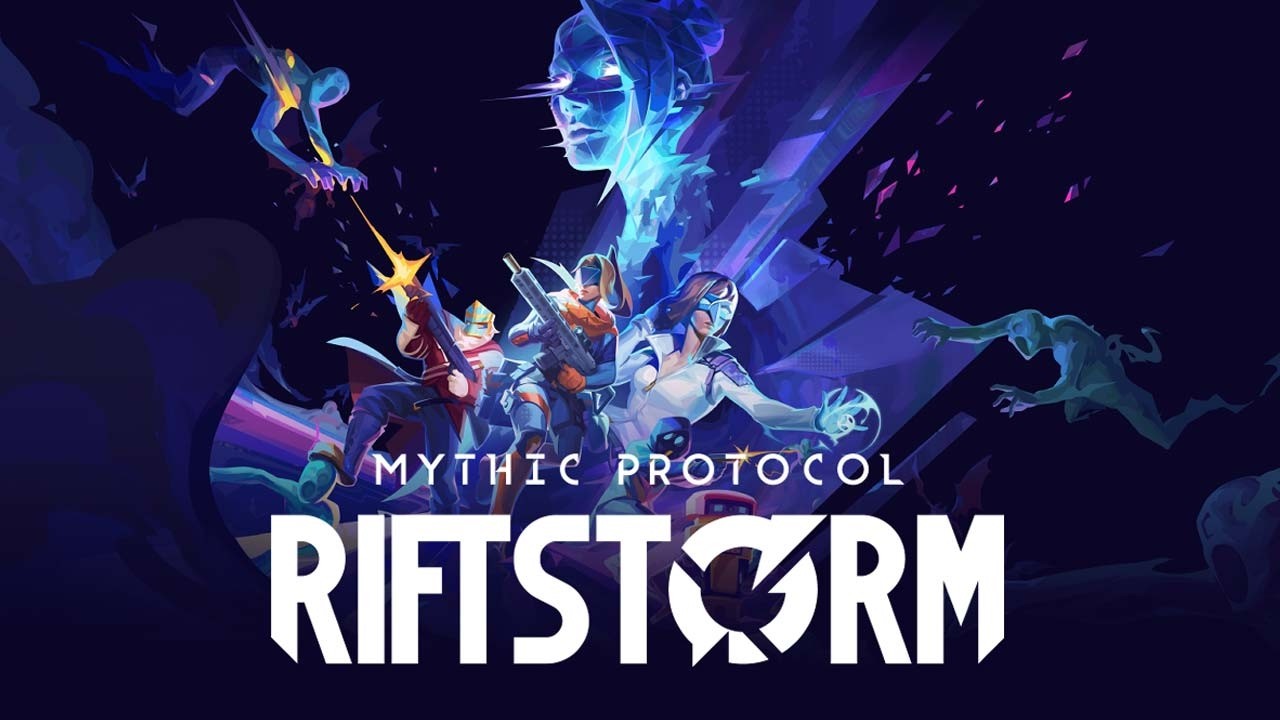
RIFTSTORM Review – Co-op PvE Looter-Shooter and Extraction Gameplay
A co-op PvE looter-shooter combining Weaver abilities, Lythogram builds, escalating Mythic threats, and extraction risk.
Developed by Confiction Labs and Agate, and published by Confiction Labs and Gamersky Games, RIFTSTORM combines co-op combat, persistent weapons, roguelite upgrades, Rift Exposure Zones, and Weapon Scarring.
Deploy into the rift, build your Weaver, push your luck, and keep reading to see how RIFTSTORM's combat and progression systems work.

RIFTSTORM


RIFTSTORM Review – Co-op PvE Looter-Shooter Built Around Risk, Builds, and Extraction Confiction Labs and Agate combine three-player PvE combat, looter-shooter progression, roguelite Lythogram upgrades, Rift Exposure Zones, and Weapon Scarring
RIFTSTORM is a co-op PvE looter-shooter developed by Confiction Labs and Agate and published by Confiction Labs and Gamersky Games. Players take the role of Weavers, elite operatives working for the Mythic Protocol, an organization tasked with investigating anomalous activity, containing rift outbreaks, and eliminating entities that should not exist. The game's core loop combines combat, equipment collection, temporary in-mission upgrades, escalating threats, and extraction decisions.
The game's position within the modern PC shooter market comes from the way those systems overlap. RIFTSTORM is built around cooperative PvE rather than competitive PvP, while its looter-shooter progression is accompanied by roguelite-style Lythogram upgrades and a lighter extraction structure. Players can deploy alone or with up to two friends, fight through mythic combat zones, collect weapons and resources, and decide when the risk of continuing outweighs the value of another reward.
RIFTSTORM is an Early Access game, and that distinction matters when assessing its current systems. Player feedback supplied for this review identifies entertaining combat, distinctive Weavers, useful mid-mission perk combinations, and generally reliable co-op connectivity, while also pointing to repetitive objectives, limited crafting depth, animation polish, and occasional performance problems. Those observations are treated as current player feedback rather than universal technical conclusions.
Deploy Into the Rift and Decide How Far to Push RIFTSTORM turns every mission into a balance between completing objectives, collecting rewards, surviving escalation, and extracting before the situation deteriorates
The fundamental RIFTSTORM gameplay loop begins with deployment. A Weaver enters a hostile mythic combat zone, investigates anomalous activity, completes objectives, fights increasingly dangerous enemies, collects weapons and resources, and eventually extracts. The structure is deliberately straightforward, but the extraction decision gives the mission a second layer because leaving early protects the value already secured while staying longer creates opportunities for additional rewards.
This is where RIFTSTORM differs from a conventional mission-based PvE shooter. Completing the immediate objective is only part of the decision-making process. The player also has to consider the condition of the squad, the value of the current haul, the danger of continuing, and the potential rewards still available in the combat zone. The game does not make extraction an incidental button at the end of a mission; it places that choice within the structure of the deployment itself.
The extraction element is also deliberately lighter than the harshest versions of the genre. RIFTSTORM's official description explicitly presents it as a power-fantasy-forward looter-shooter rather than a game centered on hardcore tactics or punishing players for wanting to experiment. That distinction gives the game a recognizable identity as a co-op PvE looter-shooter with extraction mechanics rather than a conventional competitive extraction shooter.
Three-Player Co-op Makes the Weaver System Part of the Combat Loop Each Weaver has a distinct combat identity and abilities, giving squads of up to three players a character-based layer above weapons and temporary upgrades
RIFTSTORM supports solo deployment and cooperative squads of up to three players. The Weaver system provides the foundation for that multiplayer structure, with each Weaver bringing individual abilities, a defined combat identity, and a role within the squad. The available game description does not provide a complete Weaver-by-Weaver abilities list, so specific character names, numerical values, or precise team compositions cannot be established from the supplied material.
What is clear is that cooperative play is integrated into the progression rather than being treated as a separate competitive mode. Players can deploy together, combine their character abilities, use experimental weapons, and adapt their builds during missions. The resulting structure gives squad play several overlapping layers: character identity determines the starting combat approach, weapons define the equipment foundation, and Lythogram upgrades can alter the build after deployment.
One supplied player report specifically highlights the transition from the introductory solo mission into cooperative play, including additional tutorial progression completed together with friends. Another player report describes co-op connectivity as having no notable connection issues during their experience. These are individual observations rather than independently verified network benchmarks, but they provide useful context for the current RIFTSTORM co-op experience described by players.
Lythograms Turn Each Deployment Into a Temporary Build Experiment In-mission Lythogram upgrades let players stack modifiers, create synergies, and reshape their Weaver build before extraction
The Lythogram system is one of RIFTSTORM's clearest roguelite influences. A Weaver does not enter every deployment with a completely fixed combat configuration and simply repeat it until extraction. During a mission, players can acquire Lythogram upgrades that modify their current build, stack modifiers, and create interactions between different effects.
That distinction matters because it gives the mission its own progression curve. Persistent equipment establishes the foundation of the loadout, while Lythograms provide temporary development inside the deployment. A build can therefore begin in one configuration and become substantially different by the time the squad reaches a later stage of the mission.
The supplied player feedback identifies perk combinations and the choices available during matches as one of RIFTSTORM's stronger features. That assessment fits the structure described by the developer, particularly the emphasis on stacking modifiers and triggering synergies. The available information does not establish a definitive list of the best Lythogram upgrades or a single optimal build, however. The system is explicitly designed around combinations and experimentation, and specific recommendations would require a more complete and current dataset than the supplied material provides.
Rift Exposure Zones Put the Mission's Best Rewards Behind Its Worst Risks These corrupted areas offer unstable rewards and more dangerous Mythics, forcing squads to choose between protecting a haul and pushing deeper
Rift Exposure Zones are the clearest expression of RIFTSTORM's risk-and-reward design. These heavily corrupted areas contain deadly corruption, unstable rewards, and more dangerous Mythics. They are optional, which means the game gives the squad control over whether to accept the additional danger rather than making every deployment follow the same difficulty path.
The important decision comes from what the player has already collected. A squad carrying valuable weapons and resources has something to protect, while entering an Exposure Zone creates the possibility of increasing the reward. Staying outside the corrupted area is therefore not simply the safer option; it is a decision to preserve the value already accumulated. Going deeper represents a calculated attempt to improve the outcome of the deployment.
This structure also gives the RIFTSTORM extraction loop a useful point of escalation. The game can increase the danger without requiring every mission to become uniformly more difficult from beginning to end. Players determine how much exposure they are willing to accept, and that choice is directly connected to the possibility of better rewards.
Weapon Scarring Makes Failure Matter Without Destroying the Entire Loadout A failed extraction can leave a weapon scarred by replacing one modification with a random negative mod while keeping the weapon usable
The Weapon Scarring system is one of RIFTSTORM's most specific extraction mechanics. If a player fails to extract, the resources and weapons found during the mission are lost, while the weapons brought into the deployment can return in a scarred condition. A Scarred Weapon remains usable, but one of its weapon modifications is replaced with a random negative modification.
The distinction between damage and destruction is important. Weapon Scarring does not remove the weapon from the player's collection. Instead, it changes the equipment's configuration and carries the consequence of failure into the next deployment. That creates a persistent reminder of a failed extraction without making the system equivalent to permanently deleting the player's favourite weapon.
The mechanic also reinforces the decision to extract at the appropriate time. The player is not only calculating the value of additional resources. There is also a cost attached to failing after bringing an existing weapon into the mission. RIFTSTORM therefore connects extraction, equipment management, and failure consequences through a single system rather than treating them as isolated features.
Weapons Provide the Persistent Foundation for Weaver Builds Experimental weapons, modifications, resources, and in-mission Lythograms combine persistent equipment with temporary combat development
Weapons form the persistent side of RIFTSTORM's build structure. Players deploy with equipment, use experimental weapons during missions, collect additional resources, and risk existing gear when extraction fails. The Weapon Scarring mechanic gives those weapons consequences beyond simple inventory accumulation, while Lythograms operate on a separate temporary layer during the deployment.
Player feedback supplied for this review is more critical of the current crafting system than of the combat itself. One report describes weapon crafting as functional but lacking sufficient player agency, particularly around controlling the resulting power and characteristics of crafted equipment. That criticism is relevant to an Early Access looter-shooter because long-term progression depends on more than acquiring increasingly powerful items.
The same feedback identifies the skill board as another system that would benefit from deeper choices. The criticism is not that the system is absent, but that progression could offer greater strategic agency rather than primarily functioning as a resource-gated path. These observations describe current player expectations and feedback rather than confirmed statements about the developers' final plans.
RIFTSTORM already has the foundations for a layered progression model. Weaver abilities establish character differentiation, weapons provide persistent equipment, Lythograms modify the build during a deployment, and extraction determines whether the accumulated rewards survive the mission. The long-term strength of the system will depend on how much control players ultimately have over those layers.
Mission Escalation Keeps the PvE Combat Moving Investigation, containment, extermination, resource collection, and extraction give each deployment a clear operational structure
RIFTSTORM's missions are built around the language of the Mythic Protocol: investigate anomalous activity, contain rift outbreaks, and exterminate mythic threats. That terminology is more than a narrative framing device because it describes the functional structure of the deployment. Players enter hostile environments, complete objectives, fight Mythic entities, gather equipment and resources, and determine when to leave.
The supplied player feedback identifies the moment-to-moment gameplay as entertaining, but it also raises a concern about objective repetition. That issue is particularly important for a game built around repeated deployments. Strong combat can support repeated play for a period of time, but mission variety becomes increasingly relevant when the same player is expected to return to similar environments and complete objectives across multiple runs.
The Early Access context changes how that limitation should be interpreted. Repetition in the current build is a documented player concern, but it does not establish what the final mission structure will contain. The available information supports a clear assessment of the present design while leaving future content and mission development outside the scope of confirmed facts.
The Mythic Protocol Gives RIFTSTORM Its Supernatural Identity Secret societies, impossible technologies, dimensional rifts, and Mythic entities provide the setting behind the game's repeatable combat missions
The Mythic Protocol is the narrative framework connecting RIFTSTORM's disparate combat systems. The game's world is built around the idea that humanity has always existed alongside phenomena hidden from ordinary knowledge. Mythic entities, impossible doorways, secret societies, hidden wars, and experimental technologies all exist within that setting.
The Weaver role provides the practical reason for engaging with that world. These operatives are trained to close rifts, use supernatural powers, deploy specialized technologies, and survive encounters with entities that should not exist. The mission structure consequently follows the same fictional logic: investigate an anomaly, contain it, eliminate the threat, and extract before the situation becomes unmanageable.
That framework also supports the game's supernatural visual and mechanical vocabulary. Rift energy, corruption, Mythic enemies, experimental weapons, and unstable combat zones are not separate themes placed alongside the gameplay. They are the fictional explanation for why the player is repeatedly entering dangerous areas and developing increasingly unusual combat configurations.
RIFTSTORM Keeps PvE at the Center Instead of Building Around PvP The absence of competitive PvP leaves the game's progression focused on cooperative combat, character builds, weapons, and fighting escalating Mythic threats
One of the clearest points in the supplied player feedback is the positive response to RIFTSTORM's PvE-only direction. The game does not build its progression around competitive player-versus-player encounters. Its official description instead places squads of Weavers against escalating hordes and Mythic threats in unstable combat zones.
That focus has practical consequences for the design. Weapon modifications, Weaver abilities, Lythogram synergies, and extraction risk can be tuned around cooperative PvE encounters rather than the additional requirements of competitive player balance. The result is a game whose core identity remains centered on building power and using that power against increasingly dangerous supernatural enemies.
The supplied feedback compares the game's chaotic cooperative combat to the straightforward fun of older horde-focused shooters, although that comparison is a player impression rather than an official genre classification. More concretely, the game's published mechanics establish a co-op PvE structure in which the squad's objective is to survive the environment, complete its mission, collect rewards, and decide whether to extract.
Early Access Progression Needs More Depth Than More Content Alone Current player feedback points toward crafting agency, skill-board choices, animation polish, mission variety, and technical refinement as important areas for continued development
The most substantial criticism in the supplied player feedback concerns refinement rather than the basic concept. One detailed review argues that existing systems should receive additional polish before the game simply adds more content. Weapon crafting is identified as an area where greater control would make the system more meaningful, while the skill board is described as needing stronger choices.
Animation quality is another reported weakness. The supplied feedback calls for greater animation polish and identifies movement presentation as an area requiring improvement before the game reaches its final version. Because this is player feedback rather than a measured technical analysis, it is more appropriate to record the criticism than to attach unsupported performance figures to it.
Mission objectives are also identified as becoming repetitive. That concern connects directly to RIFTSTORM's long-term replayability because the game's strongest systems are designed around repeated deployments. Lythogram combinations can change a build, weapons can alter the starting configuration, and Rift Exposure Zones can change the risk decision, but those systems still need varied mission objectives to prevent the surrounding structure from becoming predictable.
The overall picture is therefore more specific than simply describing RIFTSTORM as unfinished. The game already has a connected set of combat, progression, risk, and co-op systems. The Early Access question is whether those systems will receive enough depth and refinement to sustain the repeated deployments that define the game's intended loop.
RIFTSTORM System Requirements Target a Modern Mid-Range PC The Steam specification calls for Windows 10 or 11, 12 GB RAM, a GTX 1050 minimum, and an RTX 3060 recommendation
The published RIFTSTORM system requirements specify Windows 10 or Windows 11 64-bit and require a 64-bit processor and operating system. The minimum configuration calls for an Intel Core i3 Gen 10 processor, 12 GB of RAM, and a GTX 1050 graphics card. The game requires 15 GB of available storage, with an SSD recommended.
The recommended RIFTSTORM PC requirements increase the processor specification to an Intel Core i5 Gen 12 and system memory to 16 GB. Graphics are raised to an RTX 3060, while the storage requirement remains 15 GB and an SSD is again recommended. These are the published hardware requirements and should not be interpreted as guaranteed frame-rate results on every compatible system.
Player feedback supplied for this review reports occasional lag or stuttering and identifies reducing the thread count to two as a possible workaround. That should be treated as a community troubleshooting suggestion rather than an official universal fix. The supplied material does not provide controlled benchmarks establishing the cause, frequency, or hardware-specific behavior of the reported stuttering.
Always-Online Multiplayer Shapes the Current PC Experience RIFTSTORM currently requires a live internet connection, while offline play has been described as planned for a future update
RIFTSTORM is currently described as an always-online multiplayer game requiring a live internet connection. That requirement is relevant to the game's present position because the title is designed around cooperative deployments, persistent equipment, and an online multiplayer environment.
The supplied player feedback states that offline play is planned to be added in the coming weeks. No specific offline play release date is provided in the supplied material, so a precise date cannot be assigned. Until the feature is officially available, offline functionality should be regarded as planned rather than part of the current published requirement.
The distinction between current functionality and planned updates is particularly important when evaluating an Early Access game. The present RIFTSTORM experience is defined by its online multiplayer structure, while future updates may alter how the game can be accessed and played. Any assessment of offline support therefore needs to remain tied to the current documented state rather than an unconfirmed timetable.
Final Verdict RIFTSTORM has a defined co-op PvE identity built around Weaver abilities, Lythogram builds, extraction risk, and supernatural combat, but its Early Access systems still require refinement
RIFTSTORM has a stronger mechanical identity than its basic looter-shooter description suggests. Its core structure brings together cooperative PvE combat, persistent weapons, roguelite-style Lythogram upgrades, optional high-risk areas, extraction decisions, and a failure system that can scar existing equipment. Each part contributes to the same deployment loop rather than functioning as an isolated feature.
The Weaver system gives the three-player co-op structure a character-based foundation, while experimental weapons and Lythograms provide two different levels of build development. Persistent equipment establishes what the player brings into a mission, while in-mission upgrades determine how that configuration evolves before extraction. Rift Exposure Zones then give the squad an explicit choice over how much additional risk to accept.
Weapon Scarring is particularly effective as a connecting mechanic because it makes failure relevant beyond the end of a single mission. A failed extraction means losing the mission's collected rewards and can leave a brought weapon with a random negative modification, but the weapon remains usable. That is a distinct middle ground between consequence-free PvE progression and the severe gear loss associated with harsher extraction games.
The current Early Access build is not without weaknesses. Player feedback identifies repetitive objectives, limited agency in weapon crafting, a skill board that could offer more meaningful choices, animation polish concerns, and occasional stuttering. Those criticisms are significant because RIFTSTORM relies on repeated deployments. Its long-term success will depend not only on adding more weapons or missions, but on improving the depth of the systems that determine how players approach those deployments.
The game's technical position is clearly documented. RIFTSTORM requires Windows 10 or 11 64-bit, a 64-bit processor and operating system, 12 GB RAM, a GTX 1050 minimum graphics card, and 15 GB of storage, with an SSD recommended. The recommended configuration moves to an Intel Core i5 Gen 12, 16 GB RAM, and an RTX 3060. Current online play requires a live internet connection, while offline play has been described as a future addition without a confirmed release date in the supplied information.
As a RIFTSTORM co-op PvE looter-shooter review, the central conclusion is straightforward. The game has a recognizable foundation built around deploy, fight, build, push deeper, collect, and extract. Its supernatural Mythic Protocol setting gives those mechanics a coherent identity, while Weaver abilities, Lythograms, Rift Exposure Zones, and Weapon Scarring provide enough mechanical distinction to separate it from a generic cooperative shooter.
RIFTSTORM is best judged as an Early Access systems-driven game rather than a finished product. The strongest evidence supplied by the current material points to a compelling combination of co-op PvE combat, build experimentation, and lighter extraction mechanics. The main unresolved issue is depth: crafting, skill progression, mission variety, animation quality, and technical polish all need continued attention if the underlying systems are to support sustained long-term play.
RIFTSTORM has a clear identity within the co-op PvE looter-shooter space. Its strongest ideas come from the way Weaver abilities, experimental weapons, Lythogram upgrades, Rift Exposure Zones, and extraction decisions feed into the same mission loop. The Early Access version still needs refinement, particularly across mission variety, progression depth, crafting, animation, and performance, but the underlying structure is coherent. For players looking for a cooperative action game built around escalating combat, flexible builds, meaningful risk, and the choice to push deeper or extract, RIFTSTORM provides a distinct foundation that should become more substantial as development continues.
The VoxOdyssey Project Mission Statement for Feature games
I highlight what makes each game unique by examining gameplay mechanics, design choices, and storytelling. By analyzing systems, level design, and play styles, and referencing official media and assets, I aim to provide accurate, informative, and trustworthy insights. While I strive for accuracy, some details may change or be updated over time. Players can use this information to understand each title’s features and mechanics and make their own judgments.
RIFTSTORM gameplay screenshots Weaver combat, mythic enemies, Lythogram upgrades, Rift Exposure Zones, weapons, and extraction


RIFTSTORM video – Co-op PvE combat, Weaver abilities, mythic enemies, builds, and extraction
Step into unstable rifts, fight mythic threats, shape your Weaver with powerful upgrades, and decide when to extract. Watch the video below for a closer look at RIFTSTORM's co-op combat and chaotic missions.