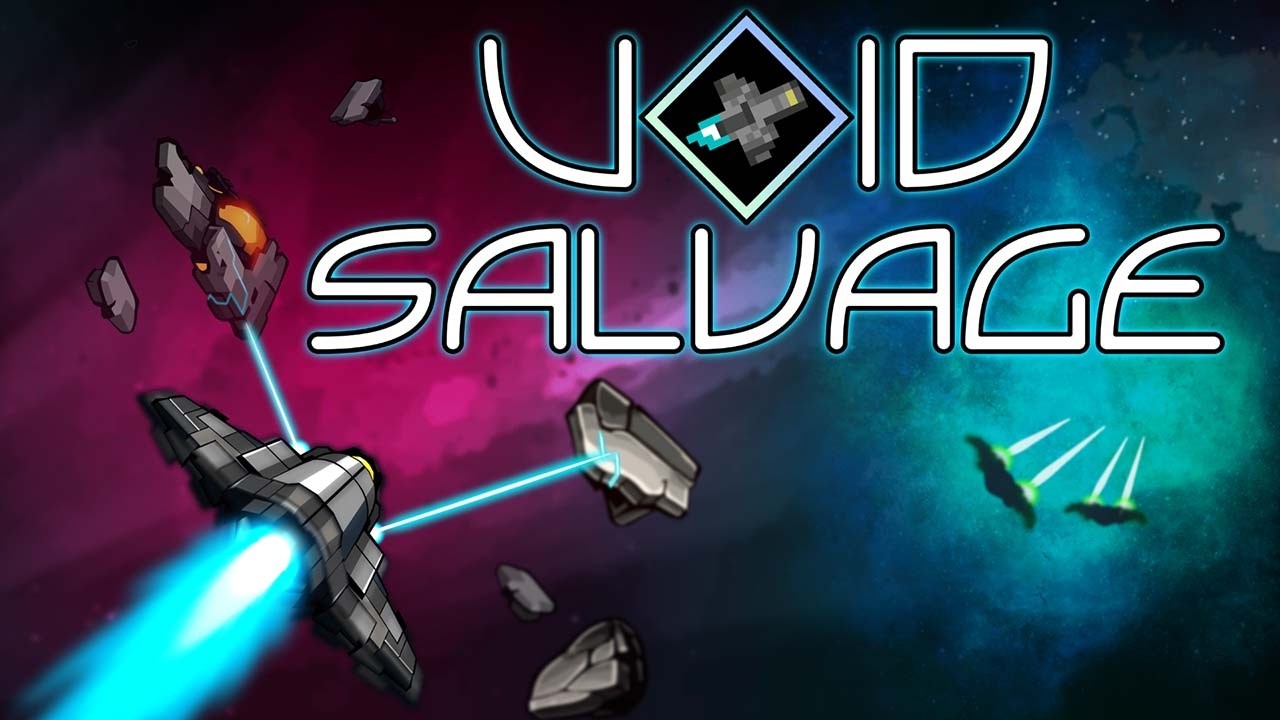
Void Salvage Review – Building an Automated Warship in Deep Space
An incremental space roguelite built around auto-battler combat, tactical pause, salvage, and modular ship upgrades.
Developed and published by myradann, this Steam space game combines roguelike runs, branching story paths, drones, weapon augments, sockets, and a Desktop Companion mode.
The ship is only the beginning. Keep reading to see how combat, builds, and progression shape each run.

Void Salvage


Void Salvage Review – A Deep Space Roguelite Built Around Automation, Salvage, and Ship Customization A striking visual presentation supports a surprisingly layered progression system, although combat interaction, onboarding, and pacing prevent the experience from reaching its full potential
Void Salvage makes an unusually strong first impression because its presentation immediately suggests a game with considerably more ambition than its compact scope might imply. The visuals are polished, the sound design and music complement the setting, and the effects give the ship, enemies, weapons, and environments a convincing sense of presence. The warp animations are particularly effective, creating a satisfying transition between destinations and helping the game maintain a feeling of movement even though the player is not manually piloting the ship through space. It is the kind of presentation that makes the underlying systems worth investigating because the game already looks and sounds like it has a clear identity.
That identity becomes clearer once the progression structure is understood. Void Salvage combines elements of an incremental game, a roguelite, an auto battler, and a ship-building system, but it does not simply stack those genres on top of one another. The different systems are connected through the condition and development of a single ship. Salvage provides resources, combat generates rewards and experience, equipment changes the ship's capabilities, upgrades improve its underlying statistics, and sector progression determines the quality of the opportunities available later in a run. The result is a loop where almost every decision ultimately feeds back into the question of how effectively the ship can survive and continue moving forward.
One of the game's most interesting decisions is giving players different ways to handle failure. Incremental mode allows progress to continue after destruction, meaning that the player can gradually strengthen the ship and eventually push through content by continuing to invest in the upgrade system. Roguelite mode takes the opposite approach, making death far more consequential and sending the player back toward the beginning. A middle mode provides a mixture of these philosophies, while additional customisation allows certain rules to be adjusted. These options are not merely difficulty presets. They change the emotional and strategic value of every decision made during a run.
In Incremental mode, a failed attempt is a setback rather than a complete collapse. The player can continue developing the ship and eventually overcome a challenge that was previously out of reach. Roguelite mode gives the same encounters much greater weight because reaching a boss represents a substantial investment of time and resources that can disappear when the ship is destroyed. The ability to choose between those approaches is one of Void Salvage's strongest structural ideas because it allows the same mechanical foundation to serve players with very different preferences for persistence and risk.
Exploration Is Built Around Short Route Decisions Rather Than Direct Piloting Each jump presents a small selection of destinations, turning navigation into a sequence of risk, reward, and resource-management decisions
The actual gameplay loop is much closer to a roguelite than a traditional space exploration game. The ship travels through a series of destinations, and the player chooses where to go next from a small group of available icons. Those choices communicate what type of encounter lies ahead, allowing the player to make an informed decision about whether the potential reward is worth exposing the current ship to another encounter. There is no expectation that the player will manually fly from one location to another. Instead, navigation is abstracted into a chain of decisions that keeps attention focused on progression and ship management.
Salvage events are a major part of this structure. Debris and wreckage provide resources that can be collected automatically, while hostile ships can appear around the same locations and turn what initially looks like a simple resource opportunity into a combat encounter. This is a useful connection between exploration and combat because salvage is never completely isolated from the condition of the ship. The player wants resources, but acquiring them can expose the vessel to damage and consume fuel or other valuable resources needed to continue the run.
Salvaging and destroying hostile ships provides Cred and experience, giving the player multiple reasons to engage with the encounters encountered along the route. Cred has an immediate economic function, allowing purchases at shop destinations, while experience contributes to longer-term progression. Fuel has a more practical role because travelling between destinations consumes it, although destroyed enemies can provide additional fuel and therefore help sustain the run. These resources work together to create a straightforward but effective economic loop: exploration creates opportunities, encounters generate resources, and those resources determine how effectively the ship can continue exploring.
This structure also makes route selection more meaningful than simply choosing the destination with the largest visible reward. A ship that has suffered repeated damage may benefit more from a safer opportunity than from another difficult salvage encounter. Conversely, a well-equipped ship may be able to accept greater risk in exchange for better rewards. Because the player is building the ship while simultaneously asking that ship to survive the route, every destination becomes part of the larger progression calculation.
Automated Combat Gives Buildcrafting More Importance Than Manual Piloting Weapons fire automatically, making the ship's equipment, statistics, and preparation the primary determinants of combat performance
Combat is one of the defining features of Void Salvage, but it is also the area where the game's design produces its biggest tension. The ship fires automatically, and resource collection is automated as well. This keeps the player focused on the strategic layer rather than requiring constant manual interaction. In principle, that makes sense for a game that wants automation and incremental progression to remain central to the experience. The player is effectively designing a combat system and then watching that system operate.
The drawback is that the encounters can sometimes feel less interactive than their visual presentation suggests. Hostile ships move around the battlefield, weapons fire across the screen, and attacks create an active combat scene, but the player's direct influence over that exchange is limited. There is an obvious difference between seeing an enemy manoeuvre into a position where it could be avoided and actually being able to move the ship out of danger. Dodge-related abilities can improve survivability, but they do not turn the player into a conventional pilot.
This does not make automated combat ineffective. In fact, it creates a clear purpose for the game's progression systems. Damage, firing speed, accuracy, equipment effects, drones, and modules all influence how well the ship performs without manual aiming. The satisfaction comes from improving the underlying machine and seeing it handle encounters that previously represented a serious threat. A stronger ship is not simply a ship with a larger health bar; it can be a ship with better accuracy, more effective automated weapons, additional equipment capacity, or modules that alter how attacks behave.
Accuracy is especially important because enemy movement can reduce the effectiveness of otherwise powerful weapons. Hostiles can also retreat after taking damage, making the ability to eliminate targets efficiently more than a simple damage-per-second consideration. Faster kills reduce the amount of time enemies have to threaten the ship while also increasing the efficiency of experience generation. This creates a useful relationship between offensive upgrades and the broader progression economy.
The strongest opportunity for future development is therefore not to abandon automation but to give the player one additional layer of control. A limited movement system, directional evasion, or another form of tactical intervention could make combat feel more responsive without turning Void Salvage into a conventional space shooter. The automated weapons could remain the foundation while movement became the player's active contribution. That would preserve the game's identity while making the visual activity on screen feel more connected to player decisions.
Drones and Modules Turn Ship Development Into Buildcrafting Equipment slots force decisions between offensive power, utility, salvage efficiency, and survivability
Ship customization is where Void Salvage becomes considerably more interesting than a straightforward incremental combat game. Shops provide drones and modules that can change the capabilities of the vessel, and the limited number of available slots prevents the player from simply collecting every useful item and keeping everything equipped. Every new piece of equipment therefore creates a decision. If an existing module is already contributing significantly to the current build, replacing it requires a genuine assessment of whether the new item improves the overall configuration.
The variety of effects makes these decisions more meaningful. A module can provide a direct improvement, such as increasing a combat statistic, or change how the ship behaves by introducing another effect. A ricochet-style weapon enhancement, for example, can extend the value of an attack beyond its initial target by sending additional damage toward nearby enemies. Dodge-related improvements can change survivability, while drones can contribute additional automated functions. These systems encourage the player to think about the ship as a collection of interacting components rather than a single statistical progression bar.
Equipment also has a maintenance cost that prevents the build system from being completely passive. When the ship takes hull damage, its drones and modules can also suffer damage. Enough accumulated damage can leave those components broken, requiring repairs at an appropriate yard event or removal from the ship. This means that surviving a fight is not necessarily the end of the problem. A ship can emerge alive but weakened because the equipment responsible for its combat effectiveness has been damaged.
That mechanic adds an additional layer of consequence to incoming damage. The player is not only protecting the ship's immediate survival but also protecting the configuration that makes the ship effective. This is particularly important in longer runs because repeated encounters can gradually degrade a carefully constructed build. The result is a useful connection between survivability and equipment management that gives defensive upgrades a purpose beyond simply increasing the ship's health.
The Upgrade Tree Provides a Deep Incremental Layer Hidden nodes, escalating costs, equipment capacity, and stat improvements create a long-term progression path between runs
The upgrade tree provides the clearest expression of Void Salvage's incremental side. Initially, not every node is visible. Purchasing an available upgrade reveals adjacent possibilities, creating a discovery element as the player works through the structure. This means that early progression combines planning with curiosity because the next branch may contain an upgrade the player did not anticipate. For players who prefer complete visibility, the tree can also be revealed, transforming the system into a more traditional planning exercise.
Most nodes can be purchased repeatedly, with each additional level increasing the cost. The benefits cover the statistics that influence nearly every part of the game: damage, firing speed, accuracy, salvage yield, fuel and other improvements. The structure encourages players to decide whether to specialise in a particular area or spread investment across several systems. Because the upgrades influence different stages of the run, there is no single universal statistic that completely replaces the rest of the tree.
One of the most important progression points is the ability to unlock additional drone and module slots. The player has to reach the required number of upgrades across the tree before gaining access to another capacity increase. This makes the tree more than a collection of optional statistical bonuses. It also functions as a gate for expanding the complexity of the ship itself. Once additional slots become available, the player can construct more sophisticated configurations and make greater use of the equipment economy.
The tree also contains progression toward better-quality equipment. Higher-tier drones and modules become increasingly important as the ship advances through sectors, and salvage quality scales with the sector reached. Sector progression is therefore connected to both difficulty and reward quality. Beating a boss is not simply about reaching another area on a map; it unlocks access to stronger opportunities that can fundamentally improve the ship's future potential.
The major problem is pacing. The tree is large enough to create a strong sense of long-term development, but the rate of progression can feel slow relative to the length of individual sessions. Early runs can produce enough resources for only a small number of upgrade levels, sometimes roughly one or two meaningful purchases. Each upgrade helps, but the overall journey through the tree can therefore feel grindy, particularly when a player understands how many additional improvements remain available.
This pacing problem becomes more significant because many of the upgrades are individually valuable. The player can see exactly how another increase in accuracy, damage, salvage yield, firing speed, or equipment capacity could improve the next attempt. When the next meaningful upgrade takes a substantial amount of time to earn, the gap between visible improvement and actual improvement becomes more noticeable. The underlying progression system is solid; its tuning is what risks making the experience feel repetitive.
Bosses Turn Long Runs Into High-Stakes Tests of the Build Sector progression culminates in boss encounters that determine whether the current ship configuration is ready to advance
After a number of jumps, the player eventually reaches a boss encounter. These fights provide the clearest test of everything accumulated during the preceding run. Route choices determine the resources available, salvage and combat provide the economic foundation, shops provide equipment, and the upgrade tree determines the underlying strength of the ship. By the time the boss appears, the encounter represents much more than another group of enemies. It is a practical examination of the build.
The first few attempts are likely to expose weaknesses quickly. A ship that lacks sufficient offensive power can struggle to eliminate enemies efficiently, while poor accuracy can reduce the value of otherwise strong weapons. Equipment damage creates another potential failure point because a build that performed well earlier in the run can arrive at the boss with weakened components. In this respect, Void Salvage makes the journey toward the boss almost as important as the boss itself.
The consequences of failure depend heavily on the chosen mode. In Roguelite mode, losing a ship can send the player back to the beginning and erase much of the immediate progress made during the run. Incremental mode softens that consequence by preserving the broader progression structure. This creates a meaningful distinction between the two experiences without requiring separate combat systems.
The Beacon and Early Onboarding Need More Clarity The underlying event structure works, but the first-run experience leaves too much of the game's logic for players to discover on their own
The first run can be confusing because the game does not provide much guidance about what the player should be doing or how the various systems fit together. That is less damaging in a prototype than it would be in a fully established commercial release, particularly because the systems become easier to understand once the player has completed a few encounters. Still, the absence of clear onboarding means that the opening moments do not communicate the depth of the progression structure as effectively as they could.
The beacon is a particularly noticeable example. It can present several options, including repairs and other improvements, but choosing a repair can immediately close the event. Other actions can allow the player to interact with the beacon again, which creates an inconsistency in how the event behaves. The player naturally expects a menu containing several available options to remain accessible until they decide they are finished with it.
Allowing the player to perform multiple available actions and then manually close the event would make the interaction considerably easier to understand. It would also better communicate that the beacon represents a broader service opportunity rather than a single-action decision. This is a relatively small interface adjustment, but it would remove unnecessary confusion from a system that otherwise fits naturally into the ship-maintenance loop.
Desktop Companion Mode Complements the Incremental Design Automation allows the ship to continue working in the background while the player uses the desktop for other tasks
Desktop Companion mode is a logical extension of the game's automated systems. Because combat and resource collection already require limited direct intervention, the ship can continue salvaging and fighting while the player works elsewhere on the desktop. This gives the incremental side of the game a practical identity rather than simply making it a number that increases in the background.
The mode also highlights one of the game's central design ideas: automation is something the player builds toward. The goal is not simply to remove interaction. It is to create a ship that has enough damage, accuracy, equipment, survivability, and resource efficiency to operate effectively with less supervision. A strong configuration therefore has value beyond the immediate encounter because it can continue producing useful results when the player's attention is elsewhere.
That makes the Desktop Companion feature particularly well matched to the incremental progression model. Players who enjoy actively optimising a build can spend their attention on upgrades, equipment, routes, and difficult encounters, while players who prefer a lower-attention experience can allow the automation to handle more of the routine activity. The feature does not need to replace the active game; it works because the active game has already established a system capable of operating without constant input.
Visuals, Sound, and Effects Give the Automated Systems Real Presence Void Salvage's presentation is a major strength, helping the automated combat and exploration loop remain visually engaging
The presentation deserves particular credit because the game could easily have become visually passive given its emphasis on automation. Instead, the ship, enemies, weapons, effects, and space environments create enough activity to make the battlefield feel alive. The warp sequences are especially polished and provide a strong sense of transition between locations. The visual quality also helps communicate the scale and progression of the ship as new equipment and systems are added.
The audio presentation supports this effectively. The music contributes to the atmosphere without overwhelming the mechanical information on screen, while sound effects reinforce the feeling that weapons, enemies, and ship systems are actually interacting. Together, the visual and audio layers give the game a much more finished presentation than its underlying prototype-like rough edges might suggest.
This is important because automation can otherwise create a difficult balance between convenience and engagement. If the player is not manually aiming, moving, or collecting resources, the presentation has to provide enough feedback to make those systems satisfying to observe. Void Salvage largely succeeds here. The action is attractive enough that watching a well-built ship operate has genuine appeal, even when the lack of direct combat control becomes noticeable.
Technical Requirements Are Unusual for Such a Compact Game The Windows release combines a 200 MB storage requirement with a published minimum of 32 GB RAM
Void Salvage has a very small published storage requirement compared with the size of most modern PC games. The listed requirement is only 200 MB, while the minimum memory requirement is 32 GB. The Windows release targets Windows 10 and Windows 11 and lists an Intel Core i3 processor alongside OpenGL 2.1-compatible graphics or integrated graphics.
The contrast between the tiny storage footprint and the unusually high memory requirement is one of the more notable technical details prospective players will encounter. It is also important to distinguish compatibility requirements from performance testing. The published specifications establish what the developer lists as the minimum hardware configuration, but they do not by themselves demonstrate frame-rate behaviour, memory consumption during extended sessions, or performance under particular desktop workloads.
From a presentation perspective, the game demonstrates that a small installation footprint does not prevent a title from delivering detailed visual effects and a polished atmosphere. The more relevant technical question for players is therefore not the amount of disk space required but how the game behaves during longer automated sessions, particularly when the Desktop Companion feature is used. That is an area where future optimisation and more extensive testing would provide useful information.
Final Verdict Void Salvage has an impressive foundation, strong presentation, and a compelling progression framework, but needs more combat agency and tighter pacing to fulfil its potential
Void Salvage succeeds because its individual mechanics are connected by a clear central idea: build a ship that can become increasingly capable of operating on its own. Salvage creates the economy, route selection determines the risks taken to acquire resources, combat tests the current configuration, equipment changes how the ship behaves, and the upgrade tree provides the long-term reason to continue improving. Sector progression then raises the stakes by introducing stronger encounters and better potential rewards.
The different progression modes strengthen that foundation. Incremental mode gives players a forgiving long-term climb where death does not erase the entire journey, while Roguelite mode makes each run substantially more demanding by putting much more progress at risk. The hybrid approach provides a useful middle ground for players who want some of the persistence of incremental progression without removing the consequences that make individual runs meaningful.
The ship-building layer is arguably the most compelling part of the design. Drones, modules, limited slots, equipment damage, upgrade levels, accuracy, damage, firing speed, salvage yield, fuel, and equipment quality all contribute to the final configuration. The result is a game where improvement is not limited to making numbers larger. The player is gradually constructing a more capable automated machine, and the effectiveness of that machine determines how far the next run can progress.
The presentation gives that progression additional weight. Void Salvage looks excellent for the style it is pursuing, with strong visual effects, polished enemies, attractive space environments, impressive warp animations, and an audio presentation that supports the atmosphere. The game can therefore remain visually interesting even when the player is not directly controlling the action. That is an important achievement for an auto-battler because the presentation has to compensate for the reduced amount of moment-to-moment manual interaction.
Combat remains the largest opportunity for improvement. Automated weapons fit the game's philosophy, but the absence of a stronger direct interaction layer can make some encounters feel like the player is watching a calculation rather than actively participating in a battle. The underlying systems are strong enough that this does not make combat uninteresting, but it does create a gap between the quality of the presentation and the amount of control available. Giving players a limited way to influence movement or evasion could close that gap without sacrificing the automated foundation.
Progression pacing is the second major issue. The upgrade tree provides substantial long-term depth, but that depth can become a source of repetition when individual runs provide only a small number of meaningful permanent improvements. The system is at its best when every run clearly changes the ship's capabilities. When several long sessions produce only a handful of additional upgrade levels, the same mechanics can begin to feel more like grinding than strategic progression.
The early interface also deserves refinement. The first run leaves players to discover too much of the game's structure without sufficient guidance, while the beacon interaction can behave in ways that are not immediately intuitive. These are not fundamental problems with the game's design. They are areas where clearer communication and more consistent interaction rules could significantly improve the player's understanding without simplifying the underlying mechanics.
Despite those weaknesses, Void Salvage already has the most important ingredient required for a successful systems-driven game: a strong relationship between its mechanics. The ship is not simply a character with statistics. It is the central object through which exploration, combat, salvage, economy, equipment, progression, and failure all connect. Every improvement changes what the ship can survive, what it can salvage, what equipment it can support, and how efficiently it can move toward the next sector.
That makes Void Salvage particularly appealing to players who enjoy optimisation and watching a build evolve from a fragile starting configuration into an increasingly autonomous machine. The game does not need to abandon its incremental or auto-battler identity to become more engaging. It needs to strengthen the connections that are already working: make combat slightly more interactive, make the first run easier to understand, smooth out event interactions, and ensure that meaningful upgrades arrive frequently enough to maintain momentum.
As it stands, Void Salvage is a promising and visually polished space roguelite with a genuinely interesting progression framework. Its combination of salvage, automated combat, modular equipment, upgrade-tree development, sector progression, equipment degradation, and multiple persistence modes gives it more mechanical depth than its simple presentation initially suggests. The game already provides a strong reason to return to another run: improve the ship, experiment with the configuration, reach a higher sector, survive the next boss, and push the progression further.
The foundation is considerably stronger than the areas that currently hold it back. Better onboarding would make the systems easier to understand, more direct combat interaction would make encounters feel more engaging, and faster or better-tuned progression would reduce the sense of repetition. If those areas receive the same level of attention already visible in the game's visuals, audio, effects, ship systems, and progression architecture, Void Salvage has the potential to develop from an impressive prototype-like experience into a much more complete and satisfying space roguelite.
The VoxOdyssey Project Mission Statement for Feature games
I highlight what makes each game unique by examining gameplay mechanics, design choices, and storytelling. By analyzing systems, level design, and play styles, and referencing official media and assets, I aim to provide accurate, informative, and trustworthy insights. While I strive for accuracy, some details may change or be updated over time. Players can use this information to understand each title’s features and mechanics and make their own judgments.
Void Salvage gameplay screenshots Space salvage, automated battles, ship customization, bosses, and evolving sector environments


Void Salvage video – Salvage runs, ship upgrades, space battles, and bosses
Strap in and head into the void as your ship salvages wrecks, fights hostile forces, grabs upgrades, and pushes toward dangerous bosses. Watch the video below to see Void Salvage in action.