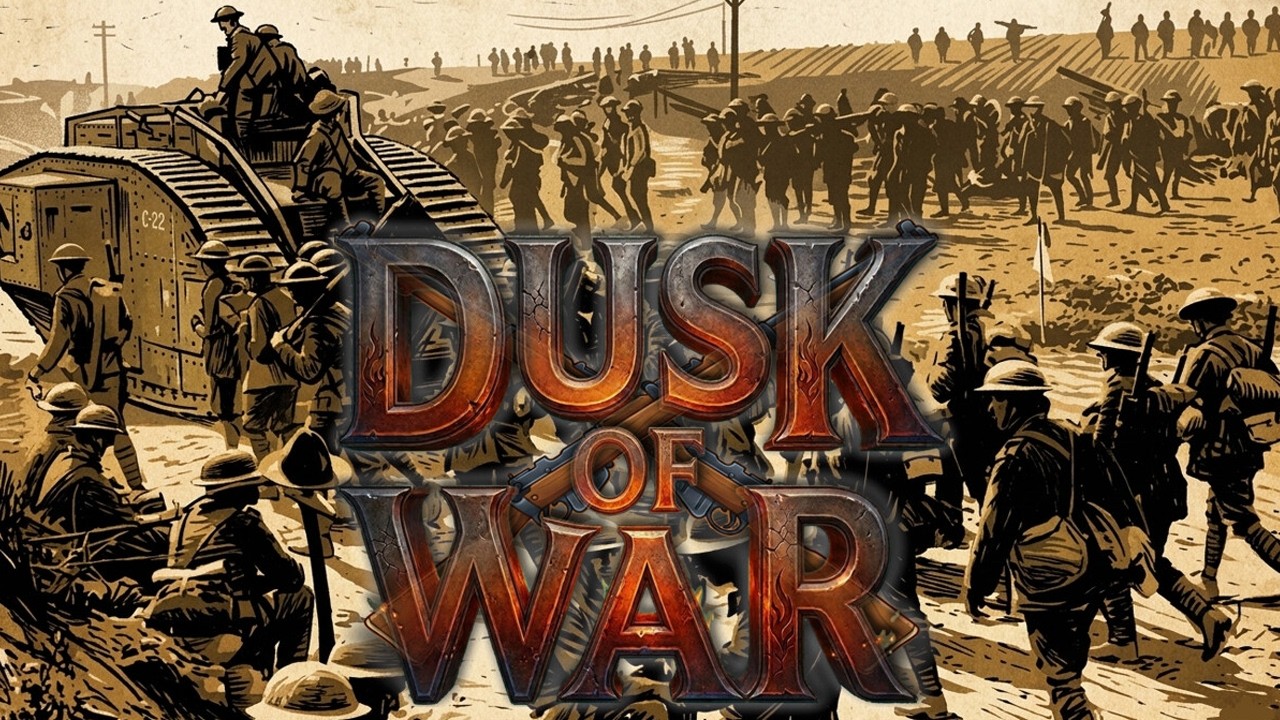
DUSK OF WAR Review – Idle Military Strategy and War Management Game
Manage resources, build armies, and defend your nation through automated battles and strategic wartime decisions in DUSK OF WAR
DUSK OF WAR is an idle military management game combining resource production, national finance, automated battlefield combat, and strategic army development as players lead a country through escalating waves of warfare.
Ready to explore the systems, strategies, and battles that define this unique war management experience? Continue below.

DUSK OF WAR


A war machine built one decision at a time DUSK OF WAR Steam review covering strategy, logistics, and survival
DUSK OF WAR is an upcoming PC strategy game developed and published by Oedipe Games that places players in the role of a national War Minister overseeing an entire wartime operation. Planned for release on the Steam client platform in July 2026 and built using Unreal Engine technology, the game combines idle progression, resource management, military production, and automated battlefield systems into a strategy experience focused on preparation rather than direct combat control.
Rather than asking players to command individual units during battles, DUSK OF WAR focuses on the decisions that make an army possible. Finances, industrial output, equipment manufacturing, recruitment, and logistics all work together to determine whether the nation's forces can withstand continuous enemy attacks. The battlefield is the final stage of a much larger management process taking place behind the scenes.
Within the wider category of idle war management games, DUSK OF WAR takes a more structured approach by linking every resource directly to military survival. Money allows expansion and upgrades, steel supports weapon production, fabric contributes to military preparation, and food keeps the army supplied. The game is built around maintaining balance between these systems rather than simply increasing values through passive growth.
The challenge begins before the battle starts Economic decisions, industry, and the foundations of a fighting force
The central idea behind DUSK OF WAR is that warfare depends on the strength of the systems supporting it. Developed by Oedipe Games, the title approaches military conflict from an administrative viewpoint where economic planning and industrial capability are essential parts of maintaining an effective defence.
Players manage the national infrastructure required to keep the war effort moving. This includes improving taxation systems, expanding production facilities, manufacturing equipment, recruiting military units, and maintaining the resources needed for long-term operations. Each improvement influences another part of the economy, creating a connected structure where decisions must be considered carefully.
This separates DUSK OF WAR from traditional real-time strategy games built around direct battlefield commands. The player's role is not to issue constant tactical orders but to create the conditions that allow an army to function. Victory depends on preparation, efficiency, and understanding how each part of the national system supports the next.
When automation meets strategic planning How DUSK OF WAR builds its battlefield progression loop
DUSK OF WAR uses automated combat as the foundation of its incremental strategy design. Military units are produced through the game's management systems before entering the battlefield automatically. This means the player's influence comes from improving the strength of the army before combat begins rather than controlling every engagement directly.
This approach places the game among incremental strategy games that focus on long-term optimisation. The outcome of battles depends on decisions made through production, recruitment, and logistics. A nation with strong industrial support can maintain better equipment and larger forces, while inefficient management can create shortages that weaken the defence.
The main progression cycle revolves around expanding infrastructure, producing resources, creating military equipment, recruiting units, and surviving enemy waves. Steel and money are the two critical resources within this structure because they directly affect the ability to manufacture weapons, improve systems, and continue expanding military strength.
Keeping the war effort supplied The economy, resources, and logistics that drive DUSK OF WAR
Resource management is the foundation of DUSK OF WAR's gameplay structure. The player must maintain a functioning production network where economic growth, industrial development, and military requirements remain balanced throughout the campaign.
Steel and money are especially important because they form the core of military expansion. Steel is required for producing weapons and equipment, while money supports upgrades, taxation improvements, and broader national development. The strongest approach is not simply increasing one resource but creating a stable system where financial growth allows industrial expansion and industrial output strengthens the army.
Players looking for the best steel and money production strategy in DUSK OF WAR will need to focus on maintaining reliable income while expanding industrial capacity at the correct pace. Increasing production too slowly can limit military growth, while spending resources too quickly can create economic pressure that affects future improvements.
Food adds another important layer to the game's logistics system. Military forces require a constant supply of food, and failing to maintain production causes recruited units to face hunger and starvation penalties. This makes food management more than a background statistic, as neglecting supply chains can directly reduce the effectiveness of the army.
Growing an army that can survive the pressure Recruitment, equipment, and the path from infantry to advanced units
The military recruitment system in DUSK OF WAR expands the player's defensive options through several specialised unit types. Available forces include infantry divisions, machine gun brigades, artillery brigades, flamethrower divisions, tank units, and bomber planes.
Each unit type represents a different stage of military development, but recruitment alone is not enough to guarantee success. New formations require equipment, supplies, and industrial support, meaning that expanding the army must always be matched by improvements to the wider economy.
The game's military progression encourages players to think about quality as well as quantity. A large force without sufficient resources can struggle to remain effective, while a properly supported army can better withstand increasingly difficult enemy attacks.
A city standing between survival and defeat Understanding the DUSK OF WAR city resistance mechanic
The DUSK OF WAR city resistance mechanic provides the central objective that gives the game's systems their purpose. A city positioned at the centre of the battlefield represents the nation's final defensive position, with its resistance decreasing whenever enemy forces successfully attack.
When the city's resistance reaches zero, the campaign ends. This creates a direct connection between every management decision and the final outcome. Industrial upgrades, resource production, and military recruitment all exist to protect this central objective.
The resistance system prevents progression from becoming simple resource accumulation. Every improvement has a practical purpose because the player's long-term goal is not only to expand but to create a defence capable of surviving repeated enemy assaults.
Behind the development of DUSK OF WAR Steam release information, technology, and asset transparency
DUSK OF WAR is an upcoming Unreal Engine PC title developed by Eddy Charles from Oedipe Games and scheduled for release on the Steam client platform in July 2026. The technical direction combines modern engine technology with a gameplay structure focused on resource systems, automated battles, and large-scale military management.
The DUSK OF WAR AI generated content disclosure provides transparency regarding the game's visual production process. According to the developer, some images were created using AI-generated material before being modified with 2D software to produce the final visual assets used in the game.
DUSK OF WAR system requirements windows 11 compatibility includes support for modern 64-bit Windows systems. The minimum requirements include a 64-bit processor and operating system, a 2 GHz Intel Dual Core processor or equivalent, 3 GB RAM, a DirectX 9.0c compatible graphics card with 512 MB memory, DirectX 11 support, and approximately 1 GB of storage space.
The recommended configuration includes Windows 11, an 11th generation Intel Core i5-11400H processor, 16 GB RAM, an Nvidia GeForce RTX 3060 graphics card, DirectX 11 compatibility, and 1 GB of available storage. The game uses standard mouse and keyboard controls, keeping the experience focused on traditional PC gameplay.
Final Verdict DUSK OF WAR review conclusion
DUSK OF WAR presents a focused interpretation of military strategy through the lens of management rather than direct combat control. Its strongest feature is the relationship between economic decisions and battlefield results, with finances, steel production, food supplies, logistics, and recruitment all contributing to the success of the national defence.
The game does not attempt to replicate traditional real-time strategy systems. Instead, it explores the infrastructure required to maintain an army, creating a slower strategic experience where planning and optimisation determine survival. The connection between industry and warfare gives each upgrade a clear purpose within the overall progression system.
For players interested in war clicker games, idle clicker games with military logistics, and incremental strategy experiences with automated battlefield mechanics, DUSK OF WAR offers a management-driven approach built around production chains, military growth, and defensive planning. Its design is centred on the idea that victory is achieved before the battle begins, through the careful construction of a system capable of sustaining conflict.
Ultimately, DUSK OF WAR is defined by its focus on preparation. The game turns national management into the main strategic challenge, asking players to balance resources, maintain logistics, and build an army strong enough to protect the country through continuous waves of warfare.
The VoxOdyssey Project Mission Statement for Feature games
I highlight what makes each game unique by examining gameplay mechanics, design choices, and storytelling. By analyzing systems, level design, and play styles, and referencing official media and assets, I aim to provide accurate, informative, and trustworthy insights. While I strive for accuracy, some details may change or be updated over time. Players can use this information to understand each title’s features and mechanics and make their own judgments.
DUSK OF WAR gameplay screenshots Military management, resource systems, and automated battlefield scenes


DUSK OF WAR trailer – Strategy, warfare, and the battle for survival
Watch DUSK OF WAR in action as the trailer showcases military management, automated battles, resource production, and the systems behind defending a nation. Explore the gameplay below and see how the war effort unfolds.