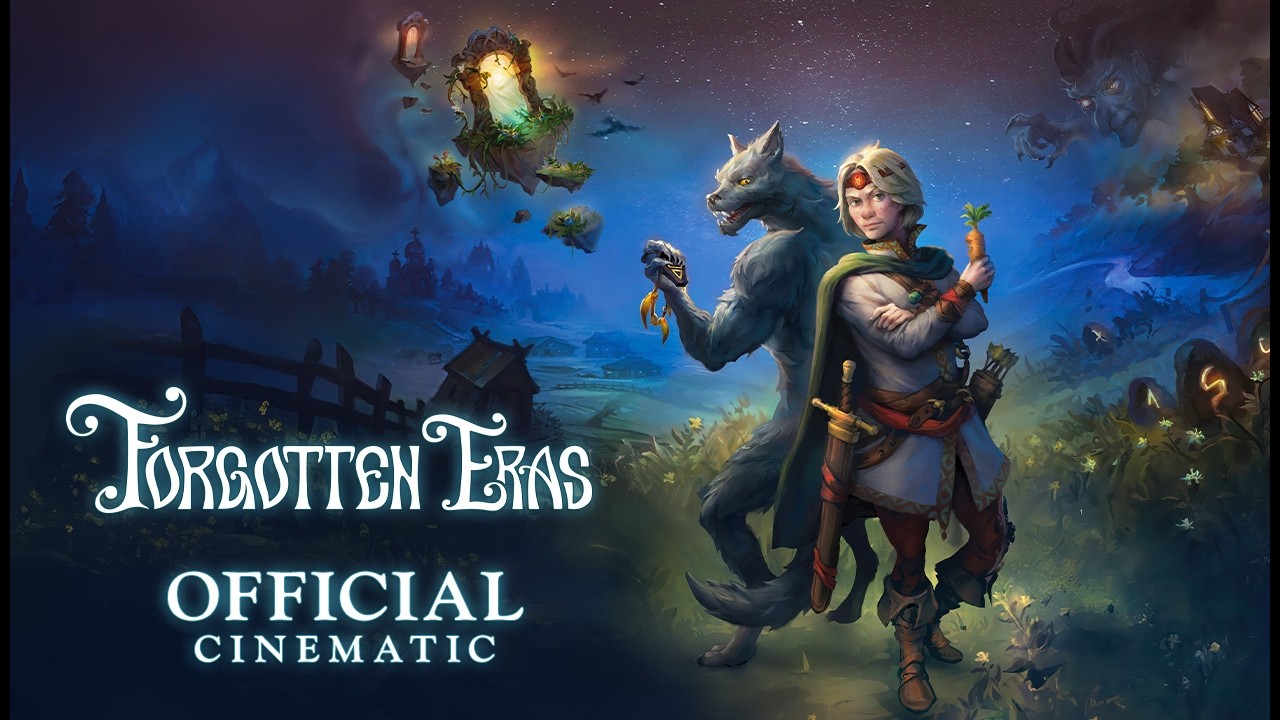
Forgotten Eras Gameplay Preview – Slavic Mythology Metroidvania Demo Systems
Analyzing Forgotten Eras Steam demo, rune combat systems, and Unreal Engine 5 Metroidvania design
Forgotten Eras is an Unreal Engine 5 Metroidvania currently in development with a playable Steam demo. This preview examines hands-on gameplay systems including rune-based combat, companion traversal with the Grey Wolf, and Slavic mythology-driven exploration across a layered 2.5D world built around ability gating and environmental progression.
Step into the forest, master the runes, and uncover what the Grey Wolf sees beyond the veil

Forgotten Eras


A forest that reshapes meaning through movement and memory Why Forgotten Eras gameplay systems redefine Slavic mythology Metroidvania design
Forgotten Eras is a first-person-adjacent 2.5D Metroidvania action-adventure developed by Behind the Hump, currently positioned in a pre-release state with a playable Steam demo used for systems evaluation. The Forgotten Eras game builds its structure around exploration-driven progression, rune-based combat layering, and companion-assisted traversal within a Slavic mythology Metroidvania framework. Rather than presenting isolated mechanics, the experience is constructed as an interconnected loop where movement, combat, and environmental interpretation operate as a unified system shaped through Unreal Engine 5 spatial design.
Across the Forgotten Eras Steam demo, progression is not communicated through linear mission structure but through layered environmental access. The player navigates a 2.5D space where visibility, verticality, and foreground occlusion are carefully balanced to maintain spatial readability during traversal-heavy sequences. This design positions the game within modern 2.5D Metroidvania games where exploration is gated by ability acquisition rather than scripted sequence advancement.
Early hands-on evaluation of Forgotten Eras gameplay mechanics reveals a deliberate pacing model centered on timing windows, animation commitment, and controlled mobility states. Movement is not purely reactive; instead, it is governed by frame-based transitions between attack, dash, and recovery states. This creates a system where precision matters as much as directional input, reinforcing the structural identity of the Forgotten Eras game as a methodical exploration-driven combat experience rather than a reflex-heavy action title.
A weapon that defines rhythm rather than raw damage output How the Sword Kladenets game weapon shapes combat timing and control
The Sword Kladenets game weapon functions as a timing anchor within the Forgotten Eras rune combat system. In active play, each attack carries a defined startup phase followed by a clearly readable recovery window that can be partially canceled into directional movement. During hands-on testing, this creates a controlled combat rhythm where aggressive chaining is possible but always constrained by animation state logic rather than unrestricted input buffering.
What distinguishes Forgotten Eras gameplay mechanics in practice is how movement and combat are interdependent. Attacks can transition into traversal states only at specific frame thresholds, meaning positioning decisions are made within narrow timing windows rather than free-form action spam. This reinforces the game’s identity as a Slavic mythology Metroidvania where precision and spatial awareness define success more than raw speed.
The Forgotten Eras rune combat system extends this structure by modifying how attacks behave in motion. Certain rune configurations alter aerial drift, dash recovery timing, and strike follow-through behavior. These changes are immediately felt during traversal-heavy encounters, where even small adjustments in movement physics alter how enemies are approached and disengaged.
A companion that actively participates in spatial problem solving How Forgotten Eras Ivan and Grey Wolf systems function in real-time gameplay
In the Forgotten Eras demo, the Grey Wolf companion is not a passive follower but a functional gameplay system integrated into traversal and encounter design. The Forgotten Eras Ivan and Grey Wolf dynamic operates through contextual commands tied to environmental triggers and enemy states, rather than scripted companion animations.
During hands-on sequences, the companion can be directed to pressure specific targets, interrupt enemy windups, or activate environmental switches such as pressure plates that unlock blocked traversal routes. This positions the game within Metroidvania games with companion mechanics where AI behavior is structurally embedded into puzzle logic rather than serving as narrative decoration.
This system becomes especially relevant in multi-layered environments where vertical space and foreground obstruction create situational awareness challenges. The companion effectively extends player agency into areas that are otherwise inaccessible without re-routing movement or revisiting prior zones with newly unlocked rune abilities.
A mythological forest that reacts to progression rather than simply framing it How Slavic folklore indie games design principles shape environmental systems
Environmental design in the Forgotten Eras game is structured around reactive mythological logic rather than static background storytelling. The presence of entities such as Baba Yaga, Morana, Domovoy, Leshy, and Veles is not limited to narrative framing; these elements influence traversal conditions, encounter pacing, and spatial interpretation across the world.
Encounters associated with Games featuring Morana and Leshy demonstrate environmental state variation, where lighting density, visibility range, and enemy positioning shift based on region-specific mythological influence. This creates a layered exploration model where environmental reading becomes essential to progression efficiency.
Boss encounters such as the Forgotten Eras Baba Yaga boss fight are structured around multi-phase environmental transformation. During observed transitions, background elements shift depth priority, lighting conditions reconfigure dynamically, and spatial layering adjusts to emphasize phase boundaries without interrupting combat flow. This reinforces the integration of narrative escalation and mechanical progression within a single spatial system.
A controlled exploration model built on observation and system literacy Why Forgotten Eras system requirements reflect UE5 mid-range optimization design
The Forgotten Eras system requirements reflect Unreal Engine 5 optimization principles focused on stable traversal performance rather than extreme graphical scaling. The Forgotten Eras system requirements baseline aligns with mid-range hardware capable of maintaining consistent frame pacing during layered 2.5D rendering and animation-heavy combat sequences.
Minimum-level performance behavior is consistent with hardware such as Intel i5-4460 or Ryzen 3 1200 CPUs paired with 8 GB RAM and GPUs in the GTX 1060 or RX 5500 XT range, operating under DirectX 12 rendering conditions. Recommended configurations scale toward Intel i7-9700 or Ryzen 5 1600 CPUs with 16 GB RAM and mid-to-upper tier GPUs such as RTX 2070 or Radeon VII equivalents, ensuring stable traversal during high-density environmental layering.
This optimization profile supports the game’s design emphasis on uninterrupted exploration flow, where traversal, combat, and environmental reading occur continuously without loading segmentation disrupting spatial continuity.
Final verdict A systems-driven Slavic mythology Metroidvania built on timing, traversal, and environmental logic
From a first-hand analysis of the Forgotten Eras Steam demo, the project establishes a coherent systems framework built around animation-timed combat, rune-modified movement behavior, and companion-assisted environmental interaction. The Forgotten Eras gameplay mechanics are most effective when viewed as an integrated loop rather than discrete features, where each system reinforces traversal readability and spatial decision-making.
The strongest structural element lies in how the Sword Kladenets game weapon, rune combat system, and Grey Wolf companion converge into a unified interaction model. Combined with Slavic mythology Metroidvania environmental design influenced by Baba Yaga, Morana, Domovoy, Leshy, and Veles, the experience maintains consistent mechanical identity across exploration and combat states.
Overall, Forgotten Eras positions itself as a controlled, systems-focused 2.5D Metroidvania experience where precision timing, environmental interpretation, and companion-driven traversal define progression. Based on the current Steam demo build, the project demonstrates a clear mechanical direction grounded in structured combat pacing and layered exploration design within Unreal Engine 5.
The VoxOdyssey Project Mission Statement for Feature games
I highlight what makes each game unique by examining gameplay mechanics, design choices, and storytelling. By analyzing systems, level design, and play styles, and referencing official media and assets, I aim to provide accurate, informative, and trustworthy insights. While I strive for accuracy, some details may change or be updated over time. Players can use this information to understand each title’s features and mechanics and make their own judgments.
Forgotten Eras Steam demo gameplay screenshots 2.5D Metroidvania exploration, rune combat systems, and Grey Wolf companion traversal


Forgotten Eras trailer – Slavic mythology Metroidvania, rune combat, and Grey Wolf exploration
Watch Forgotten Eras gameplay in motion as Ivan and the Grey Wolf traverse a layered 2.5D world, engage rune-powered combat, and uncover mythic secrets hidden within a cursed forest. The video below highlights movement, systems, and environmental storytelling in action.