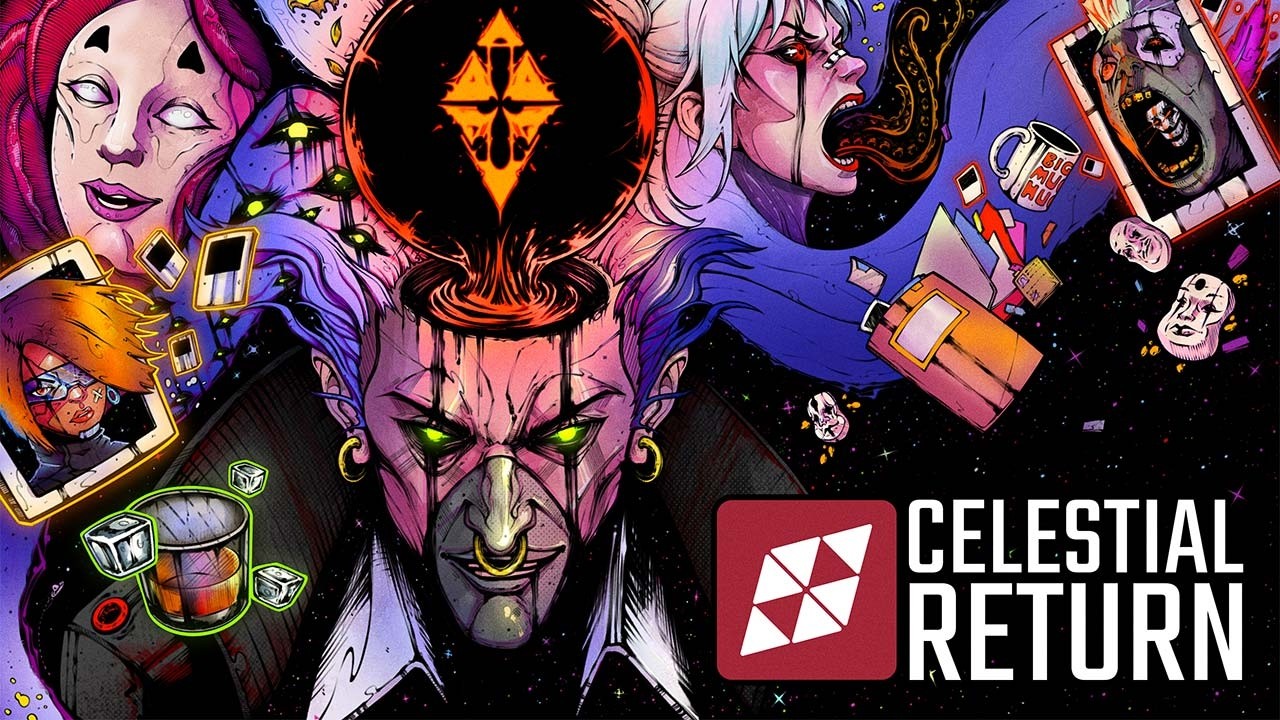
Celestial Return Review – Story Driven Dice RPG Investigation in Netherveil City
Explore Metaphor Games’ cyberpunk detective RPG featuring dice mechanics, personality fragments, and cosmic horror storytelling
Celestial Return combines detective investigation, dice resource management, branching choices, personality-driven progression, and a dark cyberpunk world where Detective Howard uncovers hidden truths across Netherveil City.
Ready to investigate Netherveil City, master the dice system, and discover what waits beyond the mystery? Continue below.

Celestial Return


A detective story where every decision carries weight Celestial Return trades traditional power progression for investigation, uncertainty, and consequence
Celestial Return is a story-driven RPG from Metaphor Games and Shoreline Games that places investigation, dialogue, and decision-making at the centre of its design. Set in the decaying cyberpunk metropolis of Netherveil City, the game follows Detective Howard as he investigates a series of unexplained suicides that gradually reveal a much larger mystery involving corporate corruption, supernatural events, and entities known as Abstracts.
Rather than following the traditional RPG formula of constant combat encounters and character power growth, Celestial Return focuses on uncertainty. Progress comes from gathering information, managing limited resources, and deciding how Howard responds to the people and situations surrounding him. The result is a detective RPG where the investigation itself becomes the main challenge.
The game sits closer to narrative-focused experiences such as Disco Elysium and Paradise Killer than a traditional combat-heavy CRPG. Its structure prioritises conversations, exploration, and interpretation, creating an experience where understanding the world is often more important than defeating an opponent.
The dice are not just a mechanic, they are the investigation Celestial Return turns every roll into a decision about risk and reward
The defining feature of Celestial Return is its dice resource management system. Dice represent the tools Detective Howard relies on when attempting important actions throughout the investigation. Each die represents two D4 rolls, creating a limited resource that must be carefully managed rather than spent without consideration.
Players must use at least one die when attempting actions that require a roll, meaning completely exhausting the available supply can bring investigative progress to a standstill. This creates constant pressure because every successful action also carries the question of whether the remaining resources will be enough for future challenges.
The system avoids making failure feel like a simple mistake. Poor results can redirect conversations, change investigative approaches, or force players to consider alternative solutions. Instead of reloading until the perfect outcome appears, Celestial Return encourages players to accept uncertainty and allow their decisions to shape the investigation.
Detective Howard becomes the result of every choice Personality fragments create an RPG system built around identity rather than statistics
Character progression in Celestial Return is built around personality fragments known as Insights rather than traditional skill trees. Dialogue choices influence the development of Howard’s personality, allowing traits such as Intelligence, Virtue, and Foolishness to affect future interactions.
These personality fragments are not simply temporary dialogue options. Choices aligned with specific traits gradually shape Howard’s identity, opening certain conversational paths while making others less available. The system creates a version of character progression where personality becomes the build.
This approach gives conversations a stronger sense of continuity. Instead of each interaction existing separately, previous decisions influence how Howard approaches future situations. The player is not only solving a mystery but also defining the type of detective attempting to solve it.
A strange companion in an even stranger city The sentient rose adds another voice to Howard’s investigation
One of Celestial Return’s most unusual narrative elements is Howard’s companion, a sentient rose that follows him throughout the investigation. Rather than functioning only as comic relief, the character provides commentary that challenges Howard’s perspective and adds another layer to the game’s internal dialogue.
The relationship between Howard and the rose helps balance the darker elements of Netherveil City. While the investigation explores themes of death, corporate control, and existential uncertainty, the companion introduces moments of reflection and criticism that prevent the narrative from becoming one-dimensional.
Netherveil City hides more than a simple crime scene A cyberpunk investigation that slowly descends into cosmic horror
Netherveil City is one of the strongest parts of Celestial Return because the setting actively supports the investigation rather than simply providing a backdrop. The city combines neon technology, corporate influence, social decay, and supernatural events to create an environment where every location feels connected to the larger mystery surrounding Detective Howard.
The investigation begins with a series of unexplained suicides, but the deeper Howard searches, the more the boundaries between crime, corruption, and the unknown begin to disappear. The discovery of Abstracts introduces a surreal element that expands the story beyond a conventional detective narrative while keeping the focus on uncovering information and understanding the forces affecting the city.
Rather than relying on constant action, Celestial Return uses conversations, environmental details, and discoveries to build its world. Players are encouraged to examine situations carefully because information gained in one part of the city can influence decisions elsewhere. The result is a setting that rewards attention rather than simply guiding players from one objective marker to another.
This approach helps establish the game as more than a standard cyberpunk RPG. The technology and corporate themes provide the foundation, but the growing presence of cosmic horror creates a sense that Netherveil City is struggling with problems far beyond ordinary human control.
A visual style built from fractured worlds Celestial Return uses illustration and atmosphere to define its identity
Celestial Return separates itself visually through its hand-shattered art style, combining influences from manga and American comic illustration. The developers have cited works including Blame!, Biomega, Akira, and Berserk as inspirations, creating a visual direction built around dramatic compositions, distorted environments, and expressive character designs.
The artwork supports the game's themes of instability and isolation. The towering structures, damaged environments, and unusual character designs reinforce the feeling that Netherveil City is a place where technology and humanity have developed in uncomfortable ways.
Instead of focusing on realistic graphics, the game uses a distinctive illustrated presentation to strengthen its atmosphere. Character portraits and dialogue scenes carry much of the emotional weight, allowing conversations to remain visually engaging while keeping the focus on investigation and storytelling.
The result is a cyberpunk RPG with a recognisable visual identity that supports its themes rather than simply decorating them. The art direction and narrative work together to create a world built around uncertainty, tension, and discovery.
The soundtrack follows the mood of the investigation Noir jazz, electronic sounds, and heavier influences shape Netherveil City
The audio design of Celestial Return follows the same philosophy as its visual presentation. Instead of relying on a single musical style, the soundtrack combines noir jazz, cyberpunk-inspired electronic music, and death metal influences to match the changing atmosphere of the investigation.
The variety of genres reflects the contrast within the game itself. Quiet investigative moments benefit from a more restrained atmosphere, while more intense situations use heavier sounds to reinforce the growing tension surrounding Howard’s discoveries.
The soundtrack works best when it complements the uncertainty at the centre of the story. It does not replace the narrative but strengthens the feeling that Netherveil City is constantly shifting beneath the player’s feet.
A role-playing experience built on different outcomes Choices, personality, and resources create reasons to investigate again
Replayability in Celestial Return comes primarily from its branching decisions rather than traditional completion systems. Since personality fragments develop through player choices, different approaches to Detective Howard can produce different conversations and investigative opportunities.
The dice mechanics strengthen this replay value because no two investigations need to unfold in exactly the same way. Spending resources on one opportunity may prevent another option from being available later, while failed rolls can create alternative paths rather than simple setbacks.
This structure encourages experimentation. A player focusing on careful analysis may experience the story differently from someone who embraces more reckless or unconventional decisions. The game’s systems are designed around discovering how choices reshape the investigation rather than finding one perfect route.
A detective RPG designed around thought instead of combat Where Celestial Return fits among modern narrative-driven games
Celestial Return occupies a specific space within the RPG genre by focusing on investigation systems rather than traditional combat progression. While many role-playing games use detective elements as a side activity, this game makes investigation the foundation of the entire experience. Information, interpretation, and decision-making become the tools that allow players to progress through the mystery surrounding Netherveil City.
The comparison to games such as Disco Elysium is understandable because both experiences place significant importance on dialogue, character psychology, and player choice. However, Celestial Return develops its own identity through the combination of dice resource management, personality fragments, and a supernatural detective storyline. The result is closer to an atmospheric interactive investigation with CRPG influences than a traditional combat-focused role-playing game.
This design approach gives every interaction greater importance. A conversation is not simply a method of receiving information, and an investigation is not only a way to unlock the next objective. Each decision contributes to the development of Detective Howard while changing how the player understands the world around them.
For players searching for a cyberpunk detective game that focuses on narrative systems, Celestial Return offers an experience built around uncertainty and consequence. Its strongest moments come from the connection between its mechanics and story, where the player experiences the same pressure and limitations facing the detective at the centre of the investigation.
Progress is measured by understanding the mystery The RPG systems reward adaptation rather than simple character optimisation
The progression model in Celestial Return is intentionally different from traditional RPG structures. Instead of building Howard through equipment upgrades or combat-focused statistics, progression comes from developing his personality, understanding the city, and learning how to manage limited investigative resources.
The dice system remains central throughout this process because it forces players to think about timing. A successful roll can provide valuable information, but spending resources too quickly can create problems later. The system encourages players to consider each action as part of a larger investigation rather than a series of disconnected tasks.
Personality fragments provide another layer of progression by allowing players to shape the type of detective Howard becomes. A more analytical approach may open different responses compared with choices driven by morality or unpredictability. This creates a role-playing system where identity influences gameplay rather than simply changing dialogue text.
The result is a slower, more reflective style of RPG progression. The reward is not only reaching the end of the investigation but seeing how the character and the world have changed because of the choices made along the way.
A focused Steam RPG with a clear creative direction Celestial Return prioritises atmosphere, writing, and player agency
Celestial Return enters the Steam RPG space with a clear understanding of its strengths. It is not designed around large-scale battles or a traditional power fantasy. Instead, Metaphor Games focuses on creating a compact narrative experience where every system supports investigation and character development.
The game’s strongest achievement is the way its individual elements connect. Dice mechanics reinforce the uncertainty of investigation, personality fragments strengthen the role-playing aspects, and Netherveil City provides the atmosphere needed for the mystery to develop naturally.
This cohesion is important because narrative RPGs depend on more than strong writing alone. Players need systems that allow them to influence the experience. Celestial Return succeeds by making choices feel connected to the character being created rather than treating them as temporary story branches.
For players looking into Celestial Return Steam information, the appeal lies in its unusual combination of detective fiction, cyberpunk themes, dice-based decisions, and cosmic horror. It is a game built for players who enjoy analysing situations, exploring possibilities, and accepting that not every outcome can be controlled.
A lightweight PC experience focused on storytelling Celestial Return system requirements and technical accessibility
The Celestial Return system requirements are relatively modest, making the game accessible across a wide range of PC hardware. The minimum requirements include a 64-bit processor and operating system, Windows 10, a 1.8GHz dual-core CPU, 8GB of RAM, integrated graphics, and 8GB of available storage space.
The recommended specifications match the minimum requirements, suggesting that the game’s focus is not on demanding graphical technology but on its illustrated art direction, narrative systems, and gameplay mechanics. The hand-shattered visual style relies on artistic presentation rather than high-end hardware performance.
These requirements align with the overall design philosophy of Celestial Return. The experience is built around investigation, dialogue, and decision-making, allowing the game’s writing and systems to remain the central focus.
Final Verdict Celestial Return review conclusion
Celestial Return is a distinctive story-driven RPG that succeeds by focusing on the parts of role-playing that are often overlooked: uncertainty, personality, and meaningful decisions. Its dice resource management system creates genuine tension, while its personality fragments ensure that Detective Howard develops according to the choices made throughout the investigation.
The game’s strongest qualities come from how closely its mechanics and themes are connected. The limited dice supply reflects the pressure of investigation, Netherveil City reinforces the feeling of isolation and discovery, and the dialogue systems make every choice feel like part of Howard’s evolving identity.
Players looking for a traditional combat-focused RPG may find Celestial Return’s slower investigative structure different from familiar role-playing formulas. However, those interested in detective games, cyberpunk worlds, cosmic horror, and narrative systems built around consequence will find an experience with a clear creative identity.
As a Metaphor Games RPG, Celestial Return stands apart because it understands that the most memorable moments in a role-playing game do not always come from defeating enemies or collecting powerful equipment. They come from making difficult decisions, living with unexpected outcomes, and discovering how those choices shape the story.
The final result is a thoughtful detective RPG built around investigation rather than domination. Celestial Return creates its strongest impact when players embrace the uncertainty at the centre of its design and allow every roll, conversation, and discovery to become part of Detective Howard’s journey through Netherveil City.
The VoxOdyssey Project Mission Statement for Feature games
I highlight what makes each game unique by examining gameplay mechanics, design choices, and storytelling. By analyzing systems, level design, and play styles, and referencing official media and assets, I aim to provide accurate, informative, and trustworthy insights. While I strive for accuracy, some details may change or be updated over time. Players can use this information to understand each title’s features and mechanics and make their own judgments.
Celestial Return gameplay screenshots Detective Howard, Netherveil City, and story-driven RPG investigation scenes


Celestial Return video – Entering Netherveil City and uncovering a dangerous mystery
Watch Celestial Return gameplay in action as the video reveals Detective Howard’s investigation, dice decisions, strange encounters, and the atmosphere of Netherveil City. Continue below to explore the story-driven RPG systems in motion.