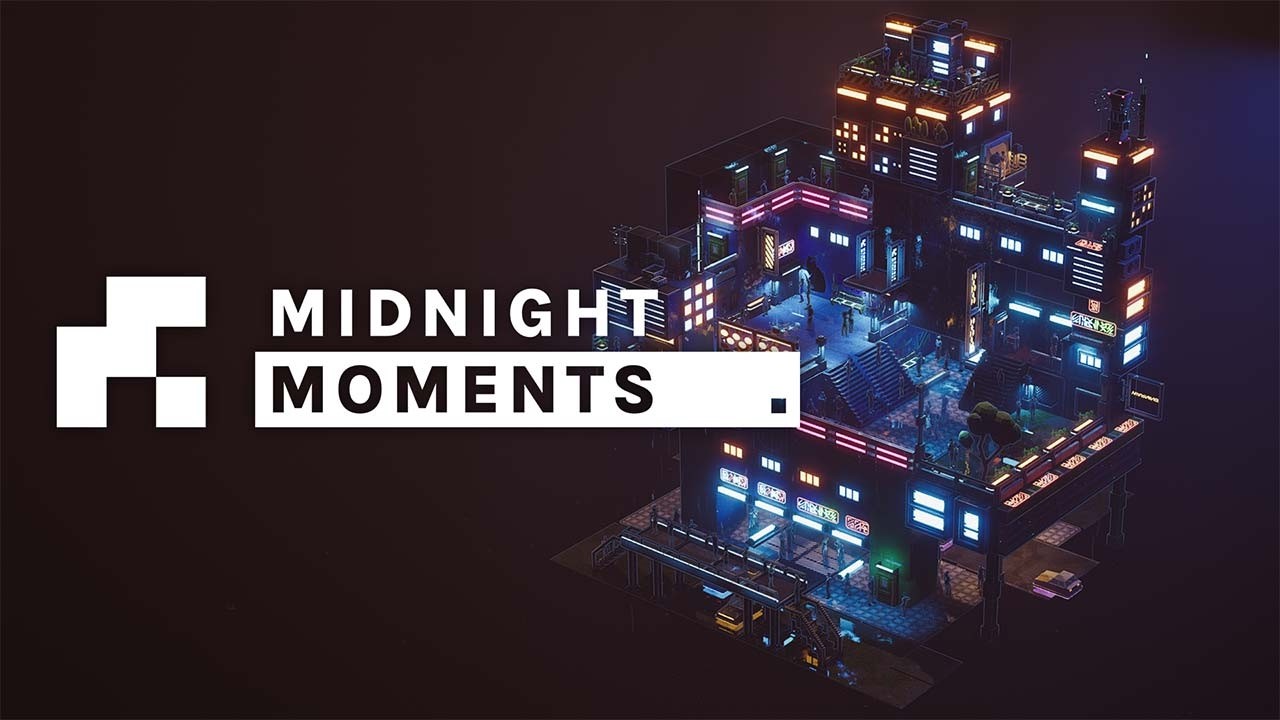
Midnight Moments Review – A Cyberpunk Diorama Builder Without Objectives
Explore Midnight Moments, Happy Volcano's atmospheric PC sandbox for building rain-soaked cyberpunk neighbourhoods, stacked buildings, and detailed urban dioramas
This Midnight Moments review examines its modular cyberpunk construction, 6×6×6 demo space, planned 10×10×10 build area, no-goal design, environmental detail, and PC system requirements.
Ready to build a neon-lit backstreet and see how Midnight Moments turns a small city corner into a creative sandbox? Continue below.

Midnight Moments


Midnight Moments turns cyberpunk city building into a quiet 3D diorama workshop Happy Volcano's PC sandbox focuses on stacked architecture, neon detail, citizen placement, and the freedom to stop when the scene feels finished
Midnight Moments is a compact cyberpunk diorama builder from Happy Volcano built around a simple idea: make a place, adjust the details, and spend time looking at the result. The game does not frame urban construction as a management problem or push the player through a campaign. Its focus is the creation of small rain-soaked environments, from a single building or backstreet to a more developed neighbourhood corner, with the player deciding how the space should look and when the arrangement is complete.
That places the Midnight Moments game in a specific part of the modern PC creative sandbox market. It is not presented as a traditional city builder with budgets, population targets, resource chains, or economic failure states. There is no stated campaign structure, timer, score, or objective system driving the construction process. The core activity is spatial composition: buildings are placed, structures can be stacked, alleyways can be threaded between them, rooftops can receive antennae and garden plots, and neon signs can be added to facades.
The result is closer to an interactive urban diorama than a conventional simulation. That distinction is central to understanding the game's purpose. In a management title, a building usually exists because it performs a function within a wider system. In Midnight Moments, the building is primarily part of the scene. A rooftop garden, a glowing sign, a narrow passage, or a citizen placed beneath a light can matter because of how it changes the composition rather than because it produces a measurable gameplay advantage.
The cyberpunk setting gives that construction framework its visual identity. Rain-soaked streets, glowing apartment blocks, neon-lit facades, rooftop details, and quiet neighbourhood corners form the basis of the game's presentation. Happy Volcano is not using the setting as a backdrop for a combat campaign or a conventional science-fiction story. The environment is the main subject, and the systems are built around shaping that environment.
Midnight Moments is built around vertical city construction rather than a flat building grid Stacked buildings, narrow alleyways, rooftops, props, and citizens give the cyberpunk diorama builder PC format its defining spatial character
The most important design feature in Midnight Moments is the relationship between scale and verticality. The game allows the player to work with compact urban spaces while building upward through stacked structures. That changes the way a scene is composed. A small footprint does not necessarily mean a visually simple environment when the player can layer buildings, place details on rooftops, and create narrow routes between structures.
The construction approach is also distinct from a conventional city-planning interface. The supplied game information describes freeform placement rather than a rigid city-management grid, allowing the player to treat the environment as a three-dimensional composition. The practical design consequence is that height, density, and sightlines become important parts of the build. A structure can contribute to the scene from its facade, roofline, side profile, or relationship to the buildings around it.
Alleyways provide another layer of spatial control. A dense cyberpunk environment depends heavily on the spaces between buildings, and Midnight Moments gives those gaps a role in the construction process. The player can create routes and openings that affect how the finished diorama reads from different viewpoints. The same collection of buildings can therefore produce a very different scene depending on how tightly the structures are arranged and where the visual breaks are left.
Rooftops extend the construction system beyond the street. Antennae and garden plots add detail to surfaces that would otherwise become visually inactive once a building has been placed. Neon signs perform a similar function on facades, adding points of visual emphasis to the architecture. These objects are not described as part of an economic or progression system. Their role is compositional, giving the player more control over the identity of each section of the district.
This is where Midnight Moments differs from a traditional city builder. The player is not primarily asking whether a structure is profitable, efficient, or strategically useful. The question is whether it belongs in the scene and whether its position improves the arrangement. That shift from system optimisation to visual decision-making is the foundation of the game's creative format.
The camera is designed to move between city-scale composition and street-level detail A broad view establishes the shape of the district while closer inspection turns props, citizens, lighting, and architecture into the focus
The camera perspective is particularly important in a game built around diorama construction. Midnight Moments is designed around the ability to zoom into the world, creating two distinct ways of reading the same environment. From a wider viewpoint, the player can assess the overall structure of the scene: how buildings are stacked, where the major gaps are, and how the district's vertical profile is balanced.
At a closer range, the task changes. Props, citizens, rooftop details, signage, and smaller environmental arrangements become more significant. This dual-scale interaction is a natural fit for a 3D diorama builder because the scene needs to work both as a complete composition and as a collection of individual details. A build that looks coherent from a distance may still invite further adjustment when examined at street level.
From an interaction-design perspective, the camera system is doing more than providing a convenient zoom function. It changes the player's role while constructing. The wider view is concerned with structure and proportion, while the closer view is concerned with placement and atmosphere. That separation helps explain why the game's small-scale environments can support a relatively high level of visual adjustment without requiring a conventional campaign or progression system.
The approach also reinforces the idea that Midnight Moments is a scene-building game rather than a standard exploration game. The player is not simply travelling through an authored cyberpunk location. The player is repeatedly changing the viewpoint to inspect a location that has been assembled directly through construction and decoration.
Rain, neon, and wet streets carry much of the atmosphere because the environment is the main event Midnight Moments uses weather, lighting, and urban density to make a small constructed space worth examining after the building is finished
The visual presentation of Midnight Moments is built around a rain-soaked cyberpunk environment. Rain streaks across neon-lit facades, while light pools beneath street lamps and reflects across wet urban surfaces. These elements give the completed diorama its atmosphere, but they also serve a more important structural purpose: they provide a reason to inspect the scene after the construction work has been done.
In a conventional game, environmental effects often support a larger objective. Rain may signal a change in weather, affect combat visibility, or accompany a story sequence. Here, the available design places the effect much closer to the centre of the experience. The weather and lighting help define the finished scene itself, making presentation part of the creative output.
The visual relationship between neon signs, wet surfaces, building facades, and street lighting also gives the player a clear aesthetic framework within which to work. The setting is not a blank architectural editor. It has a defined cyberpunk visual language, and the player's role is to arrange the available structures and objects within that language.
That focus is one reason the game occupies an unusual position within the cozy creative game category. The environment is urban rather than pastoral, vertical rather than open and rural, and atmospheric rather than brightly decorative. Midnight Moments takes the low-pressure construction format and applies it to rain-soaked backstreets, glowing apartment blocks, and compact city spaces.
Citizens and props turn an architectural arrangement into a place that appears to be inhabited The player creates the setting, then uses small details and human presence to suggest how the neighbourhood might function
Buildings provide the structural foundation of a Midnight Moments scene, but props and citizens give the environment a different kind of meaning. A structure by itself establishes architecture. Add a figure, a sign, rooftop equipment, or a garden plot, and the same space begins to suggest use and occupation.
The game does not present this as a conventional character-driven narrative system. The available information instead describes citizen placement as part of the creative process. The player decides where people belong within the scene, allowing their position to contribute to the overall composition of the neighbourhood.
This gives Midnight Moments a form of environmental storytelling that is created rather than discovered. The game does not need to explain the history of every building or provide a scripted reason for every alleyway. The player can construct a visual context through the relationship between architecture, lighting, objects, and citizens.
The result is deliberately open-ended. A quiet corner can remain mostly architectural, while a denser scene can be filled with signs, rooftop details, props, and citizens. The player is effectively deciding how much information a particular space should contain. That makes asset density part of the creative process rather than simply a technical measurement.
The lack of objectives is not an empty feature; it is the central progression decision Midnight Moments replaces scores, timers, and unlock pressure with repeated construction, editing, and the freedom to decide when a scene is finished
The most significant structural choice in the Midnight Moments game is the absence of conventional objectives. The available description presents no stated missions, timers, campaign targets, population requirements, or pressure systems. The player is not asked to reach a particular score or expand through a series of increasingly demanding stages.
That means progression is not measured in the usual way. There is no traditional ladder of increasingly powerful buildings or a campaign that unlocks new districts through successful management. Instead, the game is built around the process of creating and revising scenes. A player can construct a backstreet, alter its arrangement, return to the same space, or begin a different composition.
Replayability therefore comes from variation rather than escalation. The same basic construction tools can produce different results depending on the density of the buildings, the arrangement of the alleyways, the use of rooftop surfaces, the placement of citizens, and the distribution of props. The motivation to return is the possibility of making another scene rather than the need to complete another objective.
This also removes a familiar form of failure. The game is not described as having an economy that can collapse, a city that can become unmanageable, or a timed construction challenge that can be lost. An arrangement that does not work can simply be changed. Experimentation becomes the central risk because the cost of trying something different is primarily the time spent adjusting the scene.
That structure will not suit every player. Anyone looking for a traditional city-management game, a progression-heavy building game, or a cyberpunk action title should approach Midnight Moments with the correct expectations. The game is specifically aimed at players who find value in arranging and observing a space without needing a reward system to justify the activity.
Happy Volcano's design direction moves from high-pressure arcade action to a much quieter creative format The studio's catalogue context helps explain why Midnight Moments feels like a deliberate change of pace rather than a conventional city builder
Midnight Moments sits within Happy Volcano's wider development history, which includes You Suck at Parking, a game built around fast movement, precision, and arcade-style pressure. The contrast between that earlier high-stress physics-driven format and Midnight Moments is useful when considering the studio's catalogue. The newer game is built around slowing the interaction down and giving the player control over the pace of construction.
The difference is not simply a change of setting. The underlying relationship between player and system is different. A game such as You Suck at Parking is structured around immediate performance and successful execution, while Midnight Moments removes the need to perform against a timer or opponent. The player is given room to make adjustments, inspect the result, and continue only when another change seems worthwhile.
That shift places the Happy Volcano diorama builder within a wider movement toward games that treat creative construction and atmosphere as complete activities in themselves. The studio context is relevant because it shows a move away from a design framework centred on urgency and toward one centred on control over space.
The two approaches are not identical, and Midnight Moments should not be understood as a management simulation simply because it involves buildings. Its design is much closer to an environment editor presented as a game, with the cyberpunk setting and atmospheric presentation supplying the visual structure around the construction tools.
Townscaper and Tiny Glade show where the genre sits, but Midnight Moments takes the idea into dense urban cyberpunk Its identity comes from replacing pastoral architecture and abstract town creation with vertical buildings, wet streets, neon signage, and compact neighbourhood spaces
The clearest way to understand Midnight Moments is to place it beside other low-pressure creative construction games without treating them as identical experiences. Townscaper is associated with simple town creation and an emphasis on the pleasure of producing attractive structures through uncomplicated interaction. Tiny Glade focuses on organic pastoral architecture and a softer fantasy setting. Midnight Moments takes the same broad interest in low-pressure building and applies it to a denser, more vertical urban environment.
The difference is visible in the type of space being created. Instead of a rural landscape or an abstract coastal town, the player works with rain-soaked backstreets, apartment blocks, alleyways, rooftops, neon signs, and compact neighbourhood corners. The construction experience is therefore shaped by urban density and vertical layering.
This comparison also clarifies what Midnight Moments is not. It does not appear to be pursuing the economic simulation of Cities: Skylines or the survival-management pressure of Frostpunk. Those games ask the player to manage systems that can succeed or fail. Midnight Moments removes that layer and leaves the player with the act of creating the environment itself.
The result is a narrower but clearly defined niche. Players searching for a cozy cyberpunk game on Steam or a relaxing city builder with no objectives should understand that the experience is not about building a functioning metropolis. It is about creating a visually coherent slice of one.
The PC requirements point to a scene renderer where visual density matters more than simulation scale The listed hardware baseline is modest by current standards, while stacked architecture, lighting, rain, and detailed scenes define the technical workload
The Midnight Moments system requirements establish a clear PC baseline. The minimum configuration requires a 64-bit processor and operating system, Windows 10 64-bit, an Intel Core i5 or AMD equivalent processor, 8GB of RAM, an Nvidia GeForce GTX 1660 or AMD Radeon RX 590, DirectX 11, and 4GB of available storage. The published information also states that the game requires a 64-bit system.
Those specifications need to be read in the context of the game's design rather than its map size alone. A compact diorama can still contain a substantial number of visible elements when buildings are stacked vertically, facades are illuminated, rain effects are present, and the player zooms in to inspect props and smaller details.
The available game information does not identify a specific rendering pipeline, volumetric rain implementation, shader model, or exact lighting architecture. It would therefore be inaccurate to claim a particular technical implementation as confirmed. What can be established from the design is that visual scene density is more relevant to the experience than the simulation demands associated with pathfinding, economic modelling, or large-scale population management.
The hardware requirements consequently reflect a modern 3D environment with atmospheric presentation rather than a large-scale strategy simulation. The listed GTX 1660 or RX 590 baseline provides a clear reference point for PC players considering the cyberpunk diorama builder PC format, while the 4GB storage requirement indicates a relatively compact installation footprint.
For anyone checking the Midnight Moments system requirements before purchase, the main distinction is that the game is designed around rendering a detailed constructed scene rather than simulating a huge city. The available specifications provide the hardware floor, while the player's chosen level of architectural and decorative density determines how visually busy the finished environment becomes.
Midnight Moments is a companion-style game built for short creative sessions rather than a traditional campaign Its quiet pacing and integrated lo-fi background audio support the idea of returning to a scene simply to adjust it, observe it, and let the atmosphere do the rest
The game's presentation is closely connected to its intended pace. Midnight Moments is designed as a low-pressure creative experience where the player can build at their own speed, stop without reaching a defined endpoint, and return to the same environment later. The integrated lo-fi background audio reinforces that companion-style approach by framing the construction process as something that can sit alongside a period of relaxation rather than demanding constant attention.
That design changes the meaning of a completed scene. In a conventional builder, completion may mean reaching a target or finishing a construction objective. Here, completion is subjective. The player can decide that a building arrangement is finished because the proportions work, the lighting feels right, or the neighbourhood has reached the level of detail intended for that particular composition.
This makes the game particularly suited to players who enjoy visual editing without the pressure of optimisation. It also explains why the absence of objectives is so central to the experience. A timer or score would shift attention away from the quiet process of looking at the scene and toward performance. Midnight Moments is built around the opposite relationship with time.
The format will not appeal to everyone. Players who need constant unlocks, measurable progress, competitive challenge, or a clear campaign structure may find the game too limited. The absence of those systems is not a hidden weakness to be discovered later; it is the stated foundation of the design.
The strongest appeal comes from treating a cyberpunk neighbourhood as a finished visual object Midnight Moments is less interested in asking what the city does than in asking how the city should look when every detail has been placed
That distinction gives Midnight Moments its clearest identity. The game does not need a complex economy to make a building matter. It does not need a combat system to give an alleyway purpose. It does not need a scripted character arc to make a citizen part of the scene. Its systems are directed toward the construction of a visual environment, and the value of the result depends on how much the player enjoys that process.
The strongest scenes are likely to come from the interaction between the major structural elements and the small details. Stacked buildings establish the vertical profile. Alleyways create separation and movement through the composition. Rooftops provide additional surfaces. Neon signs create visual emphasis. Props add clutter and identity. Citizens suggest occupation. Rain and lighting unify the scene's cyberpunk atmosphere.
None of those elements needs to be treated as a separate progression system for the arrangement to have value. Their importance comes from how they work together. That is the central architectural idea behind the game: the player is building a scene whose meaning emerges from relationships between objects rather than from a sequence of objectives.
For a reference-level Midnight Moments review, that is the most important point to establish. This is not a city builder that happens to lack an economy. It is a creative diorama game whose subject happens to be a cyberpunk city. The difference affects every part of the experience, from the construction tools to the camera perspective and the way replayability is created.
Final verdict Midnight Moments is a focused cyberpunk diorama builder for players who want to construct, decorate, and observe a city without objectives getting in the way
Midnight Moments is a deliberately narrow PC creative sandbox with a clear design purpose. Happy Volcano has built the game around modular urban construction, vertical architecture, environmental decoration, citizen placement, rain, neon lighting, and the freedom to work without timers or conventional goals. The result is not trying to compete with a traditional city-management simulation or a progression-heavy construction game.
Its strongest feature is the relationship between construction and presentation. Buildings can be stacked, alleyways can be arranged between structures, rooftops can be filled with details, facades can receive neon signage, and citizens can be placed into the finished environment. The camera can then move from a wider view of the overall arrangement toward closer inspection of the details that give the scene its identity.
The game's replayability is equally specific. There is no stated progression ladder to climb and no economic system to master. Instead, the player returns to create another composition, revise an existing one, change the density of a district, or simply continue refining a space. That makes Midnight Moments a strong fit for players searching for a relaxing city builder with no objectives, but a poor match for anyone expecting traditional strategy systems or constant rewards.
The cyberpunk presentation gives the concept a clear visual direction. Rain-soaked streets, glowing apartment blocks, neon signs, rooftop gardens, antennae, props, and citizens all contribute to a setting that is more urban and vertically layered than the pastoral creative-building games commonly associated with the genre. Townscaper and Tiny Glade provide useful points of comparison, but Midnight Moments is defined by its dense city spaces and atmospheric cyberpunk framing.
The PC version also has a clearly stated technical baseline, requiring a 64-bit Windows system, 8GB of RAM, a GTX 1660 or RX 590-class graphics card, DirectX 11, and 4GB of storage at minimum. Those specifications are appropriate context for a game built around detailed 3D scenes, stacked architecture, lighting, rain, and close-range environmental inspection. The available data does not justify claims about specific shader or lighting technologies, but it does establish a modern PC rendering target rather than a large-scale simulation workload.
Happy Volcano's move from the high-pressure arcade structure associated with You Suck at Parking toward a quiet creative game also gives Midnight Moments a useful place within the studio's catalogue. The contrast is clear: one design framework is built around speed and precision, while the other gives the player time to arrange, inspect, and revise a scene without a performance requirement.
Overall, Midnight Moments is best understood as a cyberpunk environment-building game rather than a conventional city builder. Its purpose is to create a place and give the player enough control over its architecture and details to make that place feel complete. The absence of objectives is the foundation of the experience, not an omission to be compensated for elsewhere.
For players searching for a cozy cyberpunk game on Steam, a Happy Volcano diorama builder, or a low-pressure PC sandbox focused on urban composition, Midnight Moments has a clear point of entry. For players who want campaigns, resource management, combat, competitive scoring, or measurable progression, the game's deliberately minimal structure is a reason to skip it. The final assessment is therefore straightforward: Midnight Moments succeeds on the terms it establishes, offering a compact and atmospheric space for building rain-soaked cyberpunk scenes, refining their details, and deciding for yourself when the city is finished.
The VoxOdyssey Project Mission Statement for Feature games
I highlight what makes each game unique by examining gameplay mechanics, design choices, and storytelling. By analyzing systems, level design, and play styles, and referencing official media and assets, I aim to provide accurate, informative, and trustworthy insights. While I strive for accuracy, some details may change or be updated over time. Players can use this information to understand each title’s features and mechanics and make their own judgments.
Midnight Moments gameplay screenshots Cyberpunk diorama building, neon-lit streets, rain-soaked environments, and creative city decoration


Midnight Moments video – Watch a rain-soaked cyberpunk diorama take shape
See Midnight Moments in motion as buildings rise, neon lights cut through the rain, and quiet city corners fill with detail. Continue below to watch the video and take a closer look at this cyberpunk diorama builder.