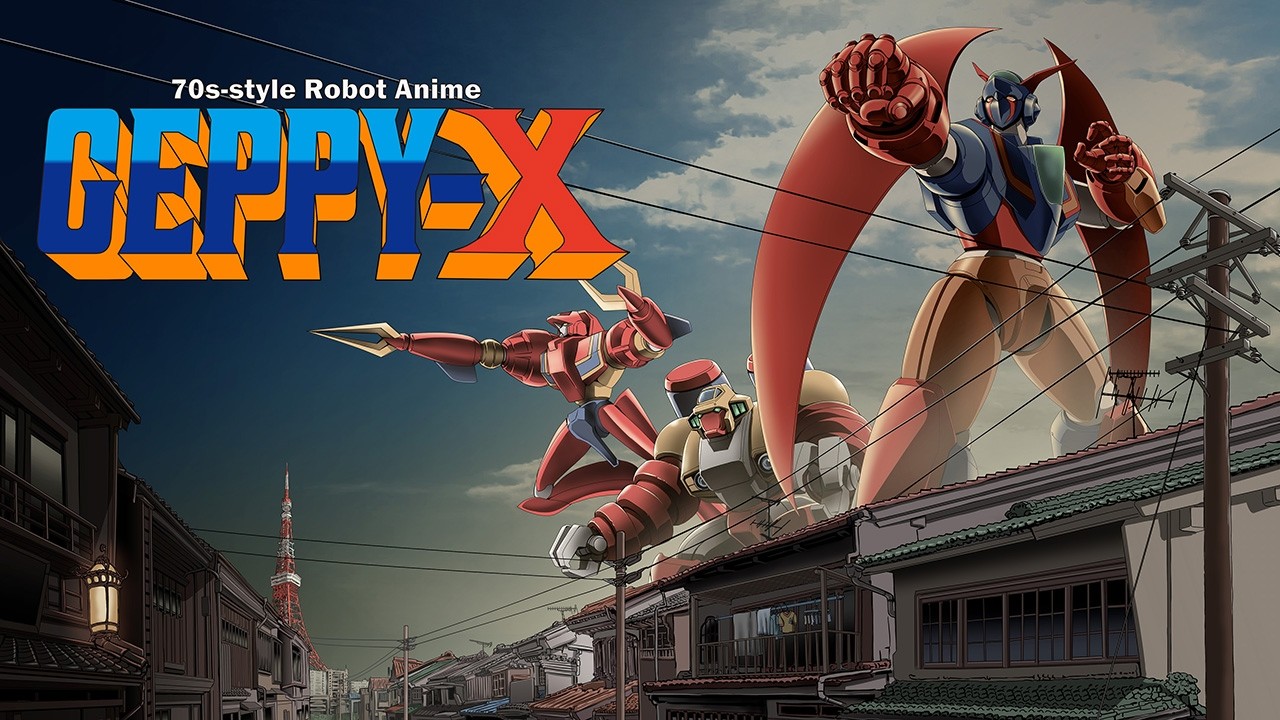
70s-Style Robot Anime Geppy-X Review – A Restored PS1 Mecha Shooter
Explore Geppy-X, Implicit Conversions' restored Japanese super robot game with 2D shooter combat, anime presentation, and 24fps animation
This 70s-Style Robot Anime Geppy-X review examines the original 1999 PS1 mecha shooter, its Betacam animation restoration, GEPPY-X gameplay, transforming combat forms, and modern remaster features.
Ready to launch GEPPY-X and discover why this rare Japanese robot anime game has returned? Continue below.

70s-style Robot Anime Geppy-X


70s-Style Robot Anime Geppy-X turns a PlayStation shooter into a full television robot anime experience A rare 1999 Japanese production returns through restored animation, transforming combat, and a remaster built around preservation
70s-Style Robot Anime Geppy-X is an unusual entry in the history of Japanese PlayStation software. Developed by Aroma Co., Ltd. and directed by Akihide Kohara, the game was released exclusively in Japan on May 27, 1999. It combines fast-paced 2D side-scrolling shooter action with the structure of a television super robot anime, presenting the player with openings, episodes, eyecatches, commercials, endings, and next-episode previews as part of the overall experience. The result is not simply a game with animated cutscenes attached to it. Its entire format is built around the idea of controlling the action inside a fictional robot anime broadcast.
The scale of the original production helps explain why Geppy-X has remained such a distinctive piece of PlayStation history. The game used approximately 8,000 hand-drawn animation frames and was distributed across four CD-ROMs. That was an unusually substantial commitment to animation for a 1999 console game, particularly for a title whose interactive foundation was a 2D side-scrolling shooter. The modern Geppy-X remaster, developed by Implicit Conversions and published by Bliss Brain, gives that production a new international release across PC, PlayStation 4, PlayStation 5, Nintendo Switch, and Xbox Series X/S.
What makes the modern release especially significant is that the restoration work goes beyond simply placing the original PlayStation software on new hardware. The original version presented its animation at 320x240 resolution and 15 frames per second. The remaster has re-digitised the animation from the original Betacam master tapes and restored it to 24fps, with optional upscaling planned as a post-launch feature. For a game whose identity is so closely connected to the format and presentation of a television anime series, the source material used for the restoration is a central part of the release.
That combination of interactive combat and restored animation gives 70s-Style Robot Anime Geppy-X a very specific place within the history of the classic super robot anime PS1 game. It is a mecha shooter, but the shooter mechanics are only one part of the design. The game is also concerned with the rhythm of a television production, the presentation of a fictional series, and the exaggerated conventions of Japanese robot anime. Its unusual format is the reason Geppy-X remains more than a standard example of a 1990s side-scrolling action game.
The Cosmic Demon Empire gives GEPPY-X a very traditional super robot mission Earth is under attack, the Space Beasts are overwhelming conventional resistance, and a secret combat robot is finally launched
The story begins in the year 197X, when the Cosmic Demon Empire launches an assault on Earth. Its forces command enormous beast-shaped war machines known as the Space Beasts, and the invasion begins with Japan facing the destructive power of an enemy that ordinary military forces cannot stop. The situation follows the familiar structure of classic super robot fiction, but Geppy-X uses that structure as the foundation for its wider television-anime concept.
Dr. Kureishi, a genius scientist who has secretly prepared for the possibility of such an attack, orders the launch of GEPPY-X. Three young pilots board the combined combat robot and take on the forces of the Cosmic Demon Empire. The premise contains the familiar elements of the genre: the hidden laboratory, the emergency launch, the previously secret machine, the young pilots, and the enemy force whose destructive power exceeds anything conventional technology can handle.
The story later introduces the new model GEPPY-XX, giving the fictional series the kind of mechanical evolution associated with long-running robot anime. This development is important because Geppy-X is not structured as a self-contained action game with a robot simply placed at its centre. The machine itself is part of the fictional television production, and its evolution becomes part of the way the player experiences the story.
That relationship between narrative and format is one of the game's clearest strengths. The player is not merely watching the story between stages. The combat sequences represent the part of the robot anime that the player controls, while the surrounding broadcast structure provides the presentation of the fictional series. It is a simple concept to describe, but it gives the game a format that remains unusual among PlayStation-era mecha titles.
GEPPY-X gameplay is built around switching forms in the middle of the battle X1 Balanced, X2 Speed, and X3 Power turn the transforming robot into the central combat system
At the centre of the 70s-style robot anime Geppy-X gameplay mechanics is the ability to switch between three combat forms in real time. X1 is the Balanced form, X2 is the Speed form, and X3 is the Power form. The three configurations give the player different approaches to movement and offensive strength, making the choice of form part of the moment-to-moment action rather than a simple equipment selection made outside combat.
The system fits the fiction of GEPPY-X as a transforming and combining combat robot. The player is not controlling a fixed character with an unchanging set of abilities. The machine can be adapted during the battle, allowing the player to balance general performance, movement, and power according to the situation. That gives the side-scrolling shooter a mechanical identity that is directly connected to its super robot premise.
The 2D side-scrolling combat is fast-paced, but the three-form structure gives the action a layer of decision-making beyond simply moving and firing. X1 provides the general-purpose option, X2 emphasises speed, and X3 shifts the balance toward power. The player therefore has to consider whether mobility or offensive strength is more useful at a given moment.
The combat system also benefits from the remaster's rapid-fire option. Players can hold the relevant R2 or L2 controls to fire the main and sub-weapons instead of repeatedly pressing the buttons. This is a practical change that makes the action more comfortable without altering the underlying structure of the original game. The difficulty level remains the same, while the modern control option reduces the physical demands of sustained firing.
The four-disc PlayStation production has been rebuilt for modern storage without losing its original scale A game once spread across four CD-ROMs now moves through its content without the same disc-swapping interruptions
The original PlayStation release required four CD-ROMs because of the amount of animated video included in the production. That physical structure was part of the reality of playing a large CD-based game in 1999. Players had to work through a disc-swapping layout that reflected the storage limitations of the original hardware.
The modern release consolidates that structure through contemporary storage buffers and unified memory access. The original content remains the basis of the experience, but the physical requirement to manage four separate discs is removed. This is one of the more practical improvements in the Geppy-X remaster because it addresses a limitation created by the original format rather than changing the game's design.
The difference is particularly relevant for a game whose presentation depends on moving between gameplay and extensive animated material. Modern storage allows those parts of the experience to be accessed without reproducing the interruptions associated with the original optical media. The result is a more continuous presentation of the television-anime format that Geppy-X was designed to imitate.
The remaster therefore preserves the scale of the original production while removing one of the physical limitations that shaped the way it was played. It is an example of a modern release changing the delivery method without needing to discard the original structure.
The Geppy-X remaster goes back to the Betacam masters instead of stopping at a basic PlayStation port Restoring the animation from 15fps to 24fps changes how the original television-style production can be experienced
The most important technical aspect of the modern release is the restoration of the animation. The PlayStation version recorded and presented the material at 320x240 and 15fps. For the remaster, the original Betacam master tapes have been re-digitised, and the animation has been restored to 24fps. The project covers approximately 8,000 hand-drawn frames from the original production.
The difference between restoring source material and simply enlarging an existing PlayStation video file is significant. The original 15fps presentation was part of the technical limitations of the PlayStation release. Returning to the Betacam masters allows the remaster to work from the original recorded animation rather than treating the compressed console video as the only available source.
The Geppy-X Betacam animation restoration 24fps work also matters because the game is built around the presentation of an animated television series. Opening themes, episode material, eyecatches, commercials, endings, and next-episode previews are all part of the format. The restoration therefore affects the central presentation of the game rather than an optional collection of cinematic sequences.
Optional upscaling is planned as a post-launch feature. That means the restoration and the later display enhancement are treated as separate parts of the technical process. The initial restoration focuses on returning the animation to its original 24fps presentation from the original Betacam source, while optional upscaling is intended to provide a further visual enhancement after launch.
Implicit Conversions Geppy-X work adds modern features without requiring the original source code The Syrup™ Engine uses low-level reverse engineering to connect legacy PlayStation software with modern preservation tools
The technical infrastructure of the remaster relies on Implicit Conversions' proprietary Syrup™ Engine, developed by the company that was acquired by Atari. Rather than requiring original source code, which was frequently lost during the PlayStation era, the Syrup engine operates through low-level binary reverse engineering. This allows modern software layers to interact with the original game loop and memory structures while preserving the native execution logic established by Aroma Co., Ltd. in 1999.
That approach is particularly relevant to the modern features added to Geppy-X. Trophy and achievement conditions, save states, and timeline rewind can be connected to the original software through memory-level hooks. The result is not a complete reconstruction of the game from newly written source code. Instead, the original PlayStation binaries remain central to the technical process while the modern layer provides functionality that the original hardware could not offer.
Rewind is one of the clearest examples of this approach from a player's perspective. A mistake can be reversed without requiring the player to restart an entire section. Save states provide another layer of flexibility by allowing progress to be saved and reloaded at different points. These features are particularly useful for a game originally designed around the limitations of a late-1990s console.
The preservation value of the Syrup™ Engine is therefore connected to the way it handles legacy software. The purpose is not simply to make an old game launch on a new platform. The architecture allows modern functions to be added while keeping the original execution logic as the basis of the experience.
The modern controls make a four-disc PlayStation game easier to live with on current hardware Keyboard-only mapping, separate audio controls, rewind, save states, and CRT filters address the practical realities of modern play
Beyond the visual restoration, the modern release adds several user-experience changes. Full keyboard-only mapping options allow the game to be played without requiring a controller. Quick-time event sequences have been removed, and the audio system provides discrete volume sliders for voice tracks, background music, and sound effects.
Those audio controls are particularly useful for a game that depends so heavily on voice acting and music. The original Japanese recordings include Akira Kamiya, Shō Hayami, Shūichi Ikeda, Ichirō Nagai, and Gorō Naya, while the music features anime song contributors including Isao Sasaki, Akira Kushida, and Hironobu Kageyama. Separating voice, BGM, and sound effects gives players more control over how those different parts of the production are balanced.
CRT filters provide another way to approach the original presentation. The options include CRT curvature effects intended to reproduce the appearance of late-1990s consumer television hardware. This is not the same as restoring the original Betacam footage, but it provides a separate display option for players who want the presentation to reflect the type of screen associated with the original PlayStation era.
Taken together, these features make the modern release more adaptable than the original version. The game can be played with keyboard-only controls, audio channels can be adjusted independently, mistakes can be rewound, progress can be saved through save states, and the display can be configured with CRT-style effects. None of these additions changes the central 2D shooter structure, but they reduce the practical friction of playing a 1999 console production today.
The television format is the real reason Geppy-X feels different from a conventional mecha shooter The player is not simply moving from stage to stage; the game is presenting the experience as a complete robot anime program
The defining structural idea in Geppy-X is the decision to reproduce the rhythm of a television robot anime. The experience moves through the expected parts of a broadcast program: a time signal, opening, main story, eyecatch, commercials, ending, and next-episode preview. The format gives the game a sense of progression that is different from a conventional arcade-style campaign.
This structure also explains why the game's extensive animation is so important. The animated material is not merely there to fill space between levels. It establishes the fictional program that the player is supposedly watching and controlling. The game treats the player as someone participating in the action of the television series rather than simply operating a character in a sequence of disconnected stages.
The result is a particularly unusual form of multimedia game design. The PlayStation era produced many games that used CD-ROM storage for voice acting, music, and video, but Geppy-X makes the broadcast format itself part of the design. The game is deliberately structured around the experience of an animated series, including the parts of a television program that would normally sit outside the main action.
That approach gives the title a clear historical identity. It belongs to the world of 1990s PlayStation software, but it also reflects the production language of 1970s super robot anime. The combination of those two eras is the reason the game cannot be reduced to a standard description of a 2D shooter.
The voice cast and music give the production a direct connection to Japanese robot anime history The original recordings and anime song contributors are part of the game's identity rather than background decoration
The original Japanese voice recordings are an important part of Geppy-X's historical character. The cast includes Akira Kamiya, Shō Hayami, Shūichi Ikeda, Ichirō Nagai, and Gorō Naya, among others. These performances support the game's television-anime structure and help establish the scale of the fictional production.
The music follows the same principle. Isao Sasaki, Akira Kushida, and Hironobu Kageyama are among the anime song artists associated with the soundtrack and songs. Their involvement places the game within the musical traditions that helped define Japanese robot anime and anime songs during the period that Geppy-X is designed to evoke.
The modern release also expands access to the original Japanese production through subtitles in eight new languages alongside Japanese: English, Japanese, French, Spanish, Italian, German, Korean, Traditional Chinese, and Simplified Chinese. This is important for a title that was originally released exclusively in Japan and remained unavailable through an official international release for much of its history.
The language support does not change the original Japanese voice performances. Instead, it provides a way for a wider audience to follow the story and television-style presentation while retaining the original audio recordings.
The extra modes give the remaster more to offer after the main GEPPY-X campaign Boss Rush, alternate timelines, and experimental episode variants extend the game's unusual television-style structure
The remaster includes six unlockable extra modes, including Boss Rush, Alternate Timelines, and Experimental Episode Variants. These modes provide additional ways to approach the game after the main experience has been completed and are particularly relevant to the title's replayability.
Boss Rush offers a more concentrated form of the game's combat, while Alternate Timelines and Experimental Episode Variants extend the idea that Geppy-X is presenting a fictional television production. The exact appeal of these modes depends on how much a player wants to revisit the combat and the unusual episode structure after the primary progression has been completed.
The unlockable structure also gives the remaster a reason to be revisited beyond the restoration itself. Rewind and save states make the main game easier to manage, while the extra modes provide additional content for players interested in the combat systems and the wider format of the production.
For searches focused on Geppy-X unlockable extra modes Boss Rush, the important point is that the modern version is not limited to a straight presentation of the original campaign. The additional modes recognise the game's identity as both a shooter and an animated production with room for alternate ways to revisit its content.
The PC version keeps the hardware requirements modest for a restored 2D animation-driven game The Geppy-X PC system requirements are aimed at modern Windows systems rather than high-end gaming hardware
The Geppy-X PC system requirements are relatively modest by current standards. The minimum configuration requires Windows 10, a 64-bit processor and operating system, an Intel Core i3 running at 1.80GHz, 8GB of RAM, an NVIDIA GeForce GTX 650, and 6GB of available storage. The recommended configuration moves to Windows 11, an Intel Core i5 running at 3.20GHz, 16GB of RAM, an NVIDIA GeForce GTX 1650, and the same 6GB storage requirement.
Those requirements reflect the nature of the remaster. The game is based around restored 2D animation and side-scrolling action rather than a modern open-world 3D environment. The PC version therefore does not require the kind of hardware associated with contemporary high-end graphics productions.
The minimum and recommended specifications also give players a straightforward way to judge compatibility. A 64-bit Windows system is required, and the recommended configuration doubles the memory from 8GB to 16GB while moving from a GTX 650 to a GTX 1650. The storage requirement remains 6GB in both configurations.
The game is also available beyond PC through PlayStation 4, PlayStation 5, Nintendo Switch, and Xbox Series X/S. That multiplatform release is historically important because the original game was confined to the Japanese PlayStation market. The modern version therefore changes not only the technical presentation but also the number of platforms through which the title can be accessed.
The original PlayStation release is the foundation, but the remaster gives Geppy-X a much wider historical audience A Japan-only 1999 game finally moves beyond its original market without abandoning the production that made it unusual
Geppy-X was originally released by Aroma Co., Ltd. on May 27, 1999, exclusively in Japan for the original Sony PlayStation. Its four-disc format, extensive animation, Japanese voice cast, and television-style presentation all belong to that particular period of console history. The game was created at a time when CD-ROM storage allowed ambitious productions to combine gameplay with large quantities of recorded video, but before modern digital distribution could make such a project immediately available worldwide.
The July 16, 2026 release by Bliss Brain changes that position. The game is now available across PC, PlayStation 4, PlayStation 5, Nintendo Switch, and Xbox Series X/S, with subtitles in Japanese and eight new languages. That makes the modern version the first official international release in the title's 27-year history.
For collectors and researchers of Japanese console software, that history is an important part of the game's significance. Geppy-X is not simply an obscure PlayStation game receiving a routine re-release. Its original distribution was limited to Japan, and its production was built around a format that required four discs and a large volume of hand-drawn animation.
The modern release consequently acts as a bridge between two different eras of game technology. The original software remains rooted in the PlayStation generation, while the remaster uses modern storage, the Syrup™ Engine, restored Betacam footage, save states, rewind, accessibility options, and cross-platform distribution to make that software usable on current systems.
Final verdict 70s-Style Robot Anime Geppy-X is a historically unusual PS1 mecha shooter whose remaster preserves the game as both an action title and a complete television-style anime production
70s-Style Robot Anime Geppy-X is difficult to categorise with a single genre label because its most important feature is the way several formats are combined. At its foundation, it is a fast-paced 2D side-scrolling shooter. The player controls GEPPY-X, switches between X1 Balanced, X2 Speed, and X3 Power forms in real time, battles the Space Beasts of the Cosmic Demon Empire, and later encounters the evolution into GEPPY-XX.
Around that combat is a television robot anime structure that includes openings, episodes, eyecatches, commercials, endings, and next-episode previews. The approximately 8,000 hand-drawn animation frames and four-disc PlayStation format demonstrate how central that presentation was to the original production. Geppy-X was not simply using animation as decoration around a game. It was designed to reproduce the experience of a fictional animated television series while allowing the player to control its action.
The Geppy-X remaster is strongest when it treats that audiovisual material as something worth preserving. The original PlayStation presentation was limited to 320x240 and 15fps, while the modern release re-digitises the original Betacam master tapes and restores the animation to 24fps. Optional upscaling is planned as a post-launch feature. That work gives the restoration a technical purpose beyond simply making an old game run on new hardware.
Implicit Conversions' Syrup™ Engine adds another important layer to the project. Through low-level binary reverse engineering, the remaster can work with the original PlayStation binaries and connect modern functions such as achievements, save states, and timeline rewind without requiring the original source code. The result is a preservation-focused approach that keeps the original execution logic at the centre of the experience.
The modern quality-of-life features are equally practical. Rewind and save states make the original difficulty easier to approach, rapid fire reduces the need for repeated button presses, keyboard-only mapping expands control options, QTE sequences have been removed, and separate audio controls allow voice tracks, BGM, and sound effects to be balanced independently. CRT filters provide additional display options for players interested in reproducing the visual character of late-1990s consumer television hardware.
The original voice cast and music also remain central to the game's identity. Akira Kamiya, Shō Hayami, Shūichi Ikeda, Ichirō Nagai, and Gorō Naya are among the original voice performers, while Isao Sasaki, Akira Kushida, and Hironobu Kageyama are among the anime song contributors associated with the production. The addition of subtitles in Japanese, English, French, Spanish, Italian, German, Korean, Traditional Chinese, and Simplified Chinese gives the previously Japan-exclusive title a much broader audience.
The inclusion of six unlockable extra modes, including Boss Rush, Alternate Timelines, and Experimental Episode Variants, also gives the modern version additional replay value beyond the main campaign. The Geppy-X Steam release and the other modern platforms make the game considerably easier to access than the original four-disc Japanese PlayStation version, while the restored animation and original Japanese audio keep the production tied to its historical source.
For anyone searching for a 70s style robot anime Geppy-X review, a PS1 mecha side scrolling shooter remaster, or information about the Geppy-X Betacam animation restoration 24fps project, the game's significance is clear. Its value comes from the combination of an unusually ambitious 1999 animation production, a distinctive transforming-robot shooter system, a television-style presentation, and a modern preservation process that addresses both the original software and its audiovisual source material.
Overall, 70s-Style Robot Anime Geppy-X is best understood as a preserved piece of Japanese PlayStation multimedia history that happens to be an action game. Its 2D shooter mechanics provide the playable foundation, but the wider experience depends equally on the animation, voice acting, music, episodic structure, and presentation of a fictional robot anime broadcast. The modern release succeeds in making that unusual combination accessible beyond Japan while retaining the core identity of the original Aroma production.
The final result is a rare example of a classic super robot anime PS1 game receiving a technically serious modern restoration rather than a simple reissue. From the original 1999 release by Aroma Co., Ltd. to the 2026 remaster from Implicit Conversions and Bliss Brain, Geppy-X has moved from a four-disc Japan-only PlayStation production to a worldwide multiplatform release built around restored source animation, modern software preservation, and contemporary quality-of-life features. Its place in retro gaming history comes from that combination: a genuine 2D mecha shooter, an interactive television anime, and an unusually ambitious preservation project in one package.
The VoxOdyssey Project Mission Statement for Feature games
I highlight what makes each game unique by examining gameplay mechanics, design choices, and storytelling. By analyzing systems, level design, and play styles, and referencing official media and assets, I aim to provide accurate, informative, and trustworthy insights. While I strive for accuracy, some details may change or be updated over time. Players can use this information to understand each title’s features and mechanics and make their own judgments.
70s-Style Robot Anime GEPPY-X gameplay screenshots PS1 mecha shooter action, transforming robot combat, and the Cosmic Demon Empire


70s-Style Robot Anime GEPPY-X video – Watch the transforming robot take on the Cosmic Demon Empire
Watch GEPPY-X in action as its fast-paced 2D side-scrolling shooter gameplay brings transforming robot combat, anime-style battles, and Space Beasts to life. Continue below and watch the video for a closer look at this PS1 mecha shooter remaster.