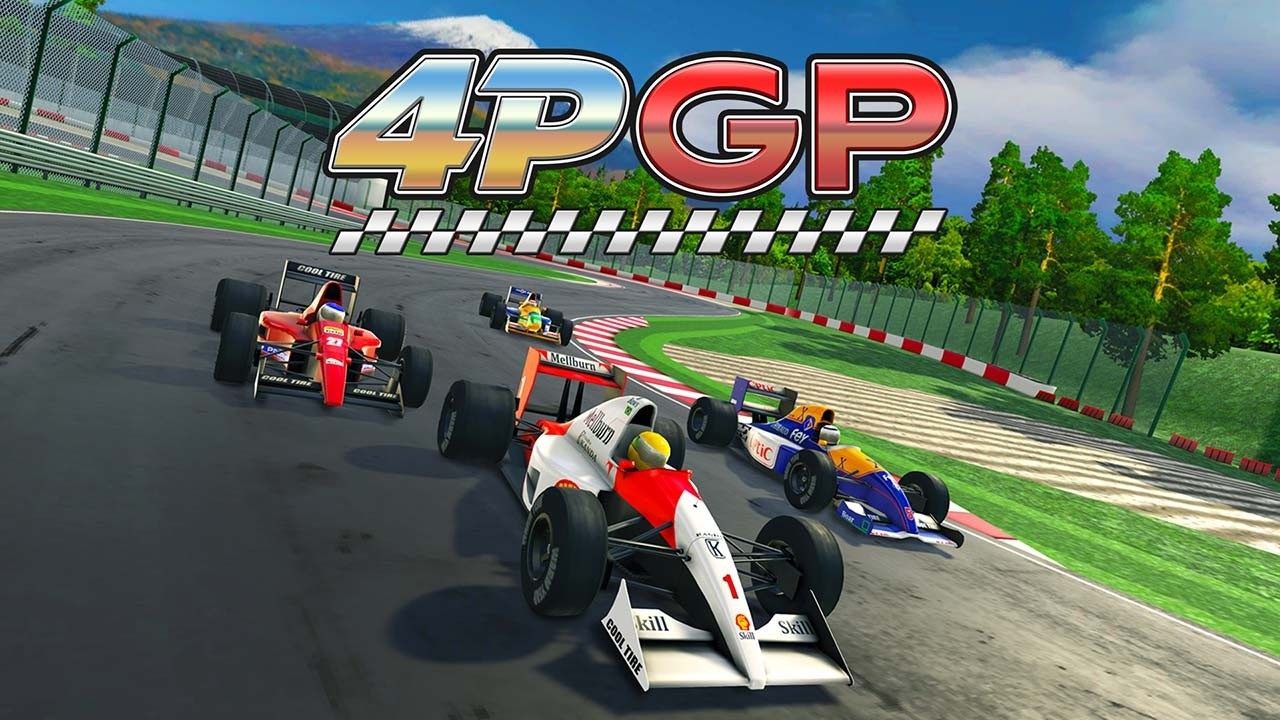
4PGP Review – Arcade Formula Racing on Switch 2, PS5 & Steam
In-depth look at 4PGP arcade formula racing, Switch 2 launch build, PS5 4K 60FPS, and split-screen multiplayer
4PGP is an arcade formula racing game from 3goo and Vision Reelle, built around structured circuit racing, scalable difficulty, and split-screen competition for up to four players. It launches on Switch and Switch 2 before expanding to PS5 and Steam with enhanced performance.
Push every lap further and see how far precision racing can take you across global circuits

4PGP


4PGP keeps arcade formula racing focused on rhythm and control instead of complexity Each lap builds familiarity across structured global circuits
4PGP, developed by Vision Reelle and published by 3goo, presents arcade formula racing in a stripped-back form that prioritises readable handling and consistent circuit flow. The structure is built around short, repeatable races where timing and positioning matter more than mechanical systems or simulation depth. Across arcade racing games 2026, it fits into a design space focused on accessibility and controlled competition.
The release structure is important for understanding how the game behaves across platforms. Nintendo Switch and Switch 2 versions arriving first in February 2026 define the base experience in terms of handling, progression, and track design. The later PS5 and Steam release in June 2026 builds on that same foundation with improved performance, higher resolution output, and smoother frame delivery without changing the underlying systems.
Switch 2, PS5, and Steam each handle 4PGP differently but keep the same racing identity Performance scaling replaces design changes across platforms
The core gameplay remains consistent across all versions, but each platform shapes how it feels in practice. On PS5 and PC, 4PGP runs at 4K and 60FPS, which gives clearer visual separation during close racing and steadier response during fast cornering. The Steam version also expands input flexibility through full control remapping, allowing different play styles depending on setup.
Nintendo Switch 2 maintains full gameplay parity, including analogue acceleration and braking, while adapting presentation to portable and docked play. The design choice here is consistency rather than simplification, keeping the same handling logic across hardware instead of splitting mechanics between versions.
Racing in 4PGP is about learning flow rather than chasing upgrades Every track becomes easier through repetition, not modification
Vehicle handling in 4PGP stays deliberately stable. Each formula-style car responds in a predictable way, which shifts focus toward braking points and corner timing. Instead of tuning systems or upgrades, progress comes from learning how each circuit behaves at different speeds and angles.
Difficulty settings range from Rookie to Expert, adjusting AI pressure rather than changing physics. Assist Mode softens early learning curves, but the underlying structure of each race stays intact, keeping long-term progression tied to player familiarity rather than mechanical changes.
Split-screen multiplayer turns 4PGP into a shared competitive space Four players can race locally without losing clarity or control
Local split-screen support for up to four players is one of the most defining parts of 4PGP. Instead of separating online and offline experiences, the game keeps all competitors in the same visual space, which maintains the tension of direct racing across every session.
Multiplayer also connects back into progression systems. Certain unlocks, including the Safety Car, are tied to competitive play, which encourages repeat group sessions rather than treating multiplayer as a side mode. On PC, Steam Remote Play Together extends that same structure online while keeping gameplay unchanged.
Cars in 4PGP feel different through handling, not numbers Each vehicle changes how you approach a circuit
The roster of formula-style cars is designed around handling differences rather than licensed accuracy. Each one shifts acceleration feel, braking stability, and corner behaviour in subtle ways that encourage adaptation instead of upgrade planning.
Progression expands the roster from nineteen to twenty vehicles, with the Safety Car acting as a multiplayer-linked unlock. This keeps progression tied to engagement with racing modes rather than long-term stat growth systems.
Tracks change direction, and that changes everything about how they play Reverse layouts make familiar circuits feel completely new again
Each of the fourteen circuits in 4PGP includes a reverse version, effectively doubling track variety without adding new environments. While the visual layout stays familiar, braking points and corner approaches shift enough to change how each race feels.
This design keeps the focus on learning rather than memorisation alone. Players are constantly adjusting to direction changes, which extends replay value without increasing system complexity.
Progress in 4PGP comes from cleaner laps, not bigger rewards Time Attack quietly becomes the most important mode over time
Progression is built around performance rather than upgrade systems. Championship Mode structures race flow, while Quick Race removes constraints for immediate play. Time Attack sits in the background as the mode that quietly defines long-term improvement.
In Time Attack, small improvements matter. Better braking, tighter corner exits, and cleaner racing lines become the real form of progression rather than unlocks or stat increases.
Sound in 4PGP changes when the race matters most Final lap music shifts the tone without breaking gameplay flow
Audio design in 4PGP is structured around race phases. Early laps use short arcade-style cues that keep pacing steady without overwhelming the driving experience. This creates a consistent rhythm during standard racing conditions.
On the final lap, full compositions by Tomoyuki Kawamura take over, shifting the audio into a more complete musical layer. The transition signals the end of the race in a way that is felt rather than shown, reinforcing pacing through sound rather than interface prompts.
Clean UI and race clarity are central to how 4PGP plays at speed Kenji Sasaki’s design focus keeps everything readable under pressure
Creative direction includes Kenji Sasaki as creative advisor, game designer, and UI designer, with a clear focus on interface clarity and in-race readability. The goal is not visual complexity but reducing friction during high-speed decision-making.
That design background, including work on classic arcade racers like Ridge Racer and Sega Rally, is reflected in how information is presented. The interface avoids clutter and keeps essential racing data easy to interpret while driving at full speed.
Final verdict 4PGP is a steady, focused take on arcade formula racing across modern platforms
4PGP delivers a consistent arcade formula racing experience built around timing, repetition, and track familiarity. It avoids heavy systems or simulation layers, instead focusing on clean handling and structured race design across all platforms.
Across Switch, Switch 2, PS5, and Steam, the experience remains mechanically identical, with differences appearing mainly in performance and input flexibility. This consistency keeps the identity stable regardless of hardware.
Taken as a whole, 4PGP works best as a straightforward competitive racer where improvement comes from cleaner laps, better awareness, and understanding how each circuit behaves over time.
The VoxOdyssey Project Mission Statement for Feature games
I highlight what makes each game unique by examining gameplay mechanics, design choices, and storytelling. By analyzing systems, level design, and play styles, and referencing official media and assets, I aim to provide accurate, informative, and trustworthy insights. While I strive for accuracy, some details may change or be updated over time. Players can use this information to understand each title’s features and mechanics and make their own judgments.
4PGP gameplay screenshots Formula racing action, split-screen races, and global circuits


4PGP trailer – arcade formula racing, split-screen battles, and global circuit action
Watch 4PGP in motion as formula cars push through tight corners, reverse tracks, and four-player split-screen races. The trailer below shows core racing flow, track variety, and how each lap builds toward the final sprint.