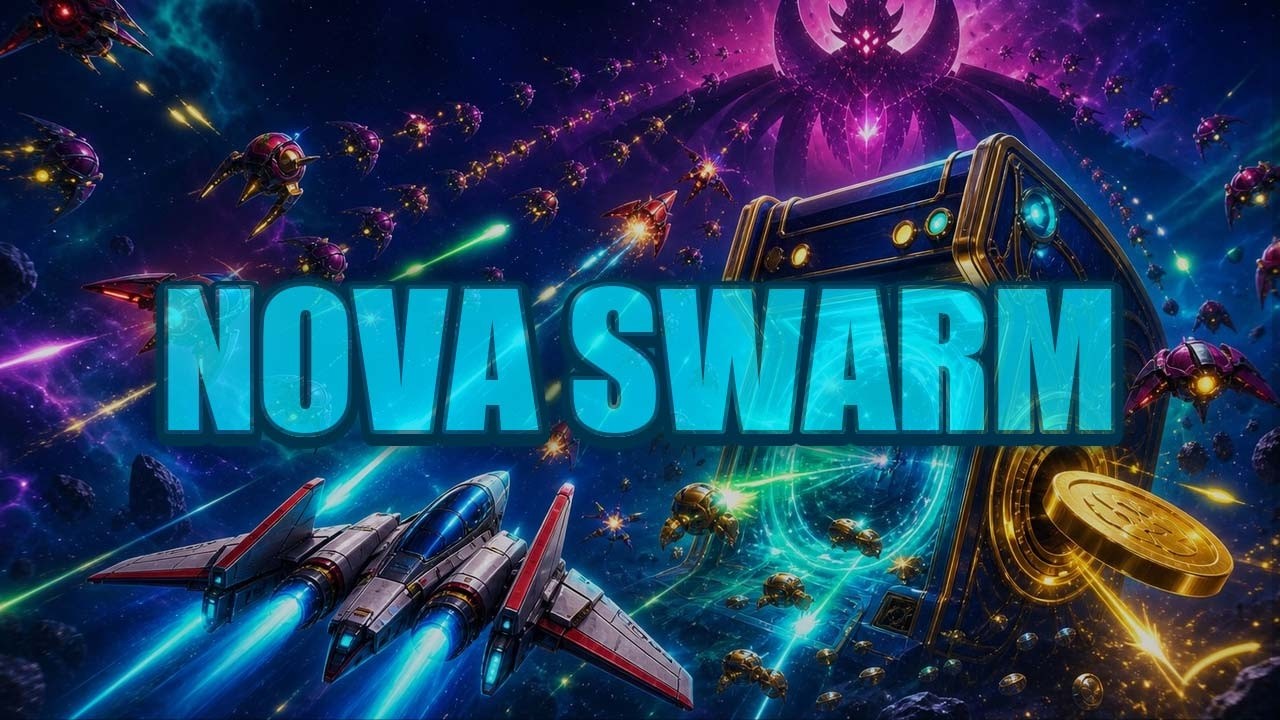
Nova Swarm Review – Editorial Breakdown of the Arcade Space Shooter
Tiny Foundry Nova Swarm PC gameplay analysis covering ships, bosses, Bullet Hell design, and score-driven Arcade systems
Nova Swarm is a compact Shoot 'Em Up from Tiny Foundry built around Bullet Hell pattern recognition, Score Attack structure, and 10-sector Arcade progression. Nova Swarm PC gameplay emphasizes readable combat design, Overrun mode scaling, Threat Codex tracking, and unlockable ships across a Sci-fi space setting.
A closer look at how Nova Swarm turns simple runs into layered arcade design

Nova Swarm


Nova Swarm keeps arcade space combat focused and readable from the first run A compact Shoot 'Em Up built around short sessions, pattern learning, and score chasing
Nova Swarm is an indie arcade space shooter developed and published by Tiny Foundry. It is designed as a compact Shoot 'Em Up where each run is short, repeatable, and focused on improvement. Nova Swarm PC gameplay does not rely on story progression or long cutscenes. Instead, it builds its structure around ten sectors of increasing difficulty where the main goal is survival and score improvement through repeated attempts.
Each run follows the same basic structure. You start in early sectors where enemy movement is slower and attack patterns are easier to read. As you move forward, Nova Swarm arcade game 2026 introduces more enemies, tighter bullet patterns, and faster reactions are needed. The difficulty comes from how many systems overlap on screen rather than from confusion or hidden mechanics. Everything is visible, and learning comes from repetition.
The most important part of Nova Swarm space shooter gameplay is readability. Even when the screen fills with bullets, enemies, and hazards, you can still see safe paths if you slow down and read what is happening. Most attacks follow clear patterns like rings, straight spreads, or aimed shots. Over time, you stop reacting blindly and start recognizing what enemies are about to do before they do it.
Movement is simple but important. Small positioning changes matter more than fast reactions. Many runs are lost not because of overwhelming difficulty, but because the player moved into a bad position too early or took a risk for extra score. This makes Nova Swarm feel fair even when it becomes intense.
Ships, systems, and progression slowly change how each run plays Small differences that build into long-term mastery
Ships are one of the main reasons Nova Swarm PC gameplay feels different from run to run. Each ship has its own movement speed, firing style, and handling feel. Some ships are slow and stable, making them easier to control in tight Bullet Hell sections. Others are fast and aggressive but require more precise movement. These differences change how you approach the same enemy waves.
As you unlock more ships, Nova Swarm space shooter starts to feel more flexible. You are not locked into one playstyle. Instead, you experiment with different setups depending on how confident you feel. A safe ship might help you survive longer runs, while a faster ship might help you push for higher scores in Score Attack runs.
Progression is not only about ships. The Threat Codex records enemies and hazards you encounter. Over time, this helps you understand how different enemy types behave. It becomes easier to predict what will happen in future runs because you have already seen similar patterns before.
The Cabinet system adds another layer by recording run history. It shows what happened during past attempts, including good runs and failed ones. This keeps progression visible even when you are not unlocking new content. It also encourages repeat play because you can clearly see improvement over time.
Bonus Cores introduce optional risk during runs. These items give rewards but often appear in dangerous positions. Taking them means moving into tighter Bullet Hell patterns or staying in risky zones longer than usual. Skipping them keeps you safe but lowers potential score. This simple choice adds tension to almost every run without overcomplicating the system.
Overrun mode and score chasing define long-term replay value Where survival turns into pure performance testing
After completing the main ten-sector path, Nova Swarm arcade game 2026 unlocks Overrun mode. This mode continues the run beyond normal completion and increases difficulty over time. Enemy density grows, patterns overlap more often, and mistakes become more costly. It is designed for players who want to push their skills further after finishing the main structure.
Overrun mode is where Nova Swarm PC gameplay shifts fully into Score Attack focus. Survival is still important, but scoring becomes the main goal. Each decision matters more because longer survival means higher potential scores. This creates a loop where small improvements in movement or pattern reading directly affect leaderboard results.
Leaderboards add another layer of motivation. Local scores let you track personal progress, while global Steam rankings let you compare performance with other players. This keeps the game relevant after you understand its systems because improvement is always possible.
Even though the structure is simple, the replay value comes from how runs change based on ship choice, risk decisions, and how well you read patterns. No two runs feel identical in outcome, even though the structure stays the same. Small differences in movement or timing can completely change how far you get.
Final verdict A focused arcade shooter built on repetition, clarity, and steady improvement
Nova Swarm is a compact Shoot 'Em Up that stays focused on arcade fundamentals. It does not try to overwhelm players with complex systems or story elements. Instead, it builds its experience around repeating runs, learning enemy behavior, and improving performance over time.
Nova Swarm PC gameplay works best in short sessions where each run teaches something new. The ten-sector structure gives clear progression, while Overrun mode extends the challenge for players who want more. Ship variety, Bonus Cores, and scoring systems all support replayability without making the game complicated.
As a Nova Swarm space shooter, it fits into the modern Indie Bullet Hell space where clarity and repetition matter more than scale. It is not about cinematic presentation or deep narrative systems. It is about learning patterns, improving reaction timing, and slowly building better runs through practice.
Across all systems, the game stays consistent. What you see is what you learn, and what you learn directly improves performance. That simple structure is what gives Nova Swarm its long-term value for players who enjoy arcade design and score chasing gameplay loops.
The VoxOdyssey Project Mission Statement for Feature games
I highlight what makes each game unique by examining gameplay mechanics, design choices, and storytelling. By analyzing systems, level design, and play styles, and referencing official media and assets, I aim to provide accurate, informative, and trustworthy insights. While I strive for accuracy, some details may change or be updated over time. Players can use this information to understand each title’s features and mechanics and make their own judgments.
Nova Swarm screenshots show fast arcade space shooter combat and bullet patterns Ship battles, Overrun mode runs, and score attack gameplay across sector stages


Nova Swarm Trailer – Arcade Space Shooter Combat, Ships, and Bullet Hell Runs
Watch Nova Swarm in action as fast arcade space combat unfolds across sectors, ships battle Bullet Hell waves, and Overrun mode pushes score chasing runs further. See the gameplay flow, then view the full trailer below.