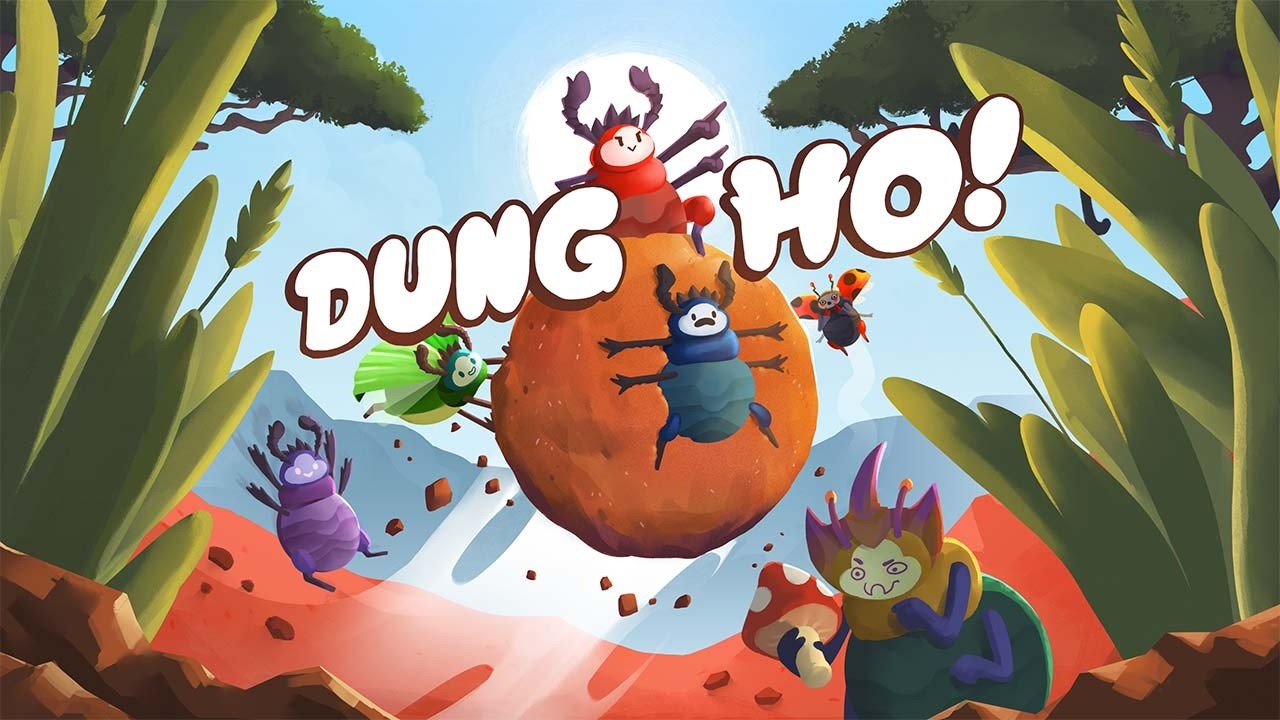
Dung Ho! Review – Cooperative Physics Adventure with Friends
Explore Lesser Weevil's physics-driven co-op adventure where up to six dung beetles roll their precious cargo across the African wilderness
Dung Ho! combines physics-based teamwork, environmental hazards, and short replayable expeditions as one to six players guide a fragile dung ball safely home through the untamed African landscape.
Think rolling a dung ball sounds easy? See what happens when wildlife, physics, and your friends get involved.

Dung Ho!


Dung Ho! Review: A Cooperative Physics Adventure Built Around Teamwork, Scale, and Controlled Chaos A technical editorial analysis of Lesser Weevil's insect-scale multiplayer design, physics systems, and cooperative gameplay structure
Dung Ho! is a cooperative physics adventure developed and published by Lesser Weevil, an independent studio based in Bend, Oregon and led by Borderlands co-creator Matthew Armstrong. Released on Steam on March 12, 2026, the game takes an unusual multiplayer concept and builds an entire experience around one shared responsibility: moving a valuable dung ball safely through a dangerous environment.
Players control dung beetles travelling through an African wilderness where the scale of the world changes the meaning of ordinary obstacles. A fallen branch, uneven terrain, a narrow path, or a sudden environmental hazard becomes a major challenge because the entire team is responsible for protecting and transporting the same physical object.
The appeal of Dung Ho! comes from its mechanical focus. Instead of relying on combat progression, competitive rankings, or individual character power systems, the game builds its identity around cooperative physics. Every player contributes to the movement of the same objective, meaning communication, timing, and coordination are not optional features; they are the foundation of the gameplay loop.
Following the release of the Pirates of the Veld update on July 28, 2026, Dung Ho! expanded its original structure with additional challenges, content, and customization options while maintaining its core philosophy of shared-object cooperation. This review examines how Lesser Weevil's design works, where its systems create memorable multiplayer moments, and how the game's technical requirements support its physics-driven foundation.
The Dung Ball Is the Entire Design Philosophy A single shared objective creates complete player dependency
The most important design decision in Dung Ho! is that every player is connected through the same physical objective. The dung ball is not simply a package that needs to be delivered. It controls the pace of the game, determines how teams move through the environment, and creates the situations where cooperation becomes necessary.
Many cooperative games divide players into separate roles. One player gathers resources, another solves objectives, and another provides support. Dung Ho! takes the opposite approach. Every player is involved in the same physical problem, and every decision influences the team's overall progress.
This creates a multiplayer structure where individual mistakes become group problems. A poorly timed movement can change the direction of the dung ball. A player moving against the team's intended route can create unwanted momentum. A lack of communication can turn a straightforward section into a recovery challenge.
The result is a cooperative system built around shared responsibility. The game understands that physics-based multiplayer experiences are often most entertaining when the mechanics create situations players cannot completely predict.
Multi-Agent Physics and Shared Momentum How multiple players influence one physical system
The core technical challenge behind Dung Ho! comes from managing multiple player inputs against one shared physics object. Rather than each player solving an isolated task, the game requires the movement of several characters to combine into one overall result.
From a design perspective, this creates a multi-agent physics problem. Each player's movement contributes to the overall direction and momentum of the dung ball, with the final outcome determined by the combined interaction between player actions, terrain, and environmental conditions.
The importance of this system becomes clear when navigating different environments. A team travelling across flat terrain has a different challenge compared with a team attempting a steep incline or recovering from a poorly controlled roll. The physical behaviour of the objective changes the way players approach every situation.
This is where Dung Ho! separates itself from many cooperative puzzle games. The solution is not always a predefined answer. Instead, players must physically experiment, adapt their approach, and learn how their combined movement affects the world around them.
Environmental Scale Turns the Wilderness Into a Puzzle Terrain, friction, and hazards define each journey
Dung Ho!'s insect perspective is one of its strongest creative decisions because it directly connects the theme to the mechanics. The game does not simply place beetles into a normal-sized environment. It changes the relationship between the player and the world by making small details meaningful obstacles.
Different surface types affect movement and route planning. Smooth dirt paths provide more predictable movement, while rougher terrain creates additional resistance and makes maintaining control of the dung ball more difficult.
Environmental objects also become gameplay systems rather than background decoration. Mushrooms can function as launch points that alter movement, while cacti create unpredictable interactions that can disrupt carefully planned routes. These moments reinforce the game's central idea: physics itself is the challenge.
Instead of traditional enemy encounters driving tension, Dung Ho! uses environmental interaction. The wilderness becomes a collection of physical problems that players must solve together.
Pirates of the Veld Expansion and Additional Content New challenges expand the physics systems without changing the core identity
The Pirates of the Veld update expanded Dung Ho!'s original foundation by introducing additional content designed around the same cooperative physics principles. Rather than replacing the original gameplay structure, the update builds on the systems that define the experience: movement, teamwork, environmental awareness, and protecting the shared objective.
The expansion introduced pirate enemies, explosive tools such as throwable bombs, and additional scenarios that create new forms of environmental pressure. These additions change how players approach encounters because teams must consider more than simply maintaining forward movement.
One of the most notable additions is the Bobbin's Nightmare Lighthouse Challenge, which shifts the focus toward vertical navigation and more demanding movement control. A lighthouse environment creates a different type of physics challenge because players must manage elevation changes, momentum, and positioning in a more restricted space.
The importance of these additions is that they expand the number of situations where the core physics systems matter. The game does not need to introduce completely separate mechanics because the existing cooperative structure already provides the foundation for new challenges.
Multiplayer Scaling and Team Physics Why one player and six players create completely different experiences
Dung Ho! supports one to six players through Steam friend-invite multiplayer. The basic objective remains unchanged across player counts, but the way teams interact with the physics systems changes significantly depending on group size.
With fewer players, each person has a greater influence over the movement of the dung ball. This creates a more controlled experience where decisions are easier to coordinate, but it also places more responsibility on each individual player.
Larger groups create additional possibilities. Six players provide more combined movement capability, but they also introduce more potential for conflicting inputs. Because everyone affects the same objective, additional players do not simply reduce difficulty. They create a different communication challenge.
This is one of the reasons cooperative physics games work so well as social experiences. The systems create situations where success depends not only on mechanical ability but also on how effectively players communicate with one another.
Damage, Repairs, and Resource Management The journey is about protecting the objective as much as reaching the destination
The dung ball's condition creates another layer of decision-making throughout each expedition. Collisions, difficult terrain, and environmental hazards can damage the objective, forcing players to balance speed with caution.
The repair system encourages teams to pay attention to their surroundings rather than simply rushing toward the finish. Additional dung piles found throughout the environment allow players to restore the ball, creating a choice between taking safer routes or accepting greater risk for faster progress.
This system also reinforces the cooperative structure because damage affects everyone. A single mistake changes the situation for the entire group, making recovery another shared responsibility.
The design avoids traditional power progression. Players do not become stronger by unlocking advantages that change the physics balance. Instead, improvement comes from understanding the systems and becoming more efficient as a team.
Cosmetic Progression and Long-Term Replay Value Customization expands identity without changing gameplay balance
Dung Ho!'s progression structure focuses on cosmetic rewards rather than gameplay advantages. Players can unlock more than 80 cosmetic options, allowing customization without creating differences in movement ability or physical interaction.
This approach preserves mechanical fairness. A new player and an experienced player operate under the same rules, with the difference coming from knowledge, coordination, and familiarity with the environment.
For a physics-based cooperative game, this is an important design decision. The entertainment comes from solving problems together, not from increasing character statistics or creating progression advantages that change the balance of the experience.
Technical Architecture and PC Requirements The hardware requirements behind a physics-focused multiplayer experience
Dung Ho! requires a 64-bit processor and operating system, Windows 10, 8 GB of RAM, DirectX 12 support, and approximately 4 GB of available storage space. Minimum graphics requirements include hardware comparable to an NVIDIA GeForce GTX 960 with 4 GB of VRAM or an AMD Radeon R9 390.
Recommended specifications include Windows 11, 12 GB of RAM, and graphics hardware comparable to an NVIDIA GeForce RTX 3060 with 8 GB of VRAM or an AMD Radeon RX 5700 XT with 8 GB of VRAM.
These requirements reflect the needs of a modern multiplayer physics title. Rendering the environment is only one part of the technical workload. The game must also maintain consistent object behaviour, player movement, environmental interaction, and multiplayer synchronization.
Physics-driven multiplayer games depend on reliable system performance because small inconsistencies can affect how players understand movement and object behaviour. Stable processing and sufficient memory resources help maintain the consistency required for cooperative gameplay.
Community Reception and Ongoing Development How player response and continued support influence the game's long-term identity
Dung Ho!'s position within the cooperative multiplayer space is shaped by how effectively it delivers on its central idea. The game does not attempt to compete through massive scale, complex progression systems, or competitive features. Instead, it focuses on creating memorable group experiences through physics interaction and shared problem solving.
Player reception has highlighted the appeal of this approach, with Steam community feedback focusing on the game's unusual concept, cooperative structure, and the unpredictable moments created when multiple players interact with the same objective. The strongest response comes from players looking for a social multiplayer experience where communication and teamwork are more important than traditional progression.
The addition of post-launch content demonstrates how the game's foundation can support expansion without losing its original identity. Updates such as Pirates of the Veld add new challenges and situations while continuing to rely on the same core systems that define Dung Ho!: movement, physics, cooperation, and environmental problem solving.
This approach gives the game a clearer long-term direction. Instead of adding unrelated mechanics, new content works by creating new ways for players to interact with the existing physics framework.
Genre Comparison: Where Dung Ho! Fits Among Cooperative Physics Games A focused multiplayer experience built around emergent teamwork
The cooperative physics genre has grown because it creates experiences that are difficult to replicate through traditional game systems. Titles such as Human Fall Flat, Overcooked, Moving Out, and Lethal Company demonstrate that multiplayer entertainment often comes from unpredictable player interactions rather than scripted events.
Dung Ho! approaches this genre from a different direction. While Human Fall Flat focuses heavily on character movement and environmental manipulation, and Overcooked builds around task management under pressure, Dung Ho! concentrates the entire experience around maintaining control of one shared physical object.
That difference gives the game a distinct identity. The challenge is not simply completing tasks alongside other players. The challenge is ensuring that every player contributes toward the same physical outcome.
The insect theme also separates Dung Ho! from more traditional cooperative games. The setting directly influences the mechanics by changing the player's relationship with space, movement, and environmental obstacles.
Editorial Assessment and Technical Evaluation A review of the systems that define Lesser Weevil's cooperative design
Dung Ho! succeeds because its systems are built around a consistent design philosophy. The shared dung ball is not just a gameplay mechanic; it is the connection point between multiplayer interaction, environmental design, progression, and replay value.
From a technical perspective, the game demonstrates how relatively simple objectives can create complex multiplayer situations when combined with physics-based interaction. Multiple player inputs, environmental variables, and object behaviour work together to create outcomes that are difficult to predict but easy to understand.
The strongest aspect of the design is that complexity comes from interaction rather than unnecessary systems. Players do not need extensive tutorials or complicated progression paths to understand the objective. The challenge comes from learning how to cooperate effectively.
This approach represents one of the strongest qualities of indie multiplayer development. A focused concept can create a complete experience when every system supports the same central idea.
Final verdict Dung Ho! is a technically focused cooperative physics adventure where teamwork becomes the entire gameplay system
Dung Ho! succeeds because it understands the value of focus. Lesser Weevil takes one unusual concept and develops every major system around it, creating a cooperative experience where physics, communication, and environmental awareness determine success.
The game's strongest features are the shared-object design, insect-scale world, and ability to create unique multiplayer situations through player interaction. The dung ball is more than an objective; it is the reason players must communicate, adapt, and work together.
The addition of expanded content, including Pirates of the Veld, demonstrates that the core concept has room to grow. New challenges, environments, and customization options add variety while preserving the mechanical foundation that makes the game distinctive.
Its focused structure also defines its limitations. Players searching for deep character progression, competitive systems, or a large-scale persistent multiplayer world may find the experience intentionally narrow. Dung Ho! is designed around short cooperative sessions where the enjoyment comes from improving teamwork rather than accumulating power.
For players interested in cooperative physics games, unusual indie multiplayer concepts, and experiences where unexpected moments emerge naturally from player interaction, Dung Ho! offers a clear and memorable identity. It demonstrates how a simple idea can become a complete adventure when the mechanics, theme, and cooperative systems all work toward the same goal.
Dung Ho! is not built around being the biggest multiplayer experience. It succeeds by being a focused one: a game where six players, one objective, and a constantly changing physical environment are enough to create an adventure shaped by teamwork and controlled chaos.
The VoxOdyssey Project Mission Statement for Feature games
I highlight what makes each game unique by examining gameplay mechanics, design choices, and storytelling. By analyzing systems, level design, and play styles, and referencing official media and assets, I aim to provide accurate, informative, and trustworthy insights. While I strive for accuracy, some details may change or be updated over time. Players can use this information to understand each title’s features and mechanics and make their own judgments.
Dung Ho! gameplay screenshots Insect-scale co-op physics, dung ball teamwork, and chaotic wilderness adventures


Dung Ho! video – Roll the dung ball, rally your team, and survive the wild journey home
Watch Dung Ho! in action as beetles team up to battle physics, hazards, and unexpected chaos across the wilderness. Keep scrolling and watch the video below to see the teamwork, movement, and madness unfold.