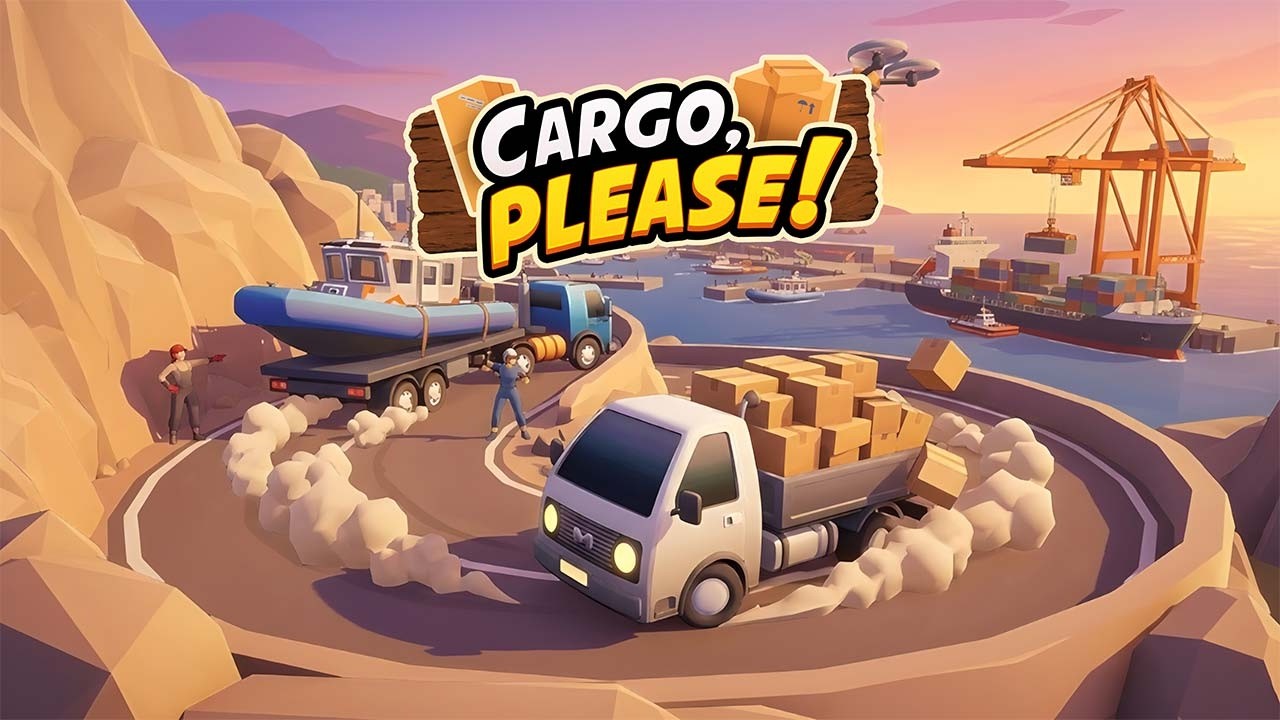
Cargo, Please! Review – Top-Down Delivery Driving and Cargo Management
Cargo, Please! puts you behind the wheel for risky deliveries, police encounters, cargo damage, truck upgrades, and open-world driving across three cities.
Cargo, Please! combines arcade delivery driving with auto-generated shipments, cargo health, vehicle upgrades, police fines, dynamic weather, three cities, and Taxi Driver Mode.
Think you can make the delivery without wrecking the cargo or attracting the cops? Keep reading to see what is waiting on the road ahead.

Cargo, Please!


Cargo, Please! Review – A Top-Down Delivery Game Built Around Risky Driving An editorial look at Cyber752 Games' delivery loop, cargo damage, police fines, truck upgrades, and open-world driving
Cargo, Please! is a top-down delivery game developed by Cyber752 Games and published by indie.io. Released on Steam in August 2026, it takes a compact approach to driving and delivery rather than attempting to reproduce the scale or realism of a traditional trucking simulator. The central idea is simple: accept a shipment, collect it, reach the destination, and make enough money from the job to keep improving the delivery operation.
The difference comes from the risks attached to every run. Cargo can be damaged, police can impose fines, and some shipments are more demanding than others. Speed matters, but driving quickly without considering the condition of the shipment can turn a profitable delivery into a costly one. That gives Cargo, Please! a clear arcade delivery driving game identity, with the emphasis placed on short-term decisions rather than lengthy simulation procedures.
The Cargo, Please! gameplay loop is built around repetition, but it is not simply a case of following the same route over and over. Shipments are auto-generated and can fall into several categories, including easy, long, timed, and special deliveries. The game uses these variations alongside three cities, a day and night cycle, dynamic weather, different truck classes, and progression systems to keep the basic act of driving connected to longer-term development.
That approach gives Cargo, Please! a more approachable structure than a heavyweight driving simulator. It is a game about making deliveries, improving a vehicle, taking on more valuable work, and deciding how much risk is worth accepting on the road. The result is a focused driving loop that does not need a complicated narrative campaign to establish a sense of progression.
Every Delivery Has a Price When Speed, Cargo Damage, and Police Attention Collide How Cargo, Please! turns routine driving into a risk-and-reward delivery system
The most important mechanical feature in Cargo, Please! is the relationship between driving behaviour and delivery value. A shipment is not simply an object that has to reach a destination. Cargo health matters, which means the way the vehicle is driven can affect the outcome of a job. Reckless driving may save time, but damage to the shipment can cost money.
The Cargo Please cargo damage mechanics and police fines create two separate sources of financial pressure. Cargo damage is linked directly to how the delivery is handled, while police attention can result in fines when the driver is spotted. Together, these mechanics stop speed from being the only consideration during a run.
This is where the game's risk structure becomes more interesting than a basic point-to-point driving system. A careful driver can protect the shipment but may spend longer on the road, while an aggressive driver can push harder at the expense of cargo condition and the possibility of attracting police attention. The player is effectively weighing the value of finishing quickly against the cost of making mistakes.
Some deliveries are also capable of attracting police attention, making the choice of shipment itself part of the risk calculation. Higher-value work is not presented as an automatic upgrade in safety or convenience. The progression system is designed to open access to better-paying and riskier shipments, so increased earning potential comes with additional responsibility behind the wheel.
Auto-Generated Shipments Keep the Three Cities Working as a Delivery Network Easy, long, timed, and special jobs provide different reasons to take the next route
Cargo, Please! uses auto-generated shipments to create variation within its delivery structure. The available jobs include easy deliveries for lower pressure runs, longer routes that demand more time on the road, timed shipments where speed becomes more important, and special deliveries that can introduce additional risk.
This system is important because the game's replayability comes primarily from repeating the delivery loop. The cities themselves remain the foundation, but the jobs give the player different reasons to travel through them. Instead of treating the open world as a static backdrop, Cargo, Please! uses it as a working space for a constantly changing list of deliveries.
The description of the game as a procedural cargo delivery game with day night cycle is therefore tied to its job structure and environmental presentation. Shipments are automatically generated, while the world changes through its day and night cycle and dynamic weather. The available information does not establish the technical details of the generation system, so its importance is best judged by the variety it provides rather than by assumptions about complex procedural algorithms.
The three-city structure also keeps the scale controlled. Cargo, Please! does not present itself as a continent-spanning trucking experience. Instead, it concentrates the delivery loop inside a smaller collection of open environments where routes, vehicle upgrades, cargo condition, and police pressure can be experienced repeatedly.
Light, Mid, and Heavy Trucks Give Progression a Practical Purpose Vehicle classes, upgrades, paint, and wheels separate functional progression from simple customization
Vehicle progression is another important part of Cargo, Please! because the game does not treat every truck as an interchangeable delivery tool. Players can choose between light, mid, and heavy trucking, with each class providing a different driving feel and delivery challenge.
The top down truck delivery simulator light mid heavy trucks structure gives the vehicle system a clear progression role. As deliveries are completed, players earn money and experience that can be used to improve their trucks and unlock further options. Upgrading the vehicle also allows access to better-paying and riskier shipments, connecting the garage directly to the delivery economy.
Cosmetic customization is present through paint and wheel options, but the more significant progression comes from functional vehicle improvements. That distinction matters because cosmetic changes can personalise a truck, while upgrades affect the type of work the player can pursue. The two systems therefore serve different purposes within the overall progression model.
New trucks, additional cities, and a larger selection of playable characters become available as progression continues. This gives successful deliveries a purpose beyond the immediate payout. Each completed job contributes to a larger process of improving the player's delivery setup and taking on work that carries greater rewards and greater risks.
Taxi Driver Mode Offers a Different Way to Use the Open World Cargo, Please! Taxi Driver Mode reduces the focus on shipment risk and puts driving itself in the foreground
Cargo Please Taxi Driver Mode provides an alternative to the main cargo delivery loop. The mode is designed as a more relaxed way to explore the cities and spend time with the driving mechanics without making every journey dependent on cargo management.
Its inclusion gives the open-world structure another function. During standard deliveries, the cities exist primarily as routes between pickups and destinations. Taxi Driver Mode allows those same environments to become spaces for a less demanding form of driving. It changes the pace without requiring a completely separate game system.
The available information does not establish a separate Taxi Driver progression campaign or a detailed set of taxi-specific mechanics, so the mode should not be presented as a second full career. Its confirmed role is to provide a change of pace and a more relaxed way to experience the game's cities and driving.
That fits the overall design of Cargo, Please!. The main delivery system creates pressure through cargo health, time, police attention, and financial consequences, while Taxi Driver Mode gives players an option to step away from some of that pressure. It adds variety without changing the game's fundamental identity as a driving-focused indie title.
Three Cities, Changing Weather, and a Full Day-Night Cycle Shape the Driving Environment The open world provides the setting for repeated deliveries rather than a traditional story campaign
Cargo, Please! takes place across three cities presented as an open world. Deliveries give the player practical reasons to move through those environments, while the full day and night cycle changes the visual conditions of the journeys. Dynamic cozy weather adds further variation to the drives.
The game does not rely on a long-form narrative to give these environments purpose. Instead, the world is connected to the delivery economy. A new shipment creates a new reason to travel, while successful work contributes toward vehicle upgrades, additional cities, new trucks, and character progression.
The phrase Cozy arcade delivery driving game open world captures the intended balance reasonably well. The presentation is lighthearted and accessible, but the actual delivery mechanics still provide consequences for careless driving. The game can therefore be relaxed in tone without making every individual run consequence-free.
Weather and the day-night cycle are primarily environmental features in the supplied description. There is not enough information to claim that every weather condition produces major changes to vehicle physics or cargo handling. Their confirmed purpose is to change how the cities look and how individual drives feel as the player continues working through the delivery system.
Cargo, Please! PC Requirements Keep the Installation Small While Requiring a Dedicated GPU The published Windows specifications and storage recommendations provide a clear starting point for PC players
Players researching Cargo Please PC requirements will find a Windows 10 minimum specification with an Intel Core i3 or AMD 2400GE processor, 8 GB of RAM, and an NVIDIA GTX 760 or Radeon R9 380 graphics card. The game requires 3 GB of available storage, with a dedicated GPU recommended and an SSD highly recommended for faster loading.
The recommended configuration raises the processor requirement to an Intel Core i5 or AMD Ryzen 5 5600-class processor while retaining 8 GB of RAM. Graphics move to an NVIDIA GTX 970 or Radeon equivalent, with a dedicated GPU required. Storage remains at 3 GB, while an SSD is again highly recommended for loading performance.
The published requirements are useful as hardware targets, but they do not provide independent frame-rate measurements. A graphics card listed as a minimum requirement does not automatically establish a guaranteed frame rate, graphics preset, or frame-time result. Those figures would require testing the released game on specific hardware.
The small 3 GB storage requirement is one of the more accessible aspects of the PC release. The SSD recommendation is specifically connected to faster loading rather than a need for a large amount of storage. For players comparing smaller indie driving games on Steam, the installation footprint is therefore unlikely to be a major barrier.
Steam Deck and Controller Support Make the Delivery Loop Suited to Short Driving Sessions Cargo, Please! Steam Deck support is confirmed, while detailed independent performance testing remains separate from the published requirements
Cargo Please Steam Deck support is listed alongside controller support, giving the game an additional option for players who prefer portable or gamepad-based driving. The delivery structure is naturally divided into individual jobs, which fits a format where players can complete a run and return to the progression system rather than committing to a lengthy uninterrupted campaign.
Cargo Please system requirements Steam Deck compatibility should nevertheless be treated as two separate pieces of information. The developer confirms Steam Deck support, but the supplied material does not include measured frame rates, battery consumption, graphics settings, loading times, or detailed controller mapping results on Valve's handheld.
It would therefore be inaccurate to attach a specific FPS figure or battery-life estimate to the Steam Deck version without hardware testing. What can be established is that controller support and Steam Deck support are part of the published feature set, while the Windows system requirements provide the official PC hardware reference.
For players looking through indie driving games on Steam, the combination of controller support, Steam Deck support, short delivery jobs, and a compact installation makes Cargo, Please! relevant to the portable-friendly side of the genre. The actual quality of that experience should still be judged against measured performance rather than assumptions based on the game's relatively modest storage requirement.
Cyber752 Games and indie.io Take a Compact Approach to the Delivery Genre Cargo, Please! establishes its identity through driving risk, vehicle progression, and repeatable city deliveries
Cargo, Please! is developed by Cyber752 Games and published by indie.io. The project's identity is defined by its focused combination of top-down driving, delivery management, vehicle upgrades, police pressure, and an open-world structure spread across three cities.
The Cyber752 Games indie.io pairing places the title within the contemporary independent PC game market, but the game itself does not depend on a complicated production pitch. Its central mechanics can be understood quickly: take a shipment, drive it to its destination, protect the cargo, avoid costly trouble, earn money, and improve the vehicle.
That simplicity is useful because the systems have a direct relationship with one another. Cargo health affects the financial result of driving, police attention can create fines, better trucks unlock more demanding work, and experience contributes to broader progression. There is little need to separate the game's mechanics into unrelated activities because the delivery itself connects them.
The game's position within the wider driving genre is therefore fairly specific. It is not presented as a realistic long-haul trucking simulator, nor does it rely on a large narrative campaign. It is a top-down delivery game designed around repeatable jobs, risk management, vehicle improvement, and the freedom to drive around its city environments.
Cargo, Please! Works Best When the Delivery Itself Becomes the Challenge A focused arcade structure where speed, careful driving, vehicle progression, and risk management stay connected
The strongest part of Cargo, Please! is the clarity of its central loop. There is no need for the game to invent an elaborate reason to keep the player moving because the delivery system already supplies a straightforward progression path. Accept a job, collect the cargo, drive through the city, protect the shipment, avoid police attention, complete the delivery, and invest the earnings into the next stage of the operation.
Cargo Please top down delivery game gameplay is consequently defined by the small decisions made during each run. The player has to consider how aggressively to drive, how much risk a shipment is worth, and whether the potential reward justifies the possibility of damage or fines. The auto-generated jobs add variety, while different truck classes and upgrades make progression more than a purely numerical exercise.
The game also benefits from not pretending to be something it is not. Its stated focus is not realism or a long story. It is about sinking into the loop of picking up jobs, driving fast, avoiding trouble, and building a better delivery setup over time. That makes the arcade approach central to the experience rather than a limitation that needs to be disguised.
Players looking for a risk based cargo delivery game with vehicle upgrades will find the core systems closely aligned with that description. The vehicle progression has a practical purpose, cargo damage gives driving behaviour consequences, and police fines ensure that reckless play can have a direct financial cost.
Final Verdict Cargo, Please! turns ordinary deliveries into compact driving challenges where every shortcut can carry a cost
Cargo, Please! has a straightforward premise but gives that premise enough mechanical consequences to support a complete progression loop. Its top-down presentation keeps attention on driving and navigation, while cargo health, police fines, shipment types, vehicle classes, and upgrades give individual deliveries more weight than simply reaching a destination.
The game's three-city open world provides the setting, but the delivery system is what gives it purpose. Auto-generated shipments create variation across easy, long, timed, and special jobs, while the day and night cycle and dynamic weather add environmental changes to repeated drives. Taxi Driver Mode provides a more relaxed alternative for players who want to spend time driving without the same emphasis on cargo risk.
The progression system is similarly focused. Money and experience earned from completed deliveries contribute toward new trucks, vehicle upgrades, new cities, and additional playable characters. Light, mid, and heavy trucks provide different driving experiences, while paint and wheel customization adds a visual layer to the growing delivery operation.
On PC, the published hardware requirements are clear, with 8 GB of RAM and 3 GB of storage required alongside a dedicated GPU. Steam Deck and controller support are also officially listed. Independent testing would still be required to establish precise performance figures, so claims about frame rates, battery life, or optimal Steam Deck settings should not be treated as established facts without measurements.
Cargo, Please! is best suited to players who prefer arcade-oriented driving and progression over detailed trucking simulation. It has enough systems to make each delivery matter without turning the experience into a complicated logistics exercise. The cargo damage mechanics, police fines, auto-generated shipments, truck upgrades, three cities, and Taxi Driver Mode all support the same central idea rather than pulling the game in unrelated directions.
As a result, Cargo, Please! finds its strongest identity as a risk-driven top-down delivery game. It asks a simple question on every run: how fast can the shipment reach its destination without becoming damaged, attracting police attention, or costing more than it earns? The answer changes with the job, the truck, and the player's willingness to take risks, which gives the delivery loop its reason to keep going.
The VoxOdyssey Project Mission Statement for Feature games
I highlight what makes each game unique by examining gameplay mechanics, design choices, and storytelling. By analyzing systems, level design, and play styles, and referencing official media and assets, I aim to provide accurate, informative, and trustworthy insights. While I strive for accuracy, some details may change or be updated over time. Players can use this information to understand each title’s features and mechanics and make their own judgments.
Cargo, Please! gameplay screenshots Top-down deliveries, truck upgrades, police chases, and open-world city driving


Cargo, Please! video – Fast deliveries, risky driving, and police trouble across the city
See Cargo, Please! in action as drivers race through city streets, protect valuable cargo, upgrade their trucks, and dodge police fines. Keep scrolling to watch the delivery runs, driving challenges, and open-world action unfold below.