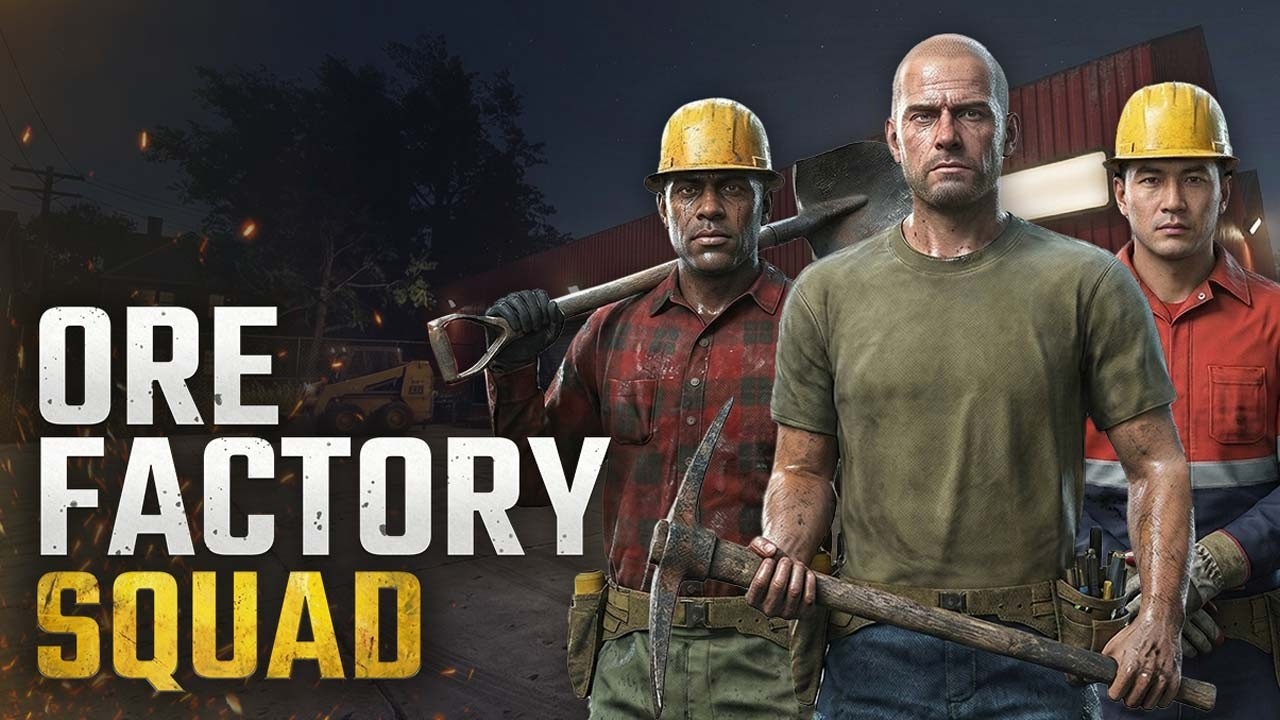
Ore Factory Squad Review – Mining and Factory Building Game
Explore threeW’s mining and factory management game featuring procedural excavation, production lines, property expansion, automation, and four-player co-op
Ore Factory Squad takes players from a basic warehouse to a growing industrial operation through procedural mining, resource processing, factory automation, contracts, logistics, property expansion, and cooperative gameplay for up to four players.
Ready to dig deeper, build smarter, and turn a small operation into a serious industrial empire? Continue below.

Ore Factory Squad


Ore Factory Squad connects mining, factory building, and co-op around one simple idea Dig for resources, turn them into products, and keep finding ways to make the operation bigger
Ore Factory Squad is a mining and factory management simulation developed by threeW and published by PlayWay S.A. The basic idea is easy to understand. Players start with a small operation, dig for resources, process those materials, complete contracts, and use the money earned to expand. The game brings together procedural mining, factory automation, logistics, property ownership, business upgrades, and online co-op for up to four players.
The important part is how these systems connect. Mining is not just a side activity before the factory becomes the main event. The resources found underground are what keep the production lines running, while the factory gives those resources a reason to exist. Products can then be sold through contracts, with the money feeding back into better equipment, new properties, and further expansion.
That gives Ore Factory Squad a fairly clear gameplay loop. You dig, process, move, sell, and reinvest. It sounds simple, but the operation becomes more involved as more machines, production stages, properties, and logistics systems become available. The appeal comes from watching a small setup slowly turn into something that requires actual planning.
The game is not built around a traditional narrative campaign. Instead, progression comes from improving the business. The main story is effectively the growth of the operation, from basic tools and a warehouse to a larger mining and manufacturing business. For players who enjoy simulation games where the systems provide the motivation, that structure makes sense.
Procedural mining gives the underground work a reason to matter The resources are not simply waiting in a fixed line for the player to collect them
The Ore Factory Squad procedural mining mechanics are one of the game's clearest points of difference. Resources are procedurally distributed underground, and the terrain can be excavated rather than working as a collection of fixed mining points. That gives the player a more direct role in deciding where to dig and how to approach a property.
This also means that the underground layout has a practical effect on the value of a site. A property is not just a different background for the same activity. What can be found below the surface helps determine what the player can eventually get out of it.
The early game begins with basic tools, which keeps the scale of excavation relatively limited. As players progress, pickaxes, jackhammers, and explosives allow them to deal with tougher terrain and clear larger areas. The change is more noticeable than simply watching a number go up. Better equipment changes how the player can approach the mine.
There is also a straightforward economic decision behind each upgrade. A better tool costs money, so the player needs to decide whether faster or larger-scale extraction will earn enough to justify the investment. That keeps mining tied to the wider business rather than treating equipment upgrades as automatic rewards.
This is where the mining side of Ore Factory Squad starts to make more sense within the larger game. The point is not only to dig a bigger hole. The resources have to go somewhere, and the value of the excavation depends on what the player can do with the materials afterward.
The shovel-to-jackhammer progression changes the scale of the work Better equipment lets the player move from basic excavation toward a more serious mining operation
The Ore Factory Squad tool progression from shovel to jackhammer gives the early game a clear direction. Players start with simple equipment before gaining access to tools that can handle more difficult terrain. Pickaxes improve access to tougher layers, jackhammers speed up larger excavation work, and explosives provide another way to clear substantial sections.
The progression is easy to follow because each tool changes the amount of work the player can take on. Early mining is smaller and more limited. Later mining becomes more about planning a larger area and deciding how much equipment and money should be committed to the job.
That progression also links directly to the factory. More resources are only useful if the production side can handle them. A player who invests heavily in mining but does not expand processing capacity may simply create a new problem by producing more materials than the operation can use.
This gives the progression a useful back-and-forth. The mine can create pressure on the factory, while the factory can create a reason to improve the mine. The player is constantly deciding which part of the operation needs attention next.
Dynamite also adds a different option to the process. Rather than making every part of excavation a slow, identical task, explosives give players a way to approach larger sections of terrain differently. The important point is that the tools are part of the wider progression rather than isolated mining gadgets.
New properties give expansion a practical purpose Different locations provide more than a change of scenery for the same mining loop
Property ownership gives the game a clear sense of expansion. The launch structure includes four different dig sites, with environments including suburban areas, forests, construction sites, and a snowy mountain quarry setting. Each property provides another place to develop the mining operation.
The environments also help separate the locations from one another. A construction site, for example, includes underground hazards such as gas pipes, which gives excavation there a different set of conditions from a more open mining location.
The Ore Factory Squad property resource layout is therefore part of the wider progression system. The player is not simply buying another map. A new property represents another opportunity to find resources and build the business, but it also creates more work for the operation.
That last part is important. Expansion only helps if the player has enough equipment, production capacity, and money to make use of it. A larger site may offer more potential, but potential is not the same thing as profit.
This keeps property ownership connected to the rest of the game. The mine, the factory, and the business all need to grow at a reasonable pace. Otherwise, the player may simply end up with more land and more problems.
The factory gives the mining operation a reason to keep going Resources become more useful once they can be processed into products and sold
The factory-building side of Ore Factory Squad is where the basic mining loop becomes a broader management game. Resources extracted from the ground can be processed through production chains involving machines, recipes, licenses, and upgrades.
The game includes more than 60 resources and products across three main production lines according to the developer's pre-launch information. That gives the factory side room to grow beyond the first few basic processing steps.
The important thing is that the factory does not exist separately from the mine. The materials coming out of the ground are the starting point for the production process. The better the player becomes at managing the chain from extraction to finished product, the more useful the mining operation becomes.
Machines and production lines also introduce a different kind of planning. Mining is about where to dig and what equipment to use. Factory management is about how to arrange the stages that come afterward.
That means the game gradually moves away from simply asking what the player can collect and toward asking what the player can do with it. A resource sitting in storage is not necessarily useful. It becomes useful when it can move through the production system and eventually become part of a sale or contract.
Conveyors, forklifts, trucks, and warehouse robots make logistics part of the game The factory has to move materials around before the final product can reach the customer
The question of how to transport materials in Ore Factory Squad has several answers. Conveyor belts connect production machines, pallets provide physical loads, forklifts help with warehouse transport, and trucks handle wider delivery work. Warehouse robots add another layer of automation to the operation.
This gives the logistics system a more physical feel than a game where every resource simply moves between menus. Materials have to be handled, stored, transported, and prepared for delivery.
That also makes factory layout more important. Machines need to be connected, warehouse areas need to remain usable, and vehicles need enough room to move around the operation. A factory can have all the right equipment and still become awkward if everything is placed too tightly.
The best factory layout in Ore Factory Squad will depend on what the player is producing and how the operation is arranged. There is no single confirmed layout that works for every situation. The general idea is simpler: keep production and transport from getting in each other's way.
This is also where the game can become more demanding from a management point of view. A small operation is easy enough to understand. A larger one requires the player to remember where materials are going, what is being produced, and what still needs to be moved.
Contracts give the factory something specific to work toward Production becomes more useful when there is an order waiting at the other end
Contracts provide a clear commercial purpose for the production system. Companies request particular products and quantities, giving the player specific targets rather than leaving the factory to produce items without a clear destination.
Completing a contract involves more than having the correct recipe. The player needs the required resources, enough production capacity, suitable stock levels, and a way to prepare the order for delivery. That connects several parts of the game at once.
For players looking for Ore Factory Squad contract negotiation tips, the main point is to look at contracts as part of the wider operation. A request may look profitable, but the player still needs to consider whether the factory can produce the required goods without creating problems elsewhere.
Business upgrades add more progression to this side of the game. Market reach, contract capacity, negotiation, workers, and other business systems allow the operation to grow beyond simply selling whatever happens to be available.
The result is a simple economic cycle. The mine provides materials, the factory processes them, contracts create demand, and the money earned can be used to improve the business. It is not a complicated idea, but the value comes from having all of those steps connected.
The four-player co-op structure fits the way the game divides its work A larger operation gives players plenty of reasons to focus on different parts of the business
Ore Factory Squad multiplayer supports online co-op for up to four players. The structure makes sense for a game with several different jobs happening at once. One player can focus on mining, another can manage production, another can deal with transport, and another can work on contracts or deliveries.
The game does not need to force those roles because the operation naturally creates them. If the mine is producing more resources than the factory can process, production becomes the problem. If finished products are sitting around, transport or contracts may need attention instead.
That makes the Ore Factory Squad 4 player co-op structure more useful than simply adding extra players to the same activity. The operation has enough separate systems for players to divide the work when the business becomes larger.
Solo play is also supported, so the same general progression can be handled alone. Multiplayer requires an internet connection according to the Steam listing, while the game also supports online cooperative play for groups of up to four.
The recommended PC specification is also considerably higher than the minimum. The recommended hardware lists an Intel Core i5-12400 or AMD Ryzen 5 5600X, 16 GB of RAM, and an NVIDIA RTX 2070 or equivalent graphics card. The minimum specification lists an Intel i7-6700 or AMD Ryzen 3 1200X, 8 GB of RAM, and a GTX 1060 6GB or equivalent.
Progression works because every upgrade creates another decision Better tools, new properties, and factory improvements all compete for the same business budget
Progression in Ore Factory Squad is built around improving the whole operation rather than following one simple upgrade path. Players can invest in mining tools, factory machinery, new recipes, licenses, properties, workers, and business upgrades.
That creates a familiar but useful management question: what should be improved next? A better tool may increase resource extraction, while a new machine may help solve a production bottleneck. A new property may offer more opportunities, but it can also require more investment before it becomes useful.
The procedural resource distribution helps with replayability because properties do not all present the same underground layout. The mining side therefore has some variation, while the broader factory progression gives players a reason to continue developing the operation.
The launch information also includes worker hiring, off-site contracts, and additional upgrades and systems. These features extend the progression beyond the basic loop of digging and processing.
The overall structure is less about finding one perfect strategy and more about deciding where the operation is currently weakest. If extraction is slow, improve the mine. If production is falling behind, improve the factory. If goods are ready but not moving, look at logistics.
The different properties add variety without changing what the game is about Each location provides a different setting for the same wider mining and business loop
The launch version includes four dig sites with different environments, including suburban areas, forests, construction sites, and a snowy mountain quarry setting. This gives the game some visual variety as the operation expands.
The locations also help make property expansion feel like part of the progression. Moving to a new site is not just a cosmetic change. The player is gaining another place to excavate and another potential source of resources.
The construction site is a useful example of how the environments can affect excavation. Underground gas pipes create an additional hazard there, giving the location a different practical identity from a more open mining site.
The game remains primarily systems-driven, however. The environments support the mining and management mechanics rather than replacing them with a separate narrative structure.
That approach suits the game. The main reason to keep playing is the operation itself and the process of improving it. The player creates the story by deciding what to mine, what to produce, where to expand, and how to keep the business moving.
Customization adds some personality to an otherwise practical industrial setup Players can change their characters and make the factory feel more like their own
Character customization allows players to change elements such as outfits, faces, gloves, and helmets. Factories can also be changed with walls, floors, signs, and decorations.
These options do not change the production economy, but they provide some control over the look of the operation. That is particularly useful in co-op, where several players can share the same industrial space while still giving their characters and factory areas a distinct identity.
The customization systems are secondary to the main gameplay, and that is probably the right balance for this type of simulation. The factory still needs to work, regardless of how it looks.
The same applies to the wider presentation. Ore Factory Squad is mainly interested in the systems behind the operation. Its identity comes from the connection between digging, production, transport, and sales rather than from a conventional story campaign.
For players who enjoy building up a business over time, that systems-first approach provides a clear reason to continue. The next upgrade is usually tied to a practical problem somewhere in the operation.
Final verdict Mining, factory building, and co-op work best when treated as one connected system
Ore Factory Squad works best when its different systems are viewed together. Mining provides the resources, the factory processes them, logistics moves them around, and contracts give the player a reason to keep the whole operation running. None of these systems exists in isolation, and that connection is what gives the game its identity.
The progression is easy to understand. Players start with basic tools and a small operation, then gradually gain access to better equipment, new production options, additional properties, and more ways to automate the work. The game does not need to reinvent each part of the simulation because its main strength comes from how those parts fit together.
Mining is the clearest point of difference. The procedural resource distribution and diggable terrain give the player a direct role in finding materials, while the factory provides the next step. What begins underground eventually becomes part of a production chain, a contract, or another business decision. That gives the mining side a practical purpose beyond simply collecting resources.
The four-player co-op also fits the design well. Different players can focus on mining, production, transport, or contracts as the operation grows. The game does not need to force those roles, but the structure naturally creates opportunities for players to divide the work.
The trade-off is that the game can become increasingly involved as the factory expands. More machines and production stages mean more planning, while logistics becomes harder to ignore. Players looking for a simple mining game may find the management side more important than expected.
For players searching for mining simulation games PC, co-op factory building games, or games like Ore Factory Squad with diggable terrain, the appeal is fairly clear. This is a game about connecting the mine to the factory and then figuring out how to make the whole operation work.
Overall, Ore Factory Squad has a clear idea of what it wants to be. It combines procedural mining, factory automation, logistics, contracts, property expansion, and four-player co-op into one progression loop. The result is not a pure mining game or a traditional factory builder. It sits somewhere between the two, and that combination is the main reason to pay attention to it.
The VoxOdyssey Project Mission Statement for Feature games
I highlight what makes each game unique by examining gameplay mechanics, design choices, and storytelling. By analyzing systems, level design, and play styles, and referencing official media and assets, I aim to provide accurate, informative, and trustworthy insights. While I strive for accuracy, some details may change or be updated over time. Players can use this information to understand each title’s features and mechanics and make their own judgments.
Ore Factory Squad gameplay screenshots Procedural mining, factory automation, logistics, and four-player co-op


Ore Factory Squad video – One small mine, one growing factory, and plenty of work to keep moving
See Ore Factory Squad gameplay in motion as players dig for resources, build production lines, move materials, and expand their operation. Keep reading below and watch the video to see the mine and factory working together.