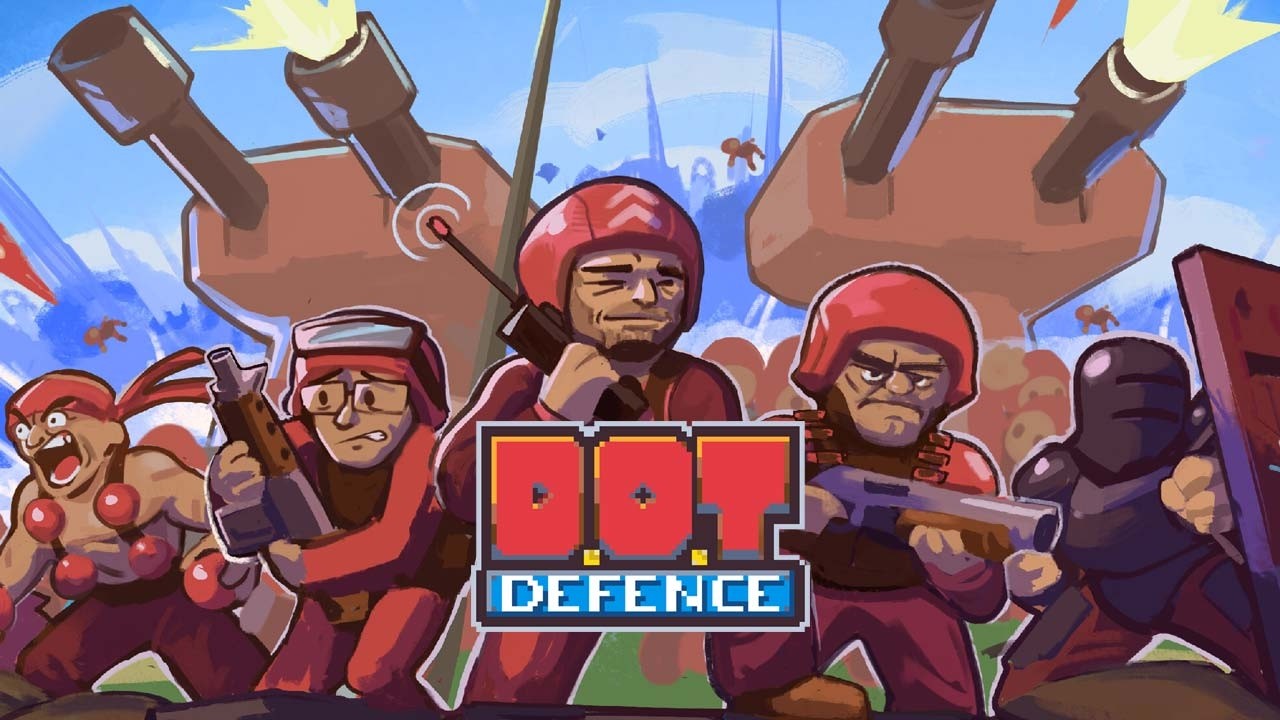
D.O.T. Defence – Action RTS and Tower Defense Strategy Game
Command armies, build defenses, and conquer territory across the Chroma Wars in a fast-paced strategy hybrid
D.O.T. Defence is a minimalist Action RTS and Tower Defense game by Rattleaxe Games, co-published with Gamersky Games. Expand across contested regions, defend your HQ, and lead automated armies through a 25-mission campaign, wave defense challenges, and global domination battles.
Choose your faction, fortify your borders, and see how the Chroma Wars unfold below

D.O.T. Defence


D.O.T. Defence turns large-scale strategy into fast, approachable battles A hybrid Action RTS and Tower Defense game built around planning, expansion, and adaptation
D.O.T. Defence is an indie strategy game developed by Rattleaxe Games and co-published alongside Gamersky Games. It combines Action RTS gameplay, Tower Defense systems, and a light 4X-style structure into matches that typically last between five and ten minutes. Rather than focusing on intensive micromanagement, the game places greater importance on territory control, defensive planning, and making effective decisions before battles reach their most demanding moments.
The first thing that stands out during play is how much information is communicated through the map itself. Regions generate resources, defensive positions create natural choke points, and expansion opportunities are clearly visible from the beginning of a match. The result is a strategy game that remains readable even when multiple systems are operating simultaneously.
Unlike many traditional RTS games where success often depends on managing dozens of units at once, D.O.T. Defence shifts attention toward broader battlefield decisions. Units can be directed toward objectives and territories, but much of the combat is handled automatically once engagements begin. This design choice keeps matches moving at a brisk pace while allowing players to focus on positioning and long-term planning.
That balance between accessibility and strategy is what gives the game its identity. New players can understand the basics quickly, while experienced strategy fans will still find meaningful decisions in how they expand, defend, and allocate resources throughout a match.
The Chroma Wars campaign constantly changes the rules of engagement Three factions, twenty-five missions, and a steady stream of new challenges
The centerpiece of D.O.T. Defence is the Chroma Wars campaign. Spread across twenty-five missions and three distinct faction perspectives, the campaign uses its structure to introduce variety rather than relying solely on new units or escalating numbers. Players experience the conflict through the disciplined U.C.F., the corporate influence of Chromatech's Zombonomics division, and the destructive ambitions of the Invaders.
The campaign revolves around control of Chroma, a powerful resource that drives both the narrative and the strategic conflict. As missions progress, the struggle over this resource pushes each faction into increasingly unusual situations. This allows the game to introduce new mission goals while maintaining a consistent strategic foundation.
Traditional wave defense scenarios appear throughout the campaign, but they are only part of the overall experience. Some missions focus on direct commander-versus-commander confrontations, while others introduce timed objectives, stealth-oriented challenges, or deployment puzzles that require careful planning before combat begins.
This variety helps prevent the campaign from becoming predictable. Just as a defensive strategy begins to feel comfortable, a new mission often asks players to rethink their priorities. Expansion may become more important than defense, speed may matter more than efficiency, or survival may depend on understanding the terrain rather than building additional structures.
The result is a campaign that remains focused on its core mechanics while still creating meaningful variation across its eight-plus hours of content.
Territory control and defensive planning drive every battle Success comes from smart positioning rather than endless micromanagement
At its core, D.O.T. Defence is a game about controlling space. Every captured region contributes resources, creates expansion opportunities, and influences how future battles unfold. Losing territory is not simply a temporary setback; it can affect economic growth and reduce the options available later in a match.
Turrets form the backbone of the defensive experience. Different defensive structures encourage different approaches, and successful layouts often depend on understanding where enemy pressure is most likely to emerge. Building too aggressively in one area can leave another vulnerable, creating a constant balancing act between expansion and protection.
One of the more effective design decisions is the ability to sell and reposition defenses as conditions change. Instead of locking players into early mistakes, the game allows defensive networks to evolve alongside the battlefield. This flexibility becomes increasingly valuable during longer engagements where enemy behavior begins to shift.
Combat itself relies heavily on automation. Units follow broader commands rather than requiring constant supervision, allowing players to focus on strategic objectives. In practice, this creates a different rhythm than traditional RTS games. Decisions are often made before the battle reaches its peak intensity, and the quality of those decisions usually determines the outcome.
The trade-off is that automation occasionally limits direct control during chaotic encounters. There are moments when players may wish for more influence over specific unit behavior. However, those situations are relatively rare and largely consistent with the game's broader goal of reducing mechanical complexity.
Wave Defense, Global Domination, and multiplayer extend replay value Several modes built around the same strategic foundation
Beyond the campaign, D.O.T. Defence offers multiple ways to engage with its systems. Wave Defense mode focuses on survival against increasingly difficult enemy forces, encouraging players to create efficient defensive networks capable of handling sustained pressure.
As enemy numbers grow, resource allocation becomes increasingly important. Expanding too quickly can leave defenses exposed, while investing too heavily in fortifications can slow long-term development. The best outcomes usually come from maintaining a balance between growth and protection.
The Global Domination mode introduces a broader strategic context. Territory gains contribute to a persistent map where expansion becomes part of a larger objective. This gives individual matches greater significance because victories contribute toward long-term progress rather than existing in isolation.
Local multiplayer further expands the game's appeal. Players can compete in one-versus-one battles, team-based matches, or free-for-all scenarios supported by AI opponents. Because the underlying systems remain consistent across modes, knowledge gained in the campaign naturally carries over into competitive play.
This consistency is one of the game's strengths. Different modes may alter objectives, but they all reinforce the same core principles of territory management, defensive positioning, and strategic adaptation.
Final verdict A focused strategy hybrid that values planning over complexity
D.O.T. Defence succeeds by understanding exactly what it wants to be. Rather than competing directly with large-scale RTS games built around intensive micromanagement, it focuses on delivering shorter matches where strategic decisions remain meaningful without becoming overwhelming.
The combination of Action RTS mechanics, Tower Defense planning, and 4X-lite progression creates a structure that feels distinct within the indie strategy space. Territory control, automated combat, and adaptable defensive systems work together to create a steady flow of decision-making throughout every mode.
The Chroma Wars campaign provides variety through mission design and faction perspectives, while Wave Defense, Global Domination, and multiplayer modes give players reasons to continue experimenting with different strategies long after the campaign is complete.
For players looking for a strategy game that emphasizes planning, expansion, and battlefield control without demanding constant micromanagement, D.O.T. Defence delivers a clear and well-structured interpretation of the Action RTS and Tower Defense genres. Its strongest qualities come not from scale or spectacle, but from how effectively its systems support one another across every mode of play.
The VoxOdyssey Project Mission Statement for Feature games
I highlight what makes each game unique by examining gameplay mechanics, design choices, and storytelling. By analyzing systems, level design, and play styles, and referencing official media and assets, I aim to provide accurate, informative, and trustworthy insights. While I strive for accuracy, some details may change or be updated over time. Players can use this information to understand each title’s features and mechanics and make their own judgments.
D.O.T. Defence gameplay screenshots showing RTS battles and tower defense layouts Territory control, automated combat, and Chroma Wars campaign strategy in action


D.O.T. Defence Gameplay Trailer – RTS Battles, Tower Defense, and Chroma Wars Strategy in Motion
Watch D.O.T. Defence in action as fast RTS decision-making meets tower defense planning and automated combat. See how territory control, base building, and large-scale battles unfold across the Chroma Wars. The trailer below shows core systems and gameplay flow in motion.