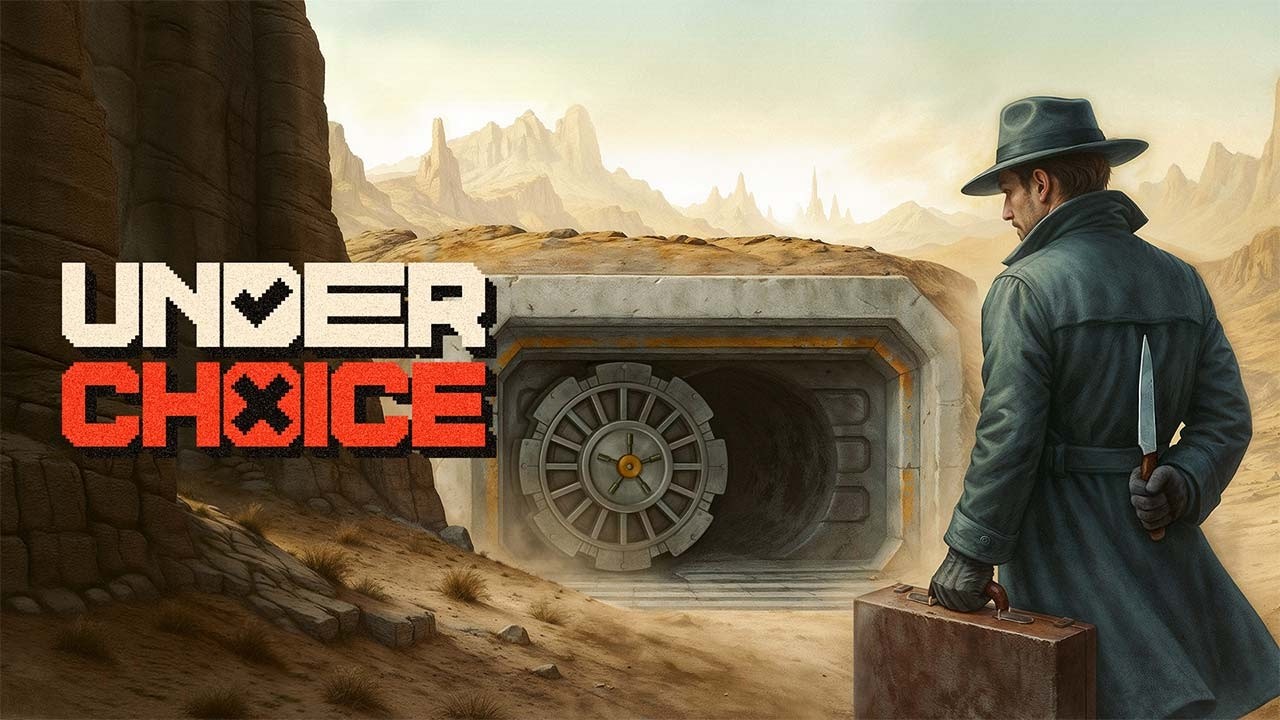
Underchoice Review: Roguelike Deckbuilding Bunker Survival Game
Post-apocalyptic bunker management with roguelike deckbuilding, card-based choices, resource strategy, and multiple endings on PC
Underchoice is a 2026 PC survival simulation from TG Indie and Targem Games built around roguelike deckbuilding systems. Players act as a bunker overseer making card-based decisions that shape survival, resource allocation, and branching outcomes in a post-apocalyptic setting.
Every card drawn decides who is allowed inside the bunker

Underchoice


Underchoice builds its bunker survival system around structured card decisions and deck evolution Every survivor, resource, and crisis is resolved through roguelike deckbuilding mechanics
Underchoice is a 2026 PC survival simulation developed by TG Indie and published by Targem Games. Positioned as a roguelike deckbuilding survival game on Steam, it places the player inside a sealed bunker where every outcome is shaped by structured decisions rather than exploration. The experience centers on Underchoice gameplay systems built around risk, resource control, and consequence-driven survival in a post-apocalyptic setting.
The core design of the Underchoice game focuses on managing uncertainty through card-based systems. Each event, from incoming survivors to system failures, is translated into a deck interaction. This creates a survival loop where choices matter at every step, and where the player must balance immediate safety against long-term bunker stability. The result is a controlled simulation of leadership under pressure rather than a traditional survival sandbox.
As a survival simulation, Underchoice removes exploration entirely and replaces it with structured decision cycles. The bunker becomes the entire playable space, and resource management is handled through evolving deck composition. Food, medicine, personnel, and infrastructure are all abstracted into systems that interact through probability-driven card resolution, reinforcing its identity as a story rich survival strategy experience with multiple endings.
Survival depends on how the deck evolves under pressure inside the bunker Every choice reshapes future outcomes through card-based risk and reward systems
The Underchoice gameplay loop is built around roguelike deckbuilding mechanics combined with bunker management simulation. Each new day or event introduces cards representing survivors, crises, or system conditions. Players must decide how to respond using limited resources and an evolving deck, where each addition or removal changes future probabilities and survival potential.
This structure turns the game into a strategic survival system where accepting or rejecting survivors directly affects deck strength. New characters may provide useful abilities or introduce new risks, while resource decisions determine whether the bunker can sustain long-term stability. The tension between expansion and control defines the core of the Underchoice PC game experience.
Unlike traditional survival titles, Underchoice does not rely on crafting loops or open-world exploration. Instead, it uses structured card battles and decision nodes to resolve every interaction. This makes it closer to a controlled simulation of governance under collapse, where probability and planning outweigh reflex-based gameplay.
Resource scarcity and trust management define survival inside the bunker Every incoming survivor introduces risk, opportunity, or instability
Progression in Underchoice is driven by resource management and internal stability systems. Food, medicine, tools, and infrastructure are tracked through mechanics that directly interact with the deck. This creates a survival loop where efficiency and planning determine whether the bunker survives or collapses over time.
Each run of Underchoice on Steam unfolds differently due to its roguelike structure. Deck composition changes constantly based on player decisions, leading to unique combinations of events and outcomes. This ensures replayability while reinforcing the importance of adapting strategy under pressure.
Trust plays a central role in decision-making. Every survivor encounter forces a judgment call based on limited information, reinforcing the game’s focus on uncertainty. These systems align Underchoice with modern survival strategy design, where moral decisions and resource logic are tightly interwoven.
Narrative emerges through systems rather than scripted storytelling The bunker becomes a space defined by consequence-driven survival events
The narrative structure of Underchoice is entirely systemic. Instead of traditional cutscenes or linear progression, story elements are delivered through card events and survival outcomes. Each encounter reflects the condition of the outside world, interpreted through limited and often incomplete information.
This creates a post-apocalyptic narrative structure where meaning emerges from accumulated decisions. The bunker serves as both interface and storytelling device, with each system failure or survivor interaction contributing to an evolving survival history shaped by player behavior.
As a story rich survival simulation, Underchoice relies on consequence rather than exposition. The absence of direct world exploration reinforces the feeling of isolation, where every decision carries weight and every outcome feeds into long-term survival patterns.
Final verdict A structured roguelike deckbuilding survival simulation focused on controlled decision-making and bunker governance
Underchoice establishes a focused survival framework built around roguelike deckbuilding mechanics and bunker management systems. Its design prioritizes structured decision-making over exploration, creating a PC survival simulation where every action influences long-term stability.
As a 2026 Steam release from TG Indie and Targem Games, the Underchoice game positions itself within modern survival strategy design that emphasizes consequence-driven systems and replayable structure. The combination of card-based mechanics and resource management creates a tightly controlled gameplay loop built around uncertainty and adaptation.
Overall, Underchoice functions as a systems-driven survival experience where roguelike deckbuilding defines every layer of progression. Its strength lies in how consistently it ties survival, narrative, and resource pressure into a single decision-based framework, making each playthrough structurally distinct through multiple endings and evolving deck states.
The VoxOdyssey Project Mission Statement for Feature games
I highlight what makes each game unique by examining gameplay mechanics, design choices, and storytelling. By analyzing systems, level design, and play styles, and referencing official media and assets, I aim to provide accurate, informative, and trustworthy insights. While I strive for accuracy, some details may change or be updated over time. Players can use this information to understand each title’s features and mechanics and make their own judgments.
Underchoice screenshots display card battles and underground bunker operations Deck management, event resolution, and resource-driven survival choices


Underchoice Trailer – Roguelike Deckbuilding Survival and Underground Bunker Management Simulation
Think you can handle the pressure of running a sealed shelter with nothing but a deck of cards? Don't let the bunker doors hit you on the way out! Watch the tactical card battles and chaotic crisis events unfold, then view more in the video below to see if you have what it takes to survive.