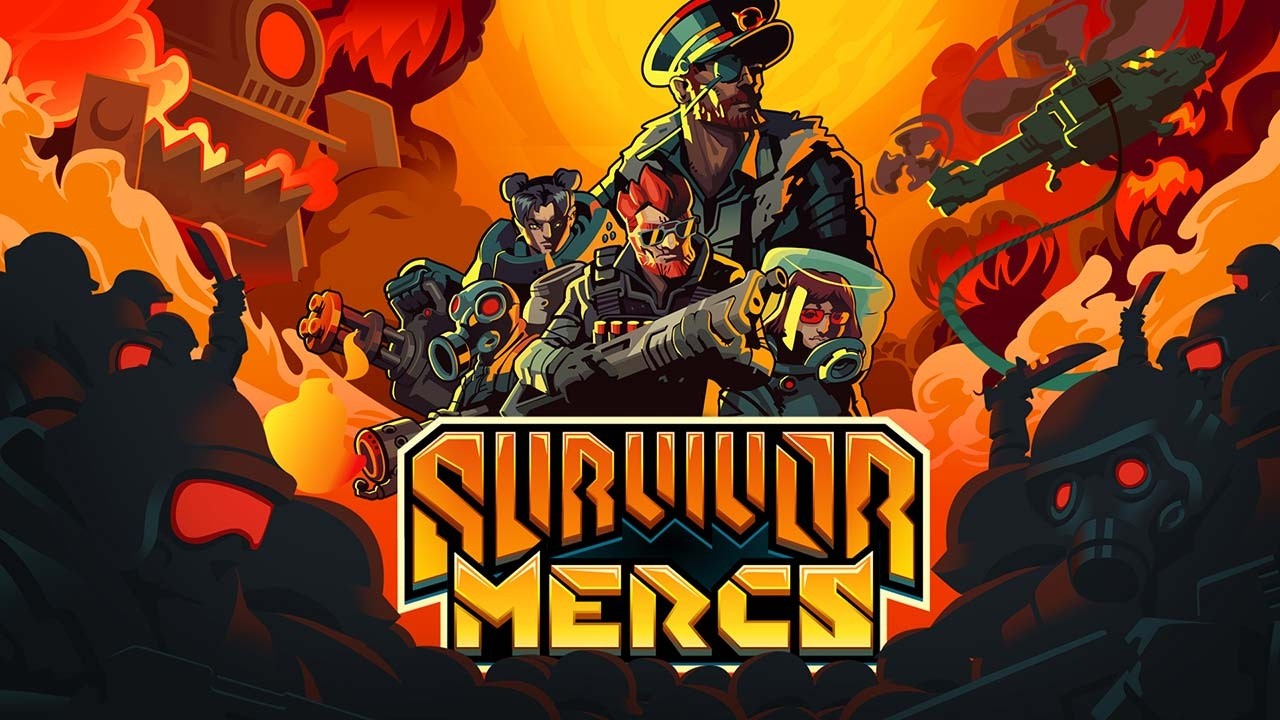
Survivor Mercs – Roguelite Squad Shooter with Twin Stick Combat
Lead a mercenary squad through procedural battles, horde survival, and trait-driven combat systems
Survivor Mercs is a sci-fi action roguelite featuring squad-based gameplay, twin stick shooting, and procedural missions against M.E.G.A. Corp forces.
Build your squad, test your traits, and push deeper into the next operation

Survivor Mercs


Take Command and Push Back Against the Robot Onslaught A squad-based roguelite shooter where twin stick combat and survival systems drive every operation
Survivor Mercs, developed by Wolpertinger Games and published by Wandering Wizard, is a sci-fi action roguelite built around squad control, procedural missions, and high-pressure survival gameplay. Set against the robotic armies of M.E.G.A. Corp, the game blends top-down shooter mechanics with RPG-style progression systems. Each run places the player in control of a Commander clone tasked with leading a mercenary unit through escalating combat scenarios. The structure emphasizes adaptability, combining twin stick shooting with layered systems that shape both moment-to-moment action and long-term progression.
Hold the Line as the Battlefield Gets More Chaotic Time-based difficulty and enemy scaling turn every mission into a high-risk survival loop
Combat in Survivor Mercs is driven by continuous escalation. Enemy waves increase in density and complexity as each operation progresses, reinforcing its identity as a difficult horde survival experience. The twin stick shooter framework ensures that positioning and aim remain central, while bullet hell elements introduce layered projectile patterns that demand awareness and precision. This structure transforms each mission into a dynamic arena where survival depends on movement, timing, and the ability to adapt under pressure. The longer a squad remains active, the more intense the battlefield becomes, creating a consistent push toward risk-heavy decision making.
No Two Commanders Feel the Same on the Field Over 15,000 trait combinations redefine strategy and create distinct combat identities
At the center of Survivor Mercs gameplay is the Commander clone system. With over 15,000 possible trait combinations, each run introduces a new configuration that directly influences combat style and squad effectiveness. Traits can modify behavior, enhance abilities, or create unexpected synergies when combined with gear and mercenary skills. This system encourages experimentation, as no single build remains dominant across all scenarios. The interaction between traits and squad composition forms a layered progression loop where players refine strategies over time, aligning the game with deeper action roguelike systems focused on build diversity.
Put Together a Squad That Actually Works as a Team Recruit mercenaries, assign roles, and coordinate actions in a responsive combat system
Squad management distinguishes Survivor Mercs from traditional top-down shooters. Players recruit mercenaries equipped with unique weapons, behaviors, and specialization trees, creating a team that operates alongside the Commander rather than as passive support. These units respond dynamically to combat conditions, allowing for coordinated attacks and tactical positioning. The system introduces a level of control that extends beyond individual performance, requiring players to consider how each unit contributes to the overall effectiveness of the squad. This layered interaction places the game within a category of squad-based arena shooters that reward planning as much as execution.
Know When to Push Forward and When to Get Out A PvE extraction loop where risk, loot, and progression are tightly connected
Each operation in Survivor Mercs follows a structured PvE extraction loop. Players enter procedurally generated maps, complete objectives, gather loot, and attempt to reach extraction points under increasing threat. The risk is immediate and tangible—failure results in the loss of collected resources, reinforcing careful decision making. Success allows players to invest in their bunker headquarters, unlocking new mercenaries, gear, and permanent upgrades. This progression system creates a balance between short-term survival and long-term development, ensuring that each run contributes to broader advancement without removing the stakes of individual missions.
Expect the Unexpected with Every New Operation Dynamic maps, shifting objectives, and M.E.G.A. Corp bosses shape each run
Procedural generation ensures that no two operations unfold in the same way. Map layouts, objectives, and enemy compositions shift between runs, requiring constant adaptation. This variability is reinforced by boss encounters tied to M.E.G.A. Corp, which serve as major progression hurdles. These battles introduce unique mechanics and demand optimized builds, pushing players to refine their strategies. The combination of unpredictable environments and structured boss encounters strengthens the game’s replayability, aligning it with roguelite systems that prioritize variation and challenge.
Clean Visuals That Keep the Action Easy to Read Top-down visuals and clean effects support readability across intense combat scenarios
Survivor Mercs uses a 2.5D top-down presentation with pixel graphics that emphasize clarity during high-intensity gameplay. Visual effects are designed to remain readable even as enemy density increases, ensuring that players can track movement and projectiles without confusion. This approach supports performance across a range of hardware, including portable systems such as Steam Deck. The visual design does not prioritize realism but instead focuses on functional clarity, aligning with the demands of bullet hell combat and fast-paced survival gameplay.
Go Solo or Bring the Squad Along for the Fight Singleplayer and 4-player local co-op offer different ways to approach squad combat
The game supports both singleplayer and local co-op modes, with up to four players participating in the same session. One player assumes the Commander role, managing strategy and direct combat, while others control individual mercenaries within the squad. This asymmetrical structure introduces coordination challenges and expands the tactical possibilities of each run. It also provides a practical answer to how Survivor Mercs local co-op functions, as each participant contributes to the overall squad performance in distinct ways.
Final Verdict A system-driven roguelite shooter where squad tactics and survival mechanics define every run
Survivor Mercs establishes itself as a distinct entry within the action roguelike and horde survival space by combining twin stick shooting with squad-based systems and procedural design. Its use of over 15,000 Commander trait combinations, coupled with a structured PvE extraction loop, creates a gameplay framework built on variation and risk. The inclusion of cooperative play, scalable difficulty, and persistent progression through bunker upgrades reinforces long-term engagement. Rather than relying on spectacle, the game focuses on system interaction, offering a consistent experience shaped by strategy, adaptation, and replay-driven depth.
The VoxOdyssey Project Mission Statement for Feature games
I highlight what makes each game unique by examining gameplay mechanics, design choices, and storytelling. By analyzing systems, level design, and play styles, and referencing official media and assets, I aim to provide accurate, informative, and trustworthy insights. While I strive for accuracy, some details may change or be updated over time. Players can use this information to understand each title’s features and mechanics and make their own judgments.
Survivor Mercs Screenshots Show Squad Combat and Roguelite Missions Top-down battles, mercenaries, and robotic enemies shaping each run


Survivor Mercs Trailer – Squad Combat, Roguelite Runs, and Twin Stick Warfare
Watch Survivor Mercs in action as mercenary squads battle robotic forces in fast-paced roguelite missions. See trait builds, chaotic firefights, and extraction runs unfold, then dive into the full trailer below for more gameplay detail.