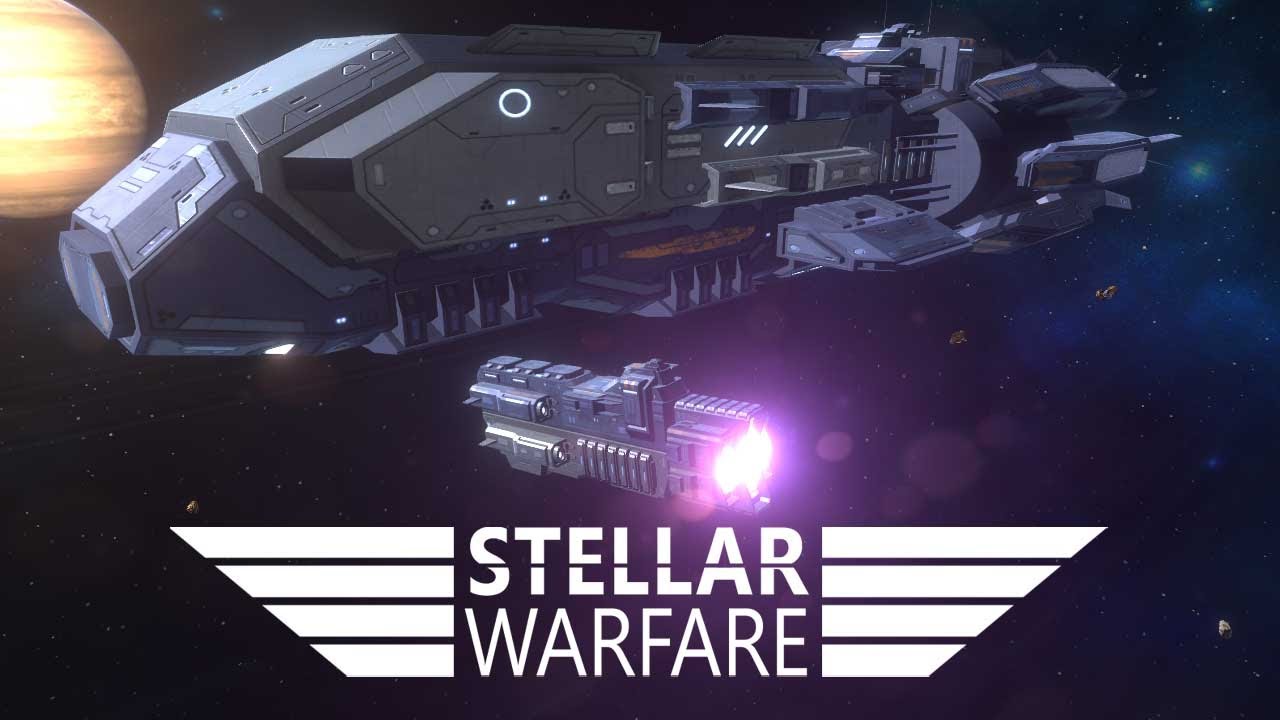
Stellar Warfare – Space RTS Fleet Combat and Base Building Review
Command custom fleets in full 3D space battles with base building, economy scaling, and tactical RTS depth
Stellar Warfare is a space RTS focused on fleet customization, base construction, and large-scale 3D combat. Build ships, manage resources, and adapt strategies across campaign, skirmish, and survival modes where every decision shapes battlefield performance.
Build your fleet, shape your economy, and see how far strategy can stretch in deep space warfare

Stellar Warfare


Stellar Warfare evolves classic RTS design into fully 3D fleet warfare with deep customization systems A systems-driven space RTS built around base economy scaling, modular ships, and persistent progression
Stellar Warfare is a solo-developed real-time strategy game created by Tense Games, structured around space-based fleet combat, base building, and long-term progression systems. It takes a familiar RTS foundation and expands it into fully three-dimensional space warfare where ship design, economic scaling, and tactical positioning all interact in a single continuous gameplay loop rather than separate mechanics.
The game positions itself within the modern space RTS category by combining influences from Homeworld, Command & Conquer: Red Alert 2, and Supreme Commander. These influences appear in different layers of its structure. Base building and resource flow follow traditional RTS logic, while fleet combat takes place in open 3D space with vertical movement, positional awareness, and multi-angle engagement. The result is a hybrid strategy framework where preparation and execution are equally important.
Unlike fixed-unit RTS design, Stellar Warfare is built around modular ship construction. Ships are assembled using hull frames, weapon systems, and upgrade modules that define combat roles and tactical behaviour. This allows fleets to be shaped around different strategic approaches such as fast strike forces, defensive formations, or long-range artillery groups. Over 200 unlockable components expand these options over time, creating a large number of possible fleet combinations without locking players into predefined unit rosters.
The economic system is tightly linked to combat readiness. Players must manage resource extraction through refineries, maintain power infrastructure, and expand production capacity while simultaneously building and deploying fleets. This creates a macro-management layer where economic efficiency directly influences battlefield strength. Poor scaling in early stages can significantly limit later fleet composition and combat effectiveness.
Fleet combat unfolds across full 3D space with vertical positioning and spatial tactics Engagements are shaped by altitude, movement vectors, and directional control rather than flat-plane positioning
Combat takes place in fully three-dimensional environments, which significantly alters traditional RTS engagement patterns. Units are not restricted to a flat battlefield and can engage from above, below, or any lateral direction. This introduces spatial depth as a core tactical factor, where positioning in vertical space can be as important as unit composition or raw firepower.
Projectile behaviour and engagement range are influenced by spatial alignment, making movement and formation control essential during large-scale battles. Fleet positioning becomes a dynamic system rather than a static formation, especially when multiple combat groups converge in the same sector. This adds a layer of micro-management where spatial awareness directly affects survival and damage efficiency.
Base construction supports this combat structure by providing production buildings, defensive installations, and resource infrastructure. Refineries generate income, power structures support production chains, and defensive turrets protect critical areas. Expansion decisions must balance economic growth with military readiness, as overinvestment in one area can weaken the other during mid-game transitions.
Progression systems unlock ships, weapons, and modules through persistent gameplay loops Blueprint acquisition expands strategic options and reshapes fleet composition over time
Progression in Stellar Warfare is built around a blueprint-based unlock system tied to gameplay performance. Destroying enemy units and completing missions rewards new ship frames, weapons, and modules that permanently expand available construction options. This creates a long-term structure where each match contributes to broader strategic development rather than isolated outcomes.
The campaign introduces core mechanics through structured missions, while skirmish modes provide repeatable AI encounters for experimentation. Additional modes such as base assault scenarios and wave survival challenges extend replayability by testing both economic scaling and fleet endurance under increasing pressure. Each mode uses the same underlying systems, ensuring that progression remains consistent across different types of play.
Wave survival in particular focuses on long-term efficiency, where escalating enemy pressure forces players to refine both fleet composition and resource management. Poorly optimized builds become increasingly ineffective as difficulty scales, reinforcing the importance of balanced economy and adaptable fleet design rather than static strategies.
Multiplayer expands strategic depth through unpredictable human-driven fleet design Competitive modes test adaptability across skirmish and battle royale-style engagements
Multiplayer systems extend the same core mechanics into competitive environments where human decision-making replaces AI behaviour. Standard skirmish matches emphasize build order efficiency, macro-management control, and reactive fleet adaptation, while cooperative wave modes focus on shared resource scaling and defensive coordination.
Battle royale-style engagements introduce elimination-based pacing that shifts strategic priorities toward survival, resource conservation, and fleet preservation. Because all players operate within the same modular ship system, no single dominant fleet composition remains permanently optimal, encouraging continuous adaptation.
The shared system architecture across single-player and multiplayer modes ensures that improvements in fleet design, economy management, and tactical execution remain relevant regardless of mode selection. This creates a unified strategy framework where mastery transfers across all gameplay formats.
Final verdict A modular space RTS built on fleet customization, 3D combat, and long-term progression systems
Stellar Warfare stands as a systems-driven real-time strategy game that focuses on interconnected mechanics rather than narrative structure or cinematic presentation. Its design is centred on the relationship between economy scaling, modular fleet construction, and spatial combat, all of which directly influence one another during gameplay.
The strongest aspect of the experience is its fleet customization system, which allows players to construct highly varied ship compositions using unlocked components. This creates a strategic environment where experimentation is consistently rewarded and where long-term progression directly impacts tactical possibilities.
Its limitations are primarily tied to balancing complexity with accessibility. The combination of 3D spatial combat, macro-economic management, and modular unit design creates a steep learning curve, particularly for players unfamiliar with systems-heavy RTS design. However, this depth also defines its identity within the space RTS genre.
Overall, Stellar Warfare delivers a cohesive RTS framework built around adaptation, fleet engineering, and layered decision-making. Its emphasis on modular systems and spatial strategy positions it as a distinctive entry within modern space RTS design, where long-term mastery is driven by understanding how economy, fleet composition, and 3D battlefield control interact over time.
The VoxOdyssey Project Mission Statement for Feature games
I highlight what makes each game unique by examining gameplay mechanics, design choices, and storytelling. By analyzing systems, level design, and play styles, and referencing official media and assets, I aim to provide accurate, informative, and trustworthy insights. While I strive for accuracy, some details may change or be updated over time. Players can use this information to understand each title’s features and mechanics and make their own judgments.
Stellar Warfare gameplay screenshots 3D space battles, fleet combat, and base building strategy systems


Stellar Warfare trailer – fleet battles, base building, and 3D space RTS combat
Watch Stellar Warfare in action as custom fleets clash in 3D space, bases expand, and battles unfold across large-scale RTS encounters. The trailer below shows ship customization, combat flow, and strategic decision-making across different game modes.