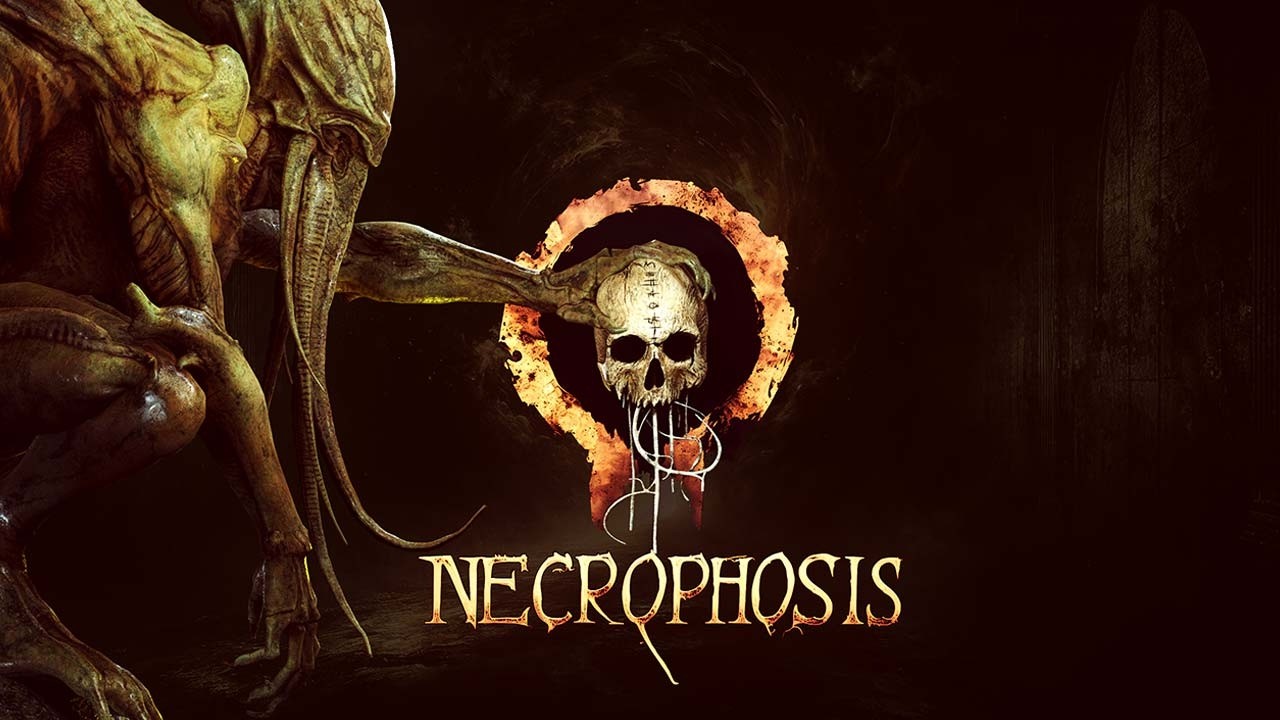
Necrophosis – Surreal Lovecraftian Horror Adventure Game
Psychological horror exploration game with puzzles, gothic environments, and multiple endings in a decaying post-apocalyptic world
Necrophosis is a first-person surreal horror adventure focused on exploration, environmental puzzles, and narrative symbolism within a decaying universe shaped by cosmic entropy and psychological instability.
Descend into the decay and uncover what remains beneath reality

Necrophosis


A surreal horror simulation where decay reshapes perception and exploration defines survival Lovecraftian horror, puzzle navigation, and psychological instability structure every descent
Necrophosis is a first-person surreal horror and exploration title developed by Dragonis Ares and Adonis Brosteanu, and published by Dragonis Games. It is structured as a psychological horror experience set within a post-apocalyptic universe defined by decay, abstraction, and fragmented reality. Rather than relying on traditional survival mechanics or combat systems, the game builds its structure around environmental storytelling, symbolic progression, and puzzle-driven navigation. The player is placed within a world where meaning is unstable, and where each environment functions as both a spatial challenge and a narrative construct shaped by cosmic entropy and psychological collapse. The design positions Necrophosis within a broader lineage of Lovecraftian-inspired horror games that emphasize atmosphere, interpretation, and existential uncertainty over explicit narrative delivery.
Exploration and puzzle systems define progression through a decaying surreal landscape Environmental logic replaces traditional objectives in a fragmented horror structure
The gameplay structure is built around exploration-based progression combined with environmental puzzle-solving systems. Movement through interconnected spaces is guided by visual cues, spatial logic, and symbolic environmental design rather than explicit mission structures. Each area presents puzzle scenarios that are embedded directly into the architecture of the world, requiring interpretation of visual patterns, object relationships, and environmental states. This approach reinforces a walking simulator framework layered with interactive puzzle mechanics, where progression is dependent on observation and cognitive interpretation rather than mechanical skill execution. The absence of conventional combat systems shifts focus toward navigation, awareness, and gradual environmental comprehension.
Psychological horror and Lovecraftian themes structure narrative interpretation and worldbuilding Cosmic decay and fragmented perception define the game’s thematic foundation
Necrophosis constructs its narrative framework through psychological horror principles and Lovecraftian thematic structures. The world is presented as a decaying post-apocalyptic reality where existence itself is unstable and continuously eroding. Narrative information is delivered through fragmented environmental cues, poetic text elements, and symbolic visual storytelling rather than direct exposition. Entities encountered within the world function as manifestations of decay and conceptual distortion rather than traditional characters. This reinforces a design philosophy where story progression is inseparable from environmental traversal, and where understanding the world requires interpreting layered symbolic structures rather than following linear narrative pathways.
Third-person and first-person perspectives reinforce disorientation and environmental scale Visual framing shifts support psychological immersion and spatial uncertainty
The game integrates both first-person and third-person perspectives to reinforce disorientation and reinforce environmental scale variation. First-person sequences emphasize immersion and direct spatial engagement, while third-person moments provide external framing that highlights the surreal architecture and distorted geometry of the world. This dual perspective structure contributes to psychological instability by disrupting consistent spatial perception. The visual design incorporates gothic architectural influences, surreal environmental formations, and post-apocalyptic decay patterns that collectively reinforce a sense of cognitive uncertainty. Lighting and spatial composition are used to amplify tension rather than provide navigational clarity, supporting the overall horror framework.
Multiple endings and choice-based systems influence narrative fragmentation Decision pathways alter interpretive outcomes rather than linear progression
The narrative structure includes branching decision systems that lead to multiple endings, reinforcing the game’s emphasis on interpretive storytelling. Player choices influence how environmental sequences unfold and how symbolic narrative fragments are assembled across progression paths. Rather than producing drastically divergent gameplay loops, these branching structures adjust contextual framing and thematic resolution. This creates a system where narrative meaning is distributed across multiple interpretive outcomes, each reflecting different aspects of the game’s underlying psychological and existential themes. The structure prioritizes ambiguity and interpretation over fixed narrative closure.
Subconsciousness DLC expands surreal environments and fragmented narrative layers New symbolic locations deepen psychological horror and environmental abstraction
The Subconsciousness DLC expands Necrophosis through a new narrative chapter that introduces additional surreal environments and fragmented narrative spaces. This content deepens the existing world structure by exploring previously unseen layers shaped by memory, instinct, and emotional abstraction rather than rational logic. The environments introduced in this expansion continue the established design language of decay and symbolic distortion, presenting spaces that function as interpretive constructs rather than literal locations. Puzzle interactions remain integrated into environmental traversal, maintaining continuity with the base game’s exploration-driven structure while increasing narrative density through new symbolic encounters.
Final verdict A psychological and Lovecraftian horror experience focused on exploration, puzzles, and symbolic narrative design
Necrophosis establishes itself as a surreal horror experience built around exploration, puzzle-solving, and psychological narrative fragmentation within a Lovecraftian-inspired framework. Developed by Dragonis Ares and Adonis Brosteanu and published by Dragonis Games, it prioritizes atmospheric design and symbolic interpretation over conventional gameplay systems. Its use of environmental storytelling, dual-perspective presentation, and multiple ending structures positions it within a niche category of experimental horror titles focused on ambiguity and thematic depth. The Subconsciousness expansion extends this framework through additional surreal environments and layered narrative structures, reinforcing the game’s emphasis on psychological instability and interpretive exploration across its entire design architecture.
The VoxOdyssey Project Mission Statement for Feature games
I highlight what makes each game unique by examining gameplay mechanics, design choices, and storytelling. By analyzing systems, level design, and play styles, and referencing official media and assets, I aim to provide accurate, informative, and trustworthy insights. While I strive for accuracy, some details may change or be updated over time. Players can use this information to understand each title’s features and mechanics and make their own judgments.
Necrophosis screenshots show surreal horror exploration and environmental puzzle design First-person traversal through decaying worlds shaped by psychological and Lovecraftian themes


Necrophosis Trailer – Surreal Lovecraftian Horror Exploration and Puzzle Gameplay
Watch Necrophosis in motion as players descend into a decaying surreal world filled with environmental puzzles, psychological horror, and fragmented narrative spaces. The video below showcases exploration, entity encounters, and symbolic world design.