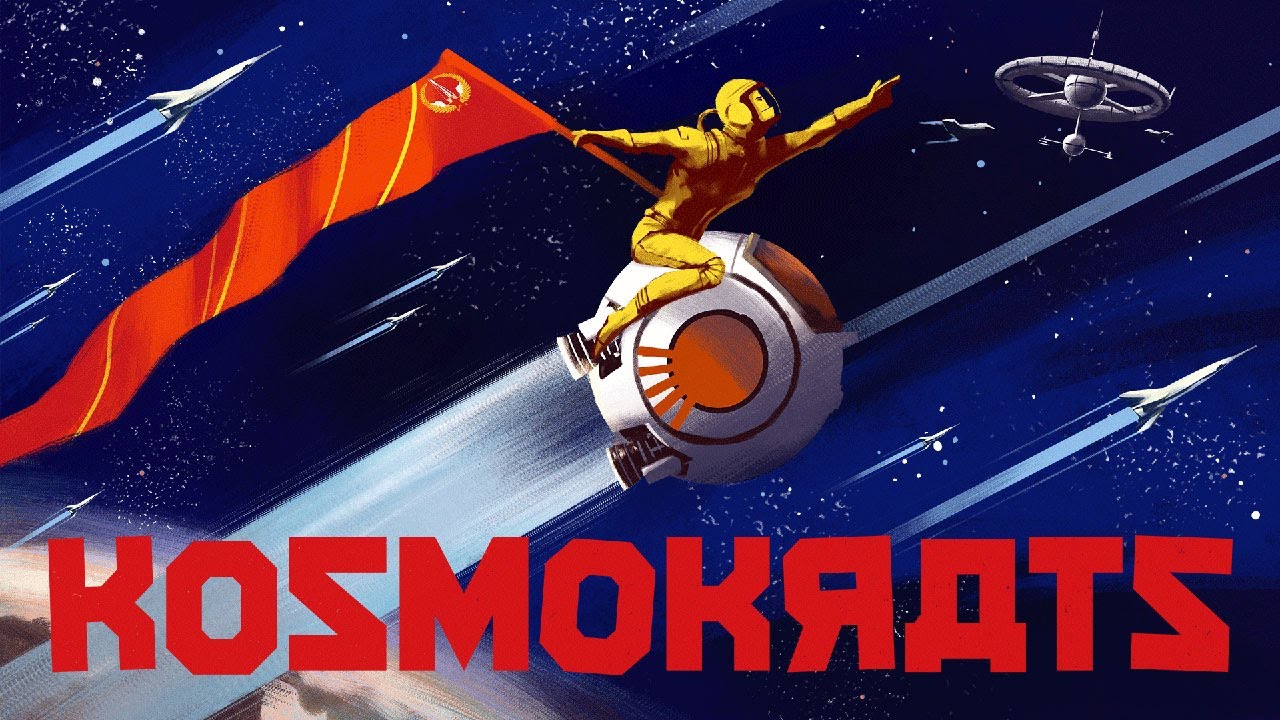
Kosmokrats Review: Zero-Gravity Space Construction Puzzle
Physics-Based Drone Gameplay, Orbital Ship Building and Branching Space Force Storylines
Kosmokrats is a physics-driven space puzzle game that challenges players to assemble spacecraft in orbit using a tractor-beam drone. Set within a darkly satirical retro-futurist Space Force, it blends zero-gravity construction, skill-based progression, and multiple story outcomes.
Think building a fleet is easy? Try doing it without crashing the station

Kosmokrats


Kosmokrats treats inertia as the primary force resisting every construction decision in orbit Each mission escalates tension through drift-heavy physics and unstable modular assembly systems
Kosmokrats is a 2020 indie physics-based puzzle game developed by Pixel Delusion and published by Modern Wolf. It builds its entire design around zero-gravity construction systems inside a stylized Cold War-inspired space program. The core experience is controlled chaos: a remote drone is used to assemble modular spacecraft in orbit, where every action is shaped by inertia, drift, and structural instability.
The design rejects open-world systems in favor of tightly constrained orbital puzzle spaces. Each mission places the player inside a limited construction zone where spacecraft components must be aligned and connected using a tractor-beam drone. The key design decision is focus: instead of managing broad simulation systems, the game isolates one pressure-heavy loop of structural assembly under unstable physics conditions.
In practice, inertia is the core antagonist of the entire gameplay system. Nothing settles cleanly, and every movement carries momentum that must be actively corrected. The result is a design where success depends on prediction rather than reaction, forcing the player to constantly think ahead of the physics simulation instead of responding to it.
Three design tensions define the entire gameplay experience Momentum, indirect control, and escalating structural instability
The gameplay structure is built around three interlocking sources of mechanical pressure. First, every interaction produces delayed physical consequences, meaning small mistakes compound into larger structural problems. A poorly judged alignment or over-correction can destabilize an entire assembly and force recovery through careful repositioning.
Second, control is entirely indirect. The player never inhabits a physical character and instead operates external tools through a remote interface. This separation increases cognitive load, as spatial awareness must be maintained across multiple drifting objects while simultaneously managing precise drone positioning.
Third, structural complexity escalates through physics behavior rather than artificial difficulty scaling. Early missions focus on simple alignment tasks, but later stages introduce multi-point assembly challenges where a single misaligned component can destabilize the entire spacecraft. Difficulty emerges naturally from the system rather than scripted escalation.
The narrative frames space construction as bureaucratic expansion under a rigid Space Force system Satire and retro-futurist presentation reinforce a controlled, institutional tone
The narrative takes place inside a fictionalized Space Force structured around hierarchy, expansion targets, and industrial output. Rather than presenting space exploration as heroic, it reframes it as administrative labor carried out through repetitive construction cycles in orbit.
Story delivery is handled through mission briefings and contextual dialogue that remain tightly integrated with gameplay progression. The dark satirical tone is reinforced by a retro-futurist 1960s visual identity and puppet-like cutscene presentation, which emphasizes artificiality and institutional detachment rather than realism.
This framing strengthens the gameplay loop by justifying repeated construction failures as expected operational outcomes within a bureaucratic system. Narrative and mechanics remain aligned, with each reinforcing the idea of controlled industrial expansion in space.
Progression is entirely skill-based with no systemic character upgrades Mastery is measured through precision, prediction, and control of physics behavior
Kosmokrats deliberately removes traditional progression systems such as upgrades, stats, or resource accumulation. Advancement is entirely skill-driven and depends on improving control over zero-gravity physics interactions rather than unlocking mechanical advantages.
Replayability is supported through two main systems. Physics-driven variability ensures that identical missions can produce different outcomes based on timing and spatial accuracy. Alongside this, branching narrative paths respond to performance consistency, leading to multiple possible campaign endings depending on how effectively objectives are completed.
Final verdict A focused physics puzzle system where mastery of inertia defines success
Kosmokrats succeeds by committing fully to a constrained physics puzzle structure where inertia is the central design challenge. Every mission reinforces the tension between precision input and uncontrolled environmental drift, making successful assembly feel earned through spatial understanding rather than scripted progression.
By combining strict mechanical focus with satirical institutional framing, the game establishes a distinct identity within indie puzzle design. It does not rely on system complexity or content breadth, but instead on the depth of its single interaction model: constructing stable structures in an environment designed to resist stability.
Ultimately, Kosmokrats is best understood as a pure physics-driven puzzle experience where mastery comes from learning how to anticipate and control unstable orbital behavior. Its strength lies in consistency of design, where every system feeds into a single, coherent challenge of precision under constant motion.
The VoxOdyssey Project Mission Statement for Feature games
I highlight what makes each game unique by examining gameplay mechanics, design choices, and storytelling. By analyzing systems, level design, and play styles, and referencing official media and assets, I aim to provide accurate, informative, and trustworthy insights. While I strive for accuracy, some details may change or be updated over time. Players can use this information to understand each title’s features and mechanics and make their own judgments.
Kosmokrats screenshots show zero-gravity ship assembly using drone-based control systems Orbital construction, modular docking, and drifting spacecraft components in space


Kosmokrats Trailer – Zero-Gravity Drone Construction and Orbital Space Assembly
Watch Kosmokrats in action as drones assemble spacecraft in orbit under unstable physics conditions. The trailer highlights zero-gravity movement, modular ship construction, and the tension of drifting components in space. View more in the video below to see how precision and inertia shape every mission.