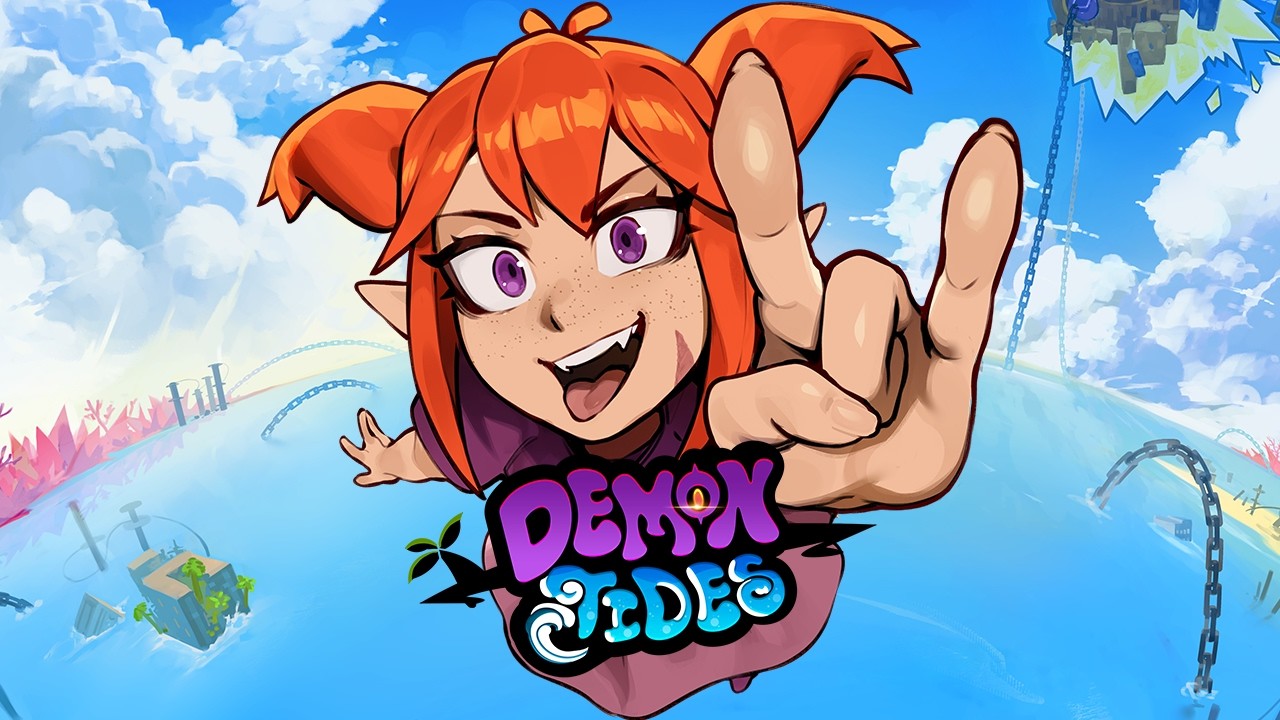
Demon Tides – Open Ocean 3D Platformer by Fabraz
Fabraz’s 2026 action adventure blends open world exploration, gear upgrades, and ghost racing
Demon Tides, developed by Fabraz, is a 3D open ocean platformer set across the kingdom of Ragnar’s Rock. Master fluid platforming mechanics, collect talismans that modify your move-set, upgrade gear, and compete in asynchronous ghost races while uncovering hidden kingdom secrets.
Continue below for a detailed breakdown of Demon Tides gameplay, progression systems, and exploration design

Demon Tides


Demon Tides by Fabraz – Open Ocean 3D Platformer Across Ragnar’s Rock Nonlinear Exploration, Expressive Movement, and Kingdom Secrets
Demon Tides is an open ocean 3D platformer developed by Fabraz, positioning traversal as the foundation of both progression and discovery. Set across the scattered structures of Ragnar’s Rock, the game follows Beebz and her crew as they navigate a seamless maritime world built around speed, verticality, and player-driven routing. Rather than structuring advancement through linear stage completion, Demon Tides gameplay centers on exploration locales that can be approached in varied sequences depending on player skill and unlocked abilities. The open world framework is not decorative; it directly informs pacing, mechanical experimentation, and environmental storytelling.
Platforming Mechanics and Move-Set Modifications Talismans, Gear Upgrades, and Systemic Traversal Depth
At the core of Demon Tides platforming mechanics is a deeply modular move-set. Players begin with a flexible baseline of jumps, spins, and aerial control, but the system expands significantly through collectible talismans. These items function as mechanical modifiers rather than passive boosts, altering how traversal works at a systemic level. Certain talismans introduce a paraglider for extended air travel, while others convert a spin into a hookshot-style grappling action or allow stationary suspension through bubble generation. Over time, Demon Tides gear upgrades transform navigation from simple platforming into layered movement expression, encouraging players to experiment with routing, sequence breaks, and risk-heavy shortcuts.
Seamless Open Ocean Design Exploration Locales Connected by Speed and Verticality
The defining structural element of Demon Tides is its seamless open ocean. Rather than isolated hubs, the sea itself functions as connective tissue between vertical landmarks, ruins, and engineered structures. Travel across water is fast and fluid, allowing players to build momentum before launching into platforming sequences embedded within each locale. Demon Tides exploration locales vary in elevation and architectural complexity, often hiding alternative entrances or traversal shortcuts that only become accessible after acquiring specific move-set modifications. This design reinforces mechanical progression as spatial expansion; new abilities meaningfully reinterpret earlier areas rather than simply unlocking gated doors.
Floating Fashionista and Social Anchoring Mobile Hub Design and Character Progression Systems
Progression and downtime converge aboard the Floating Fashionista, a mobile hub that travels with Beebz and her crew. Here, players purchase items, adjust equipment, and prepare for further exploration. The hub is integrated into the world rather than detached from it, reinforcing the maritime identity of Demon Tides. Gear upgrades acquired during exploration feed back into this central space, creating a loop between outward discovery and inward preparation. This cyclical structure supports sustained engagement while maintaining the coherence of the open ocean platformer framework.
Asynchronous Multiplayer and Ghost Racing Competitive Time Trials Within a Single-Player Framework
Although primarily a single-player adventure, Demon Tides incorporates asynchronous multiplayer systems that extend replayability. Players can race against ghost data recorded by others, competing for optimal completion times within specific exploration locales. This ghost racing feature reinforces mastery of Demon Tides gameplay systems, rewarding efficient routing and advanced movement control. Notifications inform players when their times are surpassed, encouraging iterative refinement. The absence of real-time multiplayer ensures mechanical consistency while still fostering competitive engagement rooted in platforming precision.
Graffiti Sharing and World Interaction Indirect Community Presence Across Player Worlds
Complementing ghost racing is a graffiti system that allows players to leave messages within the environment. These markings appear in other players’ worlds, creating a subtle layer of shared experience. Graffiti may function as navigational hints, environmental commentary, or misdirection. Importantly, this system integrates with the exploration-driven design of Demon Tides rather than interrupting it. The asynchronous approach preserves immersion while acknowledging a broader player community interacting across identical geography.
Narrative Integration and Kingdom Lore Environmental Clues and Cinematic Story Events
The narrative of Demon Tides unfolds through a combination of cinematic sequences and environmental storytelling. Beebz’s journey across Ragnar’s Rock is framed as both external expedition and internal self-discovery. Rather than relying on constant exposition, the game embeds lore within hidden chambers, architectural remnants, and contextual visual cues. Demon Tides kingdom secrets are discovered through attentive exploration, reinforcing the relationship between traversal mastery and narrative progression. The story does not override the platforming focus; instead, it motivates deeper engagement with the world’s structures and mysteries.
Customization and Player Expression Outfits, Visual Identity, and Mechanical Individuality
Visual customization plays a secondary yet meaningful role in Demon Tides. Players can collect headgear, outfits, and hair dyes that allow extensive aesthetic variation. While cosmetic, these options reinforce the broader theme of expression present in the movement system itself. Demon Tides move-set modifications encourage mechanical individuality, while visual customization complements that philosophy at a surface level. The combination supports a personalized experience without compromising mechanical clarity.
Progression Structure and Replay Incentives Nonlinear Advancement Through Mechanical Mastery
Progression in Demon Tides is tied directly to ability expansion rather than numerical leveling. Talismans unlock new traversal options that recontextualize earlier areas and open alternate paths forward. This nonlinear structure ensures that exploration remains relevant even after major story milestones. Players focused on optimization can revisit locales to refine ghost times, uncover hidden chests, or experiment with different gear combinations. The open ocean platformer framework thus sustains both discovery-driven and performance-driven playstyles.
Final Verdict A Movement-Driven Open World Platformer Focused on Exploration
Demon Tides represents a deliberate expansion of Fabraz’s platforming design into a seamless open ocean format. By centering progression on talisman-based move-set modifications and integrating asynchronous ghost racing, the game balances solitary exploration with competitive replay systems. Its world design encourages nonlinear routing, mechanical experimentation, and careful observation of environmental detail. Rather than relying on spectacle, Demon Tides builds its identity around traversal depth, systemic upgrades, and player-directed discovery, establishing it as a mechanically driven 3D platformer with sustained replay value.
The VoxOdyssey Project Mission Statement for Feature games
I highlight what makes each game unique by examining gameplay mechanics, design choices, and storytelling. By analyzing systems, level design, and play styles, and referencing official media and assets, I aim to provide accurate, informative, and trustworthy insights. While I strive for accuracy, some details may change or be updated over time. Players can use this information to understand each title’s features and mechanics and make their own judgments.
Demon Tides – Exploring Ragnar’s Rock Through Fluid 3D Platforming Screenshots Highlight Open Ocean Travel, Talisman Abilities, Ghost Races, and Hidden Kingdom Secrets


Demon Tides Trailer – Open Ocean Exploration and Movement Preview
Watch the Demon Tides trailer for a closer look at its fluid 3D platforming, seamless ocean traversal, and talisman-driven abilities in action. The preview highlights exploration across Ragnar’s Rock, showcasing how movement, progression, and world design come together within Fabraz’s upcoming adventure.