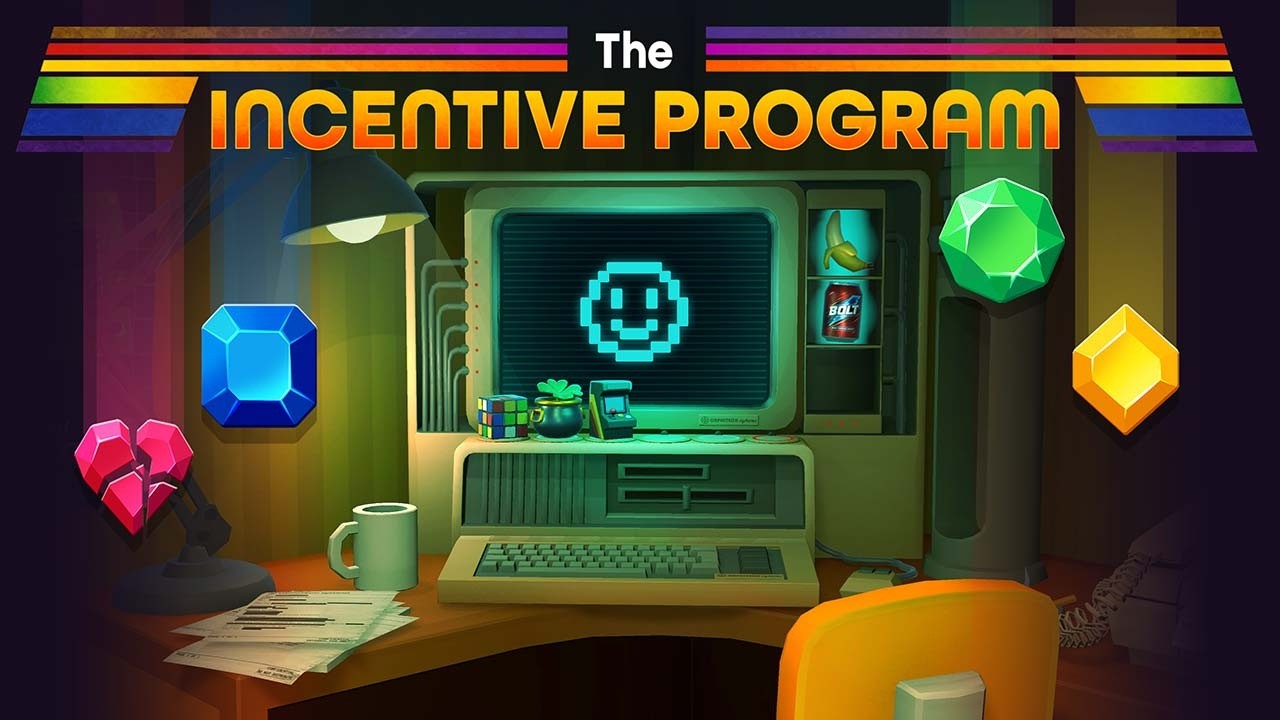
The Incentive Program – Match-3 Deckbuilding Roguelite Corporate Simulation Game
Surreal corporate horror roguelite combining match-3 systems, deckbuilding strategy, and quota-driven resource management
The Incentive Program is a systems-driven roguelite where players operate a CRT terminal workspace, manipulating match-3 mechanics, trinkets, overclocks, and corporate tools to survive escalating quotas inside a controlled simulation.
Clock in, optimize your build, and break the system before it breaks you

The Incentive Program


The Incentive Program turns corporate quotas into survival pressure inside a CRT terminal system Match-3 strategy, deckbuilding modifiers, and escalating rules define every decision cycle
The Incentive Program is a Match-3 Deckbuilding Roguelite and Corporate Horror simulation developed and published by Outplay Entertainment Ltd. Structurally, it operates within a systems-driven puzzle framework where progression is governed by escalating work quotas rather than traditional level design. The experience is delivered through a retro CRT terminal interface that functions as both gameplay surface and narrative container, positioning the player inside a monitored corporate environment defined by rule manipulation, resource optimization, and performance thresholds. Its design aligns with modern strategic puzzle roguelite structures where systemic interaction replaces linear progression and where each run represents a reconfigured operational simulation.
Match-3 systems evolve through trinkets, overclocks, and probabilistic rule manipulation Every run redefines scoring logic, board behavior, and resource outcomes
At its core, The Incentive Program builds its gameplay loop on a modified match-3 foundation layered with deckbuilding-style progression systems. The grid-based puzzle structure is continuously altered by persistent modifiers that reshape probability distributions, scoring behavior, and interaction outcomes. Trinkets function as rule-altering components that introduce conditional effects affecting tile resolution and reward scaling. Floppy disk systems extend these modifications across multiple runs by altering core gameplay parameters at a structural level, while system overclocks act as high-impact overrides that can fundamentally reshape how matches resolve. Consumables operate as temporary stabilizers during high-pressure quota escalation phases, creating a multi-layered decision space where each action interacts with both immediate and long-term system states.
Corporate horror framing turns progression into monitored work simulation under OrphiTech Fragmented system messages and restricted data shape narrative understanding
The narrative structure is embedded within a corporate simulation framework controlled by the fictional OrphiTech system, where progression is defined through productivity metrics, compliance targets, and quota fulfillment. Instead of traditional storytelling sequences, narrative delivery occurs through fragmented system communications, corrupted files, and restricted internal messages that appear during gameplay progression. This structure aligns with conspiracy-driven design frameworks commonly found in systemic horror and institutional simulation games, where meaning is constructed through partial information and environmental inference rather than direct exposition. The CRT terminal presentation reinforces this structure by limiting perceptual clarity and framing all interaction as monitored system activity within a controlled digital workspace.
Office systems, vending machine upgrades, and bosses create structured run escalation Each cycle introduces new constraints through economy, encounters, and build pressure
Progression in The Incentive Program is structured around escalating quotas that function as both difficulty scaling and systemic pressure indicators. Players accumulate run-based currency that can be spent at an in-world office vending machine, which serves as a central upgrade node for acquiring consumables, trinkets, and system-altering floppy disks. This physicalized economy reinforces the corporate simulation framework by embedding progression decisions into workplace-style resource allocation. Encounter structure expands through corporate boss systems designed to counter dominant build strategies, introducing mechanical resistance that forces adaptation across runs. These elements combine to form a loop where economic management, build composition, and encounter escalation are tightly interconnected.
Replayability emerges from meta-progression systems and modular build combinations Unlocks, starting builds, and modifiers expand strategic variation across runs
Replayability is driven by a modular progression architecture that includes meta-progression unlocks, starting build templates, and persistent modifier expansion. Initial configurations provide multiple baseline build archetypes that influence early-run strategy, while long-term progression expands the available modifier pool and system interactions. Each run produces a reconfigured ruleset shaped by interactions between trinkets, overclocks, floppy disk systems, and quota escalation parameters. This creates a high-variability decision space where optimization strategies must adapt to shifting systemic constraints rather than relying on static build paths. Failure states contribute to progression feedback loops, ensuring iterative refinement of system understanding across repeated play sessions.
Final verdict A systems-driven corporate roguelite where optimization replaces narrative progression
The Incentive Program functions as a structured Match-3 Deckbuilding Roguelite embedded within a corporate horror simulation framework. Developed by Outplay Entertainment Ltd, it integrates puzzle mechanics, probabilistic modifiers, and meta-progression systems into a unified operational structure governed by escalating work quotas. The CRT terminal interface serves as the primary interaction layer, reinforcing the simulation of monitored corporate labor while supporting layered mechanical complexity through trinkets, overclocks, consumables, and floppy disk systems. Across repeated runs, progression is defined by adaptation to increasingly complex rule interactions rather than linear advancement. Within the broader indie systems-driven roguelite landscape, it represents a tightly integrated example of economy-based progression, probabilistic manipulation, and modular build evolution operating within a single cohesive gameplay architecture.
The VoxOdyssey Project Mission Statement for Feature games
I highlight what makes each game unique by examining gameplay mechanics, design choices, and storytelling. By analyzing systems, level design, and play styles, and referencing official media and assets, I aim to provide accurate, informative, and trustworthy insights. While I strive for accuracy, some details may change or be updated over time. Players can use this information to understand each title’s features and mechanics and make their own judgments.
The Incentive Program screenshots show CRT terminal match-3 roguelite gameplay systems Trinkets, overclocks, and quota-based corporate progression loops in action


The Incentive Program Trailer – Match-3 Roguelite Corporate Simulation Gameplay
Watch The Incentive Program in action as employees navigate a surreal CRT terminal workplace filled with quota pressure, trinket builds, and system overclocks. The trailer below highlights match-3 strategy, deckbuilding progression, and corporate horror systems in motion.