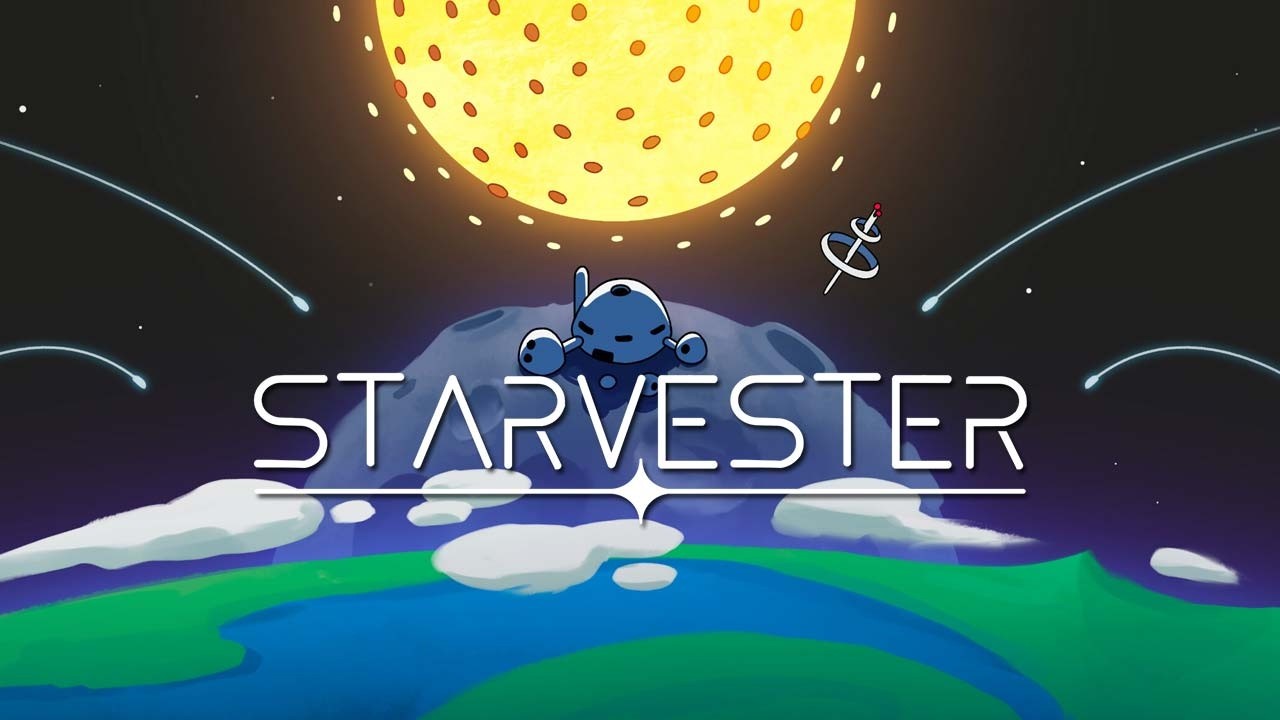
Starvester Review: Space Factory Incremental Game with Drone Automation Systems
Sci-fi Incremental Simulation Featuring Drone-Based Resource Mining, Automation Scaling, and Megastructure Construction
Starvester is a compact space factory incremental game focused on drone automation, resource management, and structured progression across a star system. Developed by Syphono4 and co-published with Future Friends Games, it blends factory automation systems with deterministic upgrade loops and a finite campaign structure lasting approximately five hours.
Build across the stars and watch automation evolve into something larger than control

Starvester


Starvester structures its progression around drone automation across a living star system factory Every expansion step shifts the balance between resource control, efficiency, and large-scale construction goals
Starvester is a space factory incremental game developed by Syphono4 and co-published with Future Friends Games, positioned within the modern wave of Experimental indie games that focus on structured systems rather than open-ended simulation. Built as a compact singleplayer incremental experience with an approximate five-hour campaign, it sits firmly in the Short-form incremental games category, where progression is deliberately finite rather than endlessly expanding. This structural choice immediately separates it from traditional idle systems that rely on indefinite passive scaling, instead framing it as a controlled Space factory simulator with a defined completion arc.
From a broader design and community perspective, Starvester is frequently discussed within Space idle game and Factory automation game circles due to its reliance on autonomous systems and layered economic progression. Aggregated player feedback highlights that the game is designed around deterministic progression loops rather than randomness, positioning it closer to structured Economy simulation games where outcomes depend on optimization rather than chance. The result is a Sci-fi incremental game framework where clarity of systems is central to player understanding of growth and efficiency.
At its foundation, Starvester operates through autonomous drone resource extraction, forming the backbone of its Space mining game structure. Drones are deployed across planetary bodies within a star system, producing a layered automation network that gradually replaces manual interaction with passive resource generation idler mechanics. Rather than using physics-heavy conveyor systems, the game functions as a 2D factory game abstraction where production is organized into modular nodes representing extraction, processing, and upgrades. This simplifies spatial complexity while maintaining a deep Automation loop typical of modern Space factory builder design.
Automation systems scale from basic mining operations into multi-planet industrial networks Efficiency depends on drone coordination, upgrade timing, and resource allocation strategy
As progression expands, the Space factory simulator loop evolves into a multi-layered economy where resource streams interact across multiple celestial bodies. Early gameplay focuses on simple mining operations, but later stages introduce complex upgrade chains that define production efficiency. Community analysis of gameplay structure notes that the system is readable in early stages, but becomes more abstract as automation density increases, particularly when multiple multipliers and upgrade tiers interact simultaneously within the same production cycle.
A recurring observation in player feedback relates to UI clarity and mathematical transparency. The absence of explicit production-per-second breakdowns in certain interface layers has been highlighted as a limitation in optimization-heavy scenarios. In a genre defined by incremental games and Optimization-driven simulation, this reduces the precision with which players can evaluate efficiency gains during mid-to-late progression. At the same time, the visual representation of dense drone activity introduces readability challenges, with large-scale automation sometimes forming visually saturated planetary clusters that obscure individual system states.
Despite these limitations, the underlying Space strategy games structure remains consistent. Resource management is driven through deterministic systems that reward planning over randomness, reinforcing its identity as a Production management games experience. The progression loop gradually shifts the player from direct involvement to high-level coordination, where optimization decisions matter more than individual actions. This transition is central to the game’s identity as a Minimalist factory game within the broader Space factory simulator genre.
Prestige systems and megastructure construction define the long-term progression arc Progress resets are structured, deterministic, and tied to efficiency scaling rather than randomness
The long-term structure of Starvester is anchored in its Prestige system, which introduces cyclical resets in exchange for permanent efficiency gains. This creates a controlled loop of progression commonly seen in Incremental games, but implemented here in a deterministic form that avoids RNG-based variability. Each cycle pushes the player closer to end-stage Megastructure building game objectives, where large-scale construction becomes the central goal of progression.
Within community discussions and observed gameplay patterns, early progression is generally described as tightly paced and mechanically clear. However, as systems scale, balance shifts become more noticeable. Certain early prestige modifiers that significantly increase production under constrained drone conditions introduce unconventional optimization paths, where limiting automation can temporarily outperform full-scale deployment. This creates a layered strategic tension that defines mid-game progression in the Sci-fi incremental game structure.
Resource economy analysis also highlights partial obsolescence in mid-tier materials as progression advances. Some resources lose relevance as higher-tier systems take over, reducing the diversity of active inputs in later stages of the Space factory builder loop. By the endgame phase, progression increasingly focuses on fewer but larger-scale systems, narrowing the decision space into high-efficiency optimization rather than broad resource management.
Late-game pacing has been described in community feedback as transitioning into a slower, more passive state, where production cycles operate on fixed intervals. This shift is most noticeable in final objectives tied to large-scale planetary systems, where completion requires extended idle-style waiting periods. While this reinforces its identity as a Short-form incremental game with a defined endpoint, it also alters the pacing rhythm of the final progression stage compared to earlier active optimization phases.
Visual systems and ambient design reinforce a controlled atmospheric sci-fi environment Presentation prioritizes clarity early, but becomes denser under large-scale automation loads
Starvester is designed as a low hardware requirement minimalist sim, capable of running on modest systems while maintaining stable performance across large-scale automation states. This aligns with its identity as a Compact singleplayer campaign game where system accessibility is prioritized over graphical complexity.
Visually, it adopts a Colorful sci-fi game aesthetic built around simplified planetary structures, drone swarms, and abstract production layers. Early presentation emphasizes readability and clear system feedback, but as automation expands, visual density increases significantly. This is particularly evident in large-scale Space mining game scenarios where overlapping drones and resource indicators reduce separation between individual production nodes.
Audio design contributes to its identity as an Atmospheric space game, using ambient layering that scales with production activity. The result is an Ambient soundscape space simulation where sound reinforces system expansion without dominating the experience. This supports its classification as a Relaxing space game during active progression, even when mechanical complexity increases in later stages.
Final verdict A structured incremental system built around automation, scaling efficiency, and finite progression across a star system factory
Starvester operates as a tightly structured entry within Incremental games and Space factory simulator design, focusing on deterministic progression systems rather than open-ended scaling. Its strongest execution lies in its early and mid-game automation loops, where drone-based industrial expansion, resource layering, and upgrade systems form a clear and readable progression structure.
Across its full campaign structure, the game maintains a consistent identity as a Finite structured progression mechanics experience, avoiding the indefinite scaling common in traditional idle systems. While later stages introduce pacing slowdowns and reduced system diversity, the overall design remains cohesive in its intent to deliver a complete, bounded experience rather than an endless optimization sandbox.
In summary, Starvester functions as a controlled Space factory simulator that blends Automation systems, Production management games design, and Megastructure construction goals into a compact campaign structure. It is best understood as a Minimalist factory game with a defined endpoint, where efficiency, system clarity, and structured progression define the core experience rather than infinite expansion.
The VoxOdyssey Project Mission Statement for Feature games
I highlight what makes each game unique by examining gameplay mechanics, design choices, and storytelling. By analyzing systems, level design, and play styles, and referencing official media and assets, I aim to provide accurate, informative, and trustworthy insights. While I strive for accuracy, some details may change or be updated over time. Players can use this information to understand each title’s features and mechanics and make their own judgments.
Starvester screenshots show drone automation and star system expansion Resource extraction, megastructure assembly, and deterministic upgrade tracking


Starvester Trailer – 2D Space Factory Automation and Star System Megastructure Strategy
Get ready to command a massive swarm of mining drones! The trailer shows how basic resource gathering scales into epic star system orchestration. Watch your autonomous empire expand, harvest stellar energy, and construct giant megastructures. View more in the video below to see the automation loops in action!