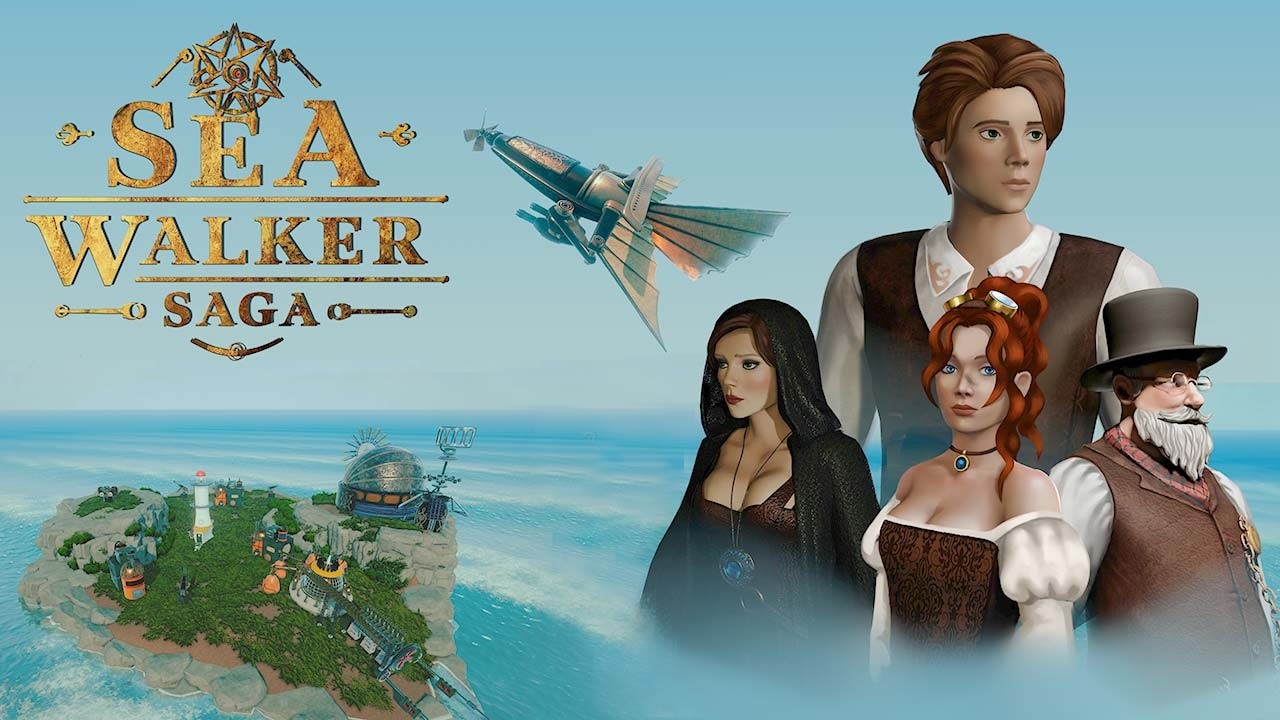
Sea Walker Saga Review: Steampunk Ocean Survival and Base Building RPG
Stylized Third Person Exploration with Mobile Island Combat, Resource Systems, and Early Access Progression
Sea Walker Saga is an Early Access steampunk ocean RPG from Antelus Games set in a flooded 1878 world. Analysis of its design highlights mobile island Base Building, Third Person exploration, and resource-driven progression tied to survival, Combat, and underwater discovery.
Dive into the flooded world where your island becomes your primary weapon and survival system

Sea Walker Saga


Sea Walker Saga reframes ocean survival through mobile Base Building and systemic progression design Every system connects back to the Isla Muvimi, forming a unified loop of exploration, combat, and resource control
Sea Walker Saga is an Early Access Action-Adventure RPG, Simulation, and Strategy hybrid developed by Antelus Games, positioned within the ocean-survival subgenre alongside titles such as Raft and Sunless Sea. From a systems-analysis perspective, the structure is built around a single dominant pillar: the Isla Muvimi, a mobile floating island that functions simultaneously as Base Building hub, exploration vessel, and progression engine. Unlike conventional survival frameworks that separate crafting, exploration, and narrative advancement, the design compresses all major gameplay vectors into a unified mobility-based economy set in a flooded 1878 world inspired by Waterworld-style post-apocalyptic fiction. The result is a progression architecture where movement, upgrades, and narrative discovery are inseparable systems rather than isolated mechanics.
Combat design operates as a dual-layer system spanning island defense strategy and Third Person field engagement Analysis of available materials suggests a shift between macro-scale tactical planning and moment-to-moment action execution
The combat structure in Sea Walker Saga can be understood as a layered interaction model rather than a single unified system. At macro scale, the island operates under RTS-adjacent constraints where turret placement, structural upgrades, and defensive resource allocation determine survivability during hostile encounters. This creates a strategic planning layer similar to management-heavy Survival Strategy hybrids. At micro scale, Third Person exploration sequences introduce direct combat scenarios involving pirates, environmental hazards, and underwater threats encountered during salvage operations. This dual-layer architecture introduces a known genre challenge: maintaining clarity between high-level management interfaces and real-time action responsiveness. Historically, games that merge RTS-style infrastructure control with Action-Adventure traversal systems often struggle with UI congestion during peak encounter intensity, particularly when defensive management must occur concurrently with active field navigation.
Resource loops, Base Building expansion, and exploration gating define the core progression economy Advancement is structured around material acquisition, technological upgrades, and ocean traversal capability thresholds
Progression in Sea Walker Saga is driven by a tightly coupled resource economy where exploration outputs directly fund Base Building expansion on the Isla Muvimi. Salvage operations, artifact recovery, and mission completion generate materials that are reinvested into structural upgrades, defensive systems, and traversal technologies. This creates a closed-loop Simulation system where exploration is both the input and output of progression. From a design perspective, this structure aligns with established survival crafting frameworks, but introduces additional complexity through mobility constraints. Unlike static Base Building systems, island movement acts as a gating mechanism that determines access to biome regions, sunken cities, and deeper ocean layers. This introduces pacing dependency between narrative advancement and infrastructure scaling, a structural risk commonly observed in Early Access survival titles where progression can become artificially gated by resource scarcity rather than exploration diversity.
Exploration design emphasizes underwater traversal, environmental storytelling, and biome-driven escalation The flooded world structure transforms geography into a layered progression system rather than a static map
Sea Walker Saga’s exploration framework extends beyond surface navigation by incorporating underwater zones, wreck sites, and submerged settlements as core progression spaces. Analysis of available gameplay information indicates a tri-layer traversal system consisting of surface ocean movement, island-based navigation, and deep-sea diving segments. Each layer introduces distinct risk profiles and resource opportunities, reinforcing a Fantasy-tinged post-collapse world where environmental storytelling replaces traditional exposition. Sunken cities function as both narrative artifacts and mechanical reward zones, often containing materials required for island upgrades or unlocking progression flags tied to the missing father storyline. This structure mirrors elements seen in Subnautica and Raft, though Sea Walker Saga appears to place stronger emphasis on mobility-based gating rather than isolated survival zones.
Early Access structure introduces balancing risks across pacing, resource economy, and narrative gating systems Long-term stability depends on how effectively progression friction is tuned across exploration and upgrade cycles
As an Early Access release, Sea Walker Saga operates within a development environment where systems are likely to evolve significantly over time. From an analytical standpoint, the most important structural risk involves progression pacing across its Simulation and RPG systems. If resource requirements for Base Building upgrades scale too aggressively, exploration may shift from discovery-driven engagement to repetitive material farming loops. Conversely, overly rapid progression could undermine the strategic value of island upgrades and reduce long-term retention depth. Additional considerations include UI clarity during RTS-style defense scenarios, optimization stability during Third Person exploration transitions, and consistency of underwater traversal performance. These are not observed failures but established development risk vectors commonly associated with hybrid survival titles operating across multiple genre systems simultaneously.
Final verdict A systems-driven ocean survival RPG built on mobile Base Building, layered progression, and multi-mode combat design
Sea Walker Saga presents a coherent but ambitious system architecture that merges Action-Adventure traversal, Simulation-based resource management, Strategy-driven Base Building, and Third Person exploration into a single mobile fortress framework. Its defining mechanical identity is the Isla Muvimi, which functions as a unified progression engine connecting combat, exploration, and economic systems. From a design analysis standpoint, the strongest aspect of the project is its commitment to mobility as a core structural constraint, transforming ocean traversal into a progression gate rather than a simple navigation layer. The primary risk lies in balancing multiple interconnected systems without overwhelming either pacing or interface clarity, particularly under Early Access iteration. If executed effectively, the design positions itself within a niche of ocean-survival titles that prioritize systemic interdependence over isolated survival mechanics, offering a progression model centered on expansion, traversal capability, and environmental discovery rather than static base optimization.
The VoxOdyssey Project Mission Statement for Feature games
I highlight what makes each game unique by examining gameplay mechanics, design choices, and storytelling. By analyzing systems, level design, and play styles, and referencing official media and assets, I aim to provide accurate, informative, and trustworthy insights. While I strive for accuracy, some details may change or be updated over time. Players can use this information to understand each title’s features and mechanics and make their own judgments.
Sea Walker Saga screenshots show floating island combat and steampunk ocean exploration systems Third-person battles, underwater salvage zones, and mobile Base Building progression loops


Sea Walker Saga Trailer – Floating Island Combat, Ocean Exploration, and Steampunk Survival Systems
Watch Sea Walker Saga gameplay as your mobile island sails across a flooded 1878 world, engaging in turret battles, underwater salvage, and exploration-driven progression. The video below showcases how combat, upgrades, and discovery shape each journey.