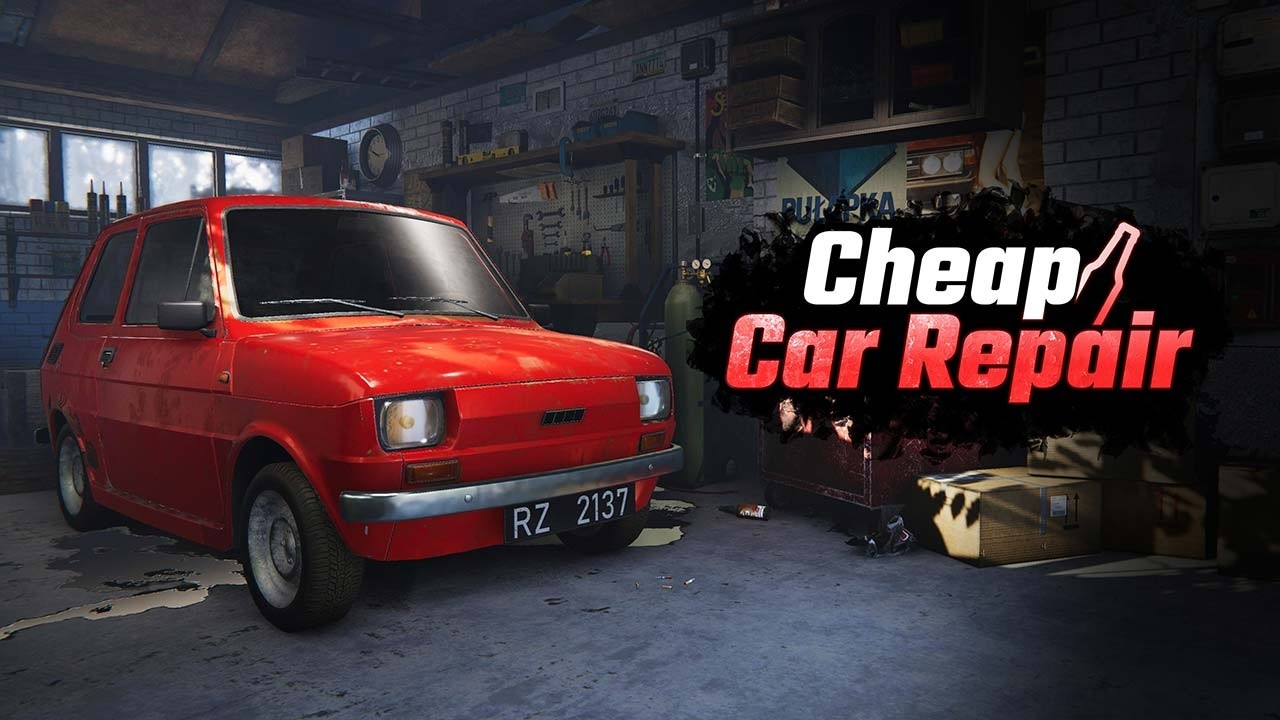
Cheap Car Repair Review: 1990s Polish Mechanic Simulator Analysis
First-Person Automobile Sim with Management, Crafting, Physics-Based Workshop Systems and 1990s Polish Gameplay
Cheap Car Repair is a first-person automobile simulation set in rural 1990s Poland, focusing on workshop management, cost-cutting repair systems, and physics-driven vehicle maintenance. Players balance profit, improvisation, and mechanical risk within a narrative-driven garage environment shaped by economic constraint and customer pressure.
Step inside a garage where every repair decision changes the outcome

Cheap Car Repair


Cheap Car Repair frames workshop survival around improvised vehicle repair in rural 1990s Poland Every job is shaped by budget pressure, uncertain repairs, and customer-driven consequences
Cheap Car Repair is a first-person Automobile Sim and Management-focused Simulation developed by Little Dog Games and published by Simplicity Games and PlayWay S.A. Built within the PlayWay mechanic simulator ecosystem, it combines Simulation, Life Sim, Job Simulator, and Indie design elements into a structured garage management framework. Set in rural Poland during the 1990s, the game establishes a workshop economy defined by scarcity, improvisation, and ongoing financial pressure, shaping how every repair decision is approached.
Gameplay centers on running a low-budget garage where every vehicle presents a cost versus quality decision. Players inspect damaged cars, determine repair priorities, and decide whether to invest in proper components or rely on cheaper substitutes to stay profitable. Instead of following fixed mechanical procedures, progression is driven by adapting repairs to limited resources, where each job affects both short-term earnings and long-term workshop stability.
Within the 1990s Polish mechanic simulator context, progression is built around a constrained garage economy. Players operate a low-budget workshop where every job requires balancing profit margins against repair quality. This creates a Management loop combined with decision-based Puzzle structure, where each mechanical action affects long-term business stability. The absence of Combat, RPG systems, RTS layers, or Base Building keeps the focus entirely on automotive problem-solving within a Simulation framework.
Cheap Car Repair gameplay focuses on improvisation, uncertainty, and cost-driven repair decisions Repair outcomes depend on substitutions, shortcuts, and financial prioritization
The Cheap Car Repair gameplay loop revolves around inspecting, disassembling, and rebuilding vehicles under financial constraints. Cars arrive in varying condition, and players must decide whether to install proper components or rely on Best parts substitutes in Cheap Car Repair game systems. This creates a Simulation structure where financial survival often matters more than mechanical precision.
Repair systems include rust removal, bodywork fixes, part replacement, and improvised repairs that reflect the Cheap Car Repair guide to cutting corners approach. These mechanics form a Crafting-like layer where temporary fixes and substitutions can still lead to functional results. Physics-based interactions reinforce hands-on repair work, while the First-Person view keeps operations clear and grounded.
Compared to traditional automotive simulators such as Car Mechanic Simulator, which rely on structured assembly steps, Cheap Car Repair replaces fixed repair paths with flexible improvisation. This shifts the experience into a Simulation focused on economic reasoning rather than strict procedural accuracy.
Economic systems drive progression through profit pressure, customer behavior, and reputation effects Financial survival replaces linear progression as the main goal
Progression in Cheap Car Repair is driven by Management systems tracking profit, repair efficiency, and customer satisfaction. Each completed job contributes to financial stability, while poor decisions can damage reputation and bring returning customers with complaints. This reinforces a Simulation structure where long-term economic survival is the key success measure.
The design includes simple learning loops where players improve through consequence-based repetition. Instead of abstract systems, every decision is tied to visible workshop actions, keeping the Simulation grounded in practical outcomes. This places the game within Job Simulator and Life Sim categories focused on occupational progression.
Community feedback reflects the strength of this core loop. Cheap Car Repair holds a Very Positive rating of 91 percent across 1,409 Steam user reviews, showing strong engagement from Simulation players. While the core mechanics are widely praised, feedback also notes that narrative content ends more abruptly than expected, creating a contrast between gameplay depth and story pacing.
Open-world exploration extends workshop life into rural driving and environmental systems Vehicle condition directly affects movement, travel, and mission access
Beyond the garage, Cheap Car Repair includes Open-world exploration across rural 1990s Polish environments. This expands the Simulation loop by linking Transportation and Driving systems directly to workshop outcomes, since vehicle performance determines how and where players can travel.
The environment design focuses on grounded rural spaces and small community interactions. These areas extend the Life Sim structure and reinforce the link between workshop economics and surrounding social systems. Exploration supports pacing while staying tied to Simulation progression.
Story missions and customer systems shape narrative through everyday work scenarios Dialogue and consequences replace scripted storytelling
Cheap Car Repair includes story-driven missions that follow John the Mechanic within a rural workshop setting. These narrative elements place the game within Simulation and Life Sim categories where occupation defines progression and structure.
Customer systems directly affect gameplay outcomes, especially in situations involving How to handle angry customers Cheap Car Repair scenarios. Poor repairs or excessive shortcuts can lead to complaints or return visits, reinforcing accountability within the Management loop.
Dialogue and missions focus on everyday economic interactions rather than dramatic storytelling. This reinforces the Simulation identity, where systems and consequences drive narrative structure instead of scripted scenes.
Technical systems combine physics-based repair with mid-range PC simulation requirements AI-assisted audio supports voice modulation and music generation
Cheap Car Repair runs on Windows 10 64-bit systems and is designed for mid-range hardware common in modern Simulation games. The technical setup supports Physics-based interaction systems across workshop environments while maintaining performance balance.
The developers confirmed Cheap Car Repair voice modulation AI disclosure, stating that artificial intelligence was used for voice modulation and music generation. This places the game among Simulation titles that use AI-assisted audio production workflows.
System requirements reflect a moderate performance target suitable for Simulation and Indie audiences, ensuring accessibility while maintaining environmental detail and interaction density.
Final verdict A focused Simulation of automotive improvisation, economic pressure, and workshop survival in 1990s Poland
Cheap Car Repair builds a structured Simulation experience around improvised automotive repair, financial constraint, and Management-driven progression. Its identity comes from flexible repair logic where success depends on cost control, substitution choices, and long-term workshop stability rather than strict mechanical accuracy.
Within Automobile Sim and PlayWay mechanic simulator games, it stands out through its Shady mechanic simulator PC framing and 1990s Polish setting. The combination of First-Person interaction, Physics-based repair systems, and Open-world exploration creates a hybrid Simulation spanning Life Sim, Job Simulator, and Transportation mechanics.
Overall, Cheap Car Repair functions as a systems-driven Simulation where economic pressure replaces traditional progression models. Workshop management, improvised repairs, and consequence-based customer systems combine into a focused survival economy experience built around practical decision-making rather than mechanical perfection.
The VoxOdyssey Project Mission Statement for Feature games
I highlight what makes each game unique by examining gameplay mechanics, design choices, and storytelling. By analyzing systems, level design, and play styles, and referencing official media and assets, I aim to provide accurate, informative, and trustworthy insights. While I strive for accuracy, some details may change or be updated over time. Players can use this information to understand each title’s features and mechanics and make their own judgments.
Cheap Car Repair screenshots show workshop repairs and rural 1990s garage management Vehicle disassembly, rust work, and cost-driven repair decisions


Cheap Car Repair Trailer – 1990s Polish Garage Simulation and Workshop Management
Watch Cheap Car Repair in action as it showcases workshop repairs, cost-driven decision making, and rural garage life in 1990s Poland. The trailer highlights vehicle breakdowns, improvised fixes, and open-world driving moments. View more in the video below to see how each repair choice affects your garage and customers.