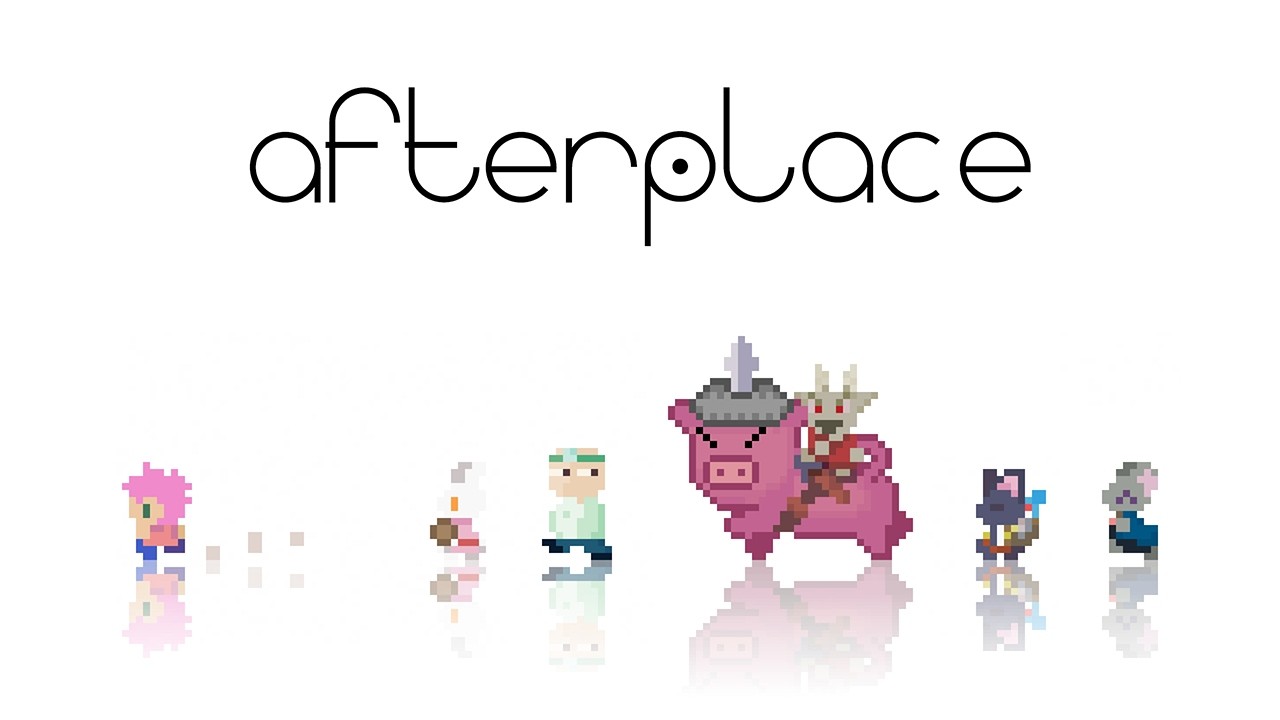
Afterplace Open World Action RPG by Evan Kice
A nonlinear 2D pixel action adventure by Evan Kice, published by indie.io, built around exploration, combat, and player-driven endings
Afterplace by Evan Kice and indie.io is a story rich open world action RPG featuring hack and slash combat, hidden paths, and choices that shape multiple endings. Explore a handcrafted 2D pixel world with minimal guidance and persistent consequences.
Continue below for a complete Afterplace review covering open world systems, combat depth, secrets, and PC performance analysis

Afterplace


Afterplace by Evan Kice An Open World Action RPG Built Around Player Autonomy
Playing Afterplace on PC immediately clarifies its design priorities. Created entirely by Evan Kice and published on PC by indie.io, the game positions exploration above instruction. There are no persistent waypoints guiding movement and no dense interface layers framing objectives. Instead, the 2D pixel world unfolds through touch-driven origins adapted cleanly to keyboard, mouse, or controller. Combat and traversal feel intentionally lightweight, keeping attention on discovery rather than mechanical complexity. The opening hours establish a nonlinear structure where curiosity dictates pacing. This approach reinforces the game’s identity as a story rich open world action RPG that trusts players to observe, experiment, and interpret outcomes independently.
Nonlinear World Design and Spatial Memory Exploration Without Handholding or Persistent Waypoints
Afterplace’s most defining characteristic is its open world layout. Forest paths branch organically, hidden corridors sit behind unmarked walls, and dungeons emerge without formal announcement. The limited overworld mapping system intentionally avoids precision, encouraging players to build spatial awareness rather than rely on UI prompts. This design decision strengthens immersion and replayability: missing a concealed entrance or secret path becomes part of the experience rather than a failure state. By reducing navigational scaffolding, the game reinforces its exploration focus and distinguishes itself from contemporary action RPGs that prioritize quest tracking over environmental literacy. The result is a world that feels cohesive and internally consistent, where learning terrain becomes a meaningful skill.
Combat Systems and Mechanical Clarity Responsive Hack and Slash Encounters in a 2D Pixel Framework
Combat in Afterplace operates in real time with straightforward hack and slash mechanics. Enemy types exhibit distinct movement and attack patterns, requiring positional awareness rather than elaborate combo execution. On PC, controls remain responsive whether using keyboard and mouse or a controller, reflecting the game’s mobile-first origins while maintaining platform stability. Weapon upgrades, armor purchases, and consumables introduce incremental progression without overwhelming the player with layered skill trees. This restraint supports clarity. Encounters guard secret routes and environmental choke points, linking combat directly to exploration rather than isolating it as a separate gameplay loop. The mechanical economy ensures that combat enhances discovery instead of overshadowing it.
Narrative Integration and Choice Architecture Story Rich Design Shaped by Subtle Player Decisions
Afterplace integrates narrative consequences into ordinary interactions. Dialogue can be pursued, interrupted, or ignored entirely, and these behaviors influence available endings. The game rarely signals when a decision carries long-term impact. This subtlety strengthens immersion by embedding “choices matter” design within natural play. Characters relocate, conversations evolve, and certain scenes become inaccessible depending on engagement patterns. Environmental storytelling complements direct dialogue, revealing broader world instability beneath the forest’s colorful surface. The gradual tonal shift from comedic exchanges to systemic unraveling demonstrates deliberate narrative layering. Instead of overt branching menus, the game employs cumulative behavioral tracking, aligning story progression with exploration habits.
Secrets, Worldbuilding, and Environmental Cohesion Hidden Areas, Layered Spaces, and Organic Discovery
Secrets are central to Afterplace’s identity. Caves conceal labyrinths, hidden tunnels lead to unexpected narrative threads, and optional encounters alter interpretive context. The pixel graphics remain colorful and readable while supporting environmental depth. Lighting, terrain variation, and subtle landmark placement guide attentive players without explicit instruction. This balance preserves accessibility while rewarding curiosity. Because progression does not depend solely on main objectives, uncovering optional content meaningfully expands world understanding. The design encourages repeated playthroughs, as missed spaces or overlooked characters can substantially change narrative outcomes. Exploration is not filler; it is the structural foundation of the game.
PC Performance and Technical Accessibility Lightweight System Requirements with Stable Execution
On PC, Afterplace maintains modest system requirements: a 64-bit Windows 10 or newer operating system, 600 MB of RAM, and 300 MB of storage. Graphics and processor demands are minimal, reflecting the efficiency of its 2D architecture. The recommended specifications do not significantly exceed the minimum, indicating stable performance scaling across contemporary hardware. During extended sessions, frame pacing remains consistent and load times are brief. This lightweight footprint enhances accessibility and long-term compatibility, particularly for players maintaining older systems. The restrained technical demands reinforce the game’s design philosophy: focus resources on cohesive worldbuilding rather than graphical excess.
Platform Context and Indie Positioning A Premium Mobile Origin Adapted Cleanly for PC
Originally released on mobile, Afterplace was designed to function without microtransactions or energy timers. That premium structure carries forward to PC under indie.io publishing. The transition retains control fluidity while benefiting from expanded input precision and larger display clarity. Unlike many mobile adaptations, the PC version does not inflate systems or introduce artificial complexity. Instead, it preserves the handcrafted scale that defined the original release. This consistency strengthens its identity within the indie action RPG niche, where authorial cohesion often outweighs mechanical volume.
Progression, Replay Value, and Structural Intent Multiple Endings and Emergent Playthrough Variation
Progression in Afterplace balances equipment upgrades with narrative consequence. Because the open world can be approached in varying sequences, pacing differs across playthroughs. Some players may encounter advanced enemies early, altering strategic decisions. Others may discover key narrative threads late, reshaping interpretive context. Multiple endings depend on cumulative choices rather than singular branching decisions. This structure incentivizes return visits without relying on randomized systems. Replay value emerges organically from exploration variance and decision layering. The design encourages analysis and reinterpretation rather than repetition.
Final Verdict A Cohesive Open World Action RPG Defined by Exploration and Intentional Design
Afterplace succeeds by aligning mechanics, narrative, and technical structure under a unified design philosophy. Evan Kice’s single-developer authorship is evident in the consistent tone, measured combat systems, and carefully embedded secrets. Published on PC by indie.io, the game retains its mobile-born emphasis on accessibility while benefiting from stable desktop performance. Its open world avoids excess scale, instead focusing on density and interpretive depth. Combat supports discovery, choices subtly shape outcomes, and environmental storytelling reinforces thematic cohesion. As a reference-level indie action RPG, Afterplace demonstrates how restraint, nonlinear structure, and lightweight technical execution can produce lasting engagement. It is an exploration-driven experience that rewards attentiveness and respects player autonomy without reliance on overt direction.
The VoxOdyssey Project Mission Statement for Feature games
I highlight what makes each game unique by examining gameplay mechanics, design choices, and storytelling. By analyzing systems, level design, and play styles, and referencing official media and assets, I aim to provide accurate, informative, and trustworthy insights. While I strive for accuracy, some details may change or be updated over time. Players can use this information to understand each title’s features and mechanics and make their own judgments.
Afterplace – Open World Exploration and Player-Driven Action RPG Screenshots Highlight Hidden Paths, Combat, Choices, and 2D Pixel Environments


Afterplace Trailer – Explore Open World, Combat, Secrets, and Player Choices
Watch the trailer below to see Afterplace in action, showcasing exploration through hidden paths, combat encounters, dialogue decisions, and the vibrant 2D pixel world crafted by Evan Kice.