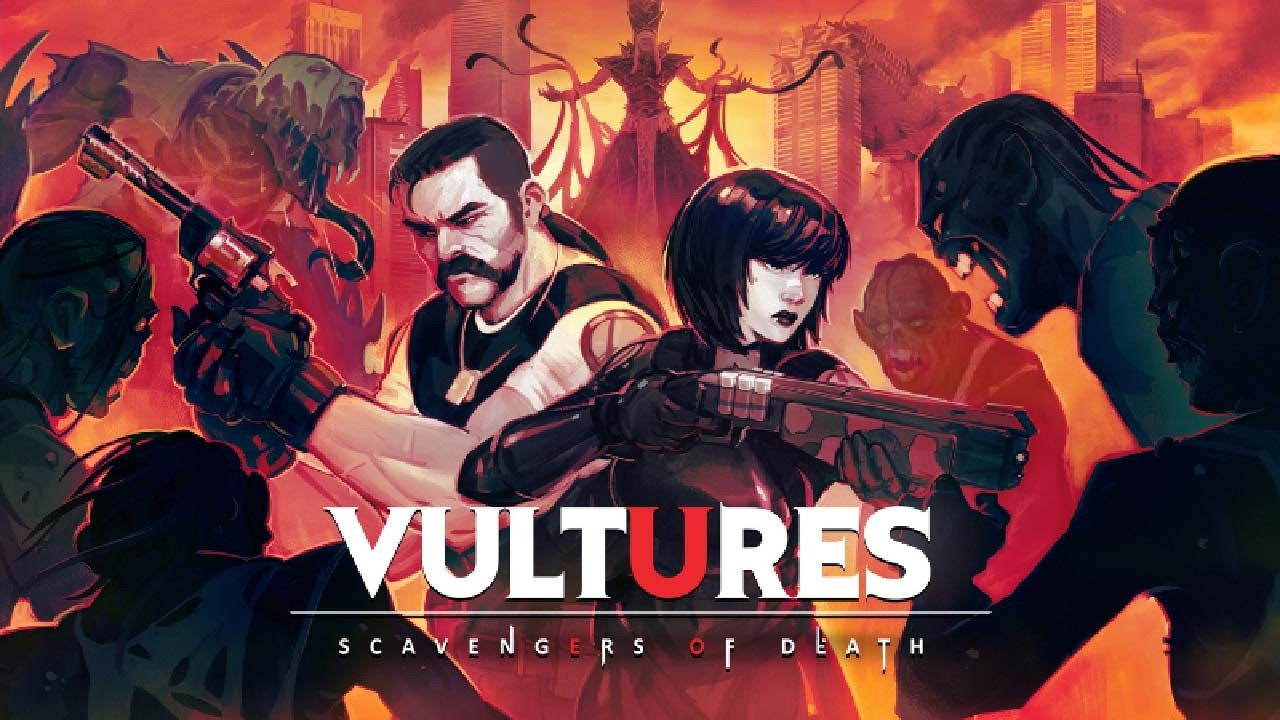
Vultures: Scavengers of Death – Tactical Survival Horror RPG
Retro-inspired extraction horror game featuring turn-based combat, stealth, and tactical zombie survival
Vultures: Scavengers of Death is a turn-based tactical survival horror game set inside a quarantined post-apocalyptic city where players extract Targets, scavenge Credits, and survive infected threats using stealth, strategy, and resource management.
Every extraction starts with a Target—but getting out alive is the real mission

Vultures - Scavengers of Death


Nothing in Salento Valley stays quiet for very long once the extraction begins Tactical survival horror works best when every hallway feels like a bad decision waiting to happen
Vultures: Scavengers of Death is an upcoming tactical survival horror RPG developed by Team Vultures and published by Firesquid alongside Gamersky Games, scheduled for release on May 13, 2026. Built around turn-based tactics, extraction gameplay, and retro PS1 style graphics, the game places players inside the quarantined ruins of Salento Valley where infected mutants, collapsing infrastructure, and limited supplies shape every mission. Instead of functioning as a fast-paced zombie shooter, the game leans heavily into tactical survival systems inspired by classic survival horror and modern indie extraction games. Players assume the role of mercenaries operating within the VULTURE unit, accepting dangerous contracts from a mysterious Client tasked with recovering Targets hidden throughout contaminated sectors of the city. Early developer footage and Steam demo impressions suggest that the game prioritizes environmental pressure, movement economy, and survival-oriented decision making over direct combat efficiency. The result feels positioned somewhere between tactical RPG design and psychological horror, using resource scarcity and extraction risk to create tension rather than relying entirely on cinematic scares.
Backtracking suddenly becomes stressful once every supply starts competing for inventory space Every extra resource collected feels useful until extraction turns into a race back to safety
One of the strongest aspects visible in current gameplay demonstrations is the game’s approach to turn-based combat and tactical readability. Vultures uses a dynamic tactical camera with rotational movement and grid-snapping traversal rather than traditional fixed-camera survival horror controls. Despite this flexibility, the visual framing still captures the oppressive atmosphere associated with classic PlayStation-era horror games. Narrow hallways, dim industrial lighting, quarantine barriers, and abandoned infrastructure create combat spaces where visibility becomes part of the tactical challenge itself. Analysis of recent developer walkthroughs shows that encounters are intentionally designed around movement economy and environmental positioning rather than overwhelming enemy counts. Combat pacing feels structurally closer to tactical strategy games such as XCOM than to traditional action horror shooters, particularly because ammunition scarcity discourages reckless engagement. The seamless transition between exploration and combat also helps preserve tension throughout missions, with the tactical overlay appearing naturally during encounters instead of interrupting gameplay with dramatic perspective changes or loading screens.
Amber handles collapsing environments like improvisation is part of the assignment Leopoldo feels safer in direct encounters until the city starts forcing vertical movement
Rather than operating as a squad-based tactical RPG, Vultures: Scavengers of Death revolves around a single-operative deployment structure where players choose between two mercenaries before each mission. Leopoldo focuses on environmental manipulation, object displacement, and defensive spatial control, making him particularly effective in confined combat zones where enemy movement can be restricted. Community feedback from the Steam Next Fest demo frequently described him as the more durable option during direct encounters, though his limited vertical mobility creates disadvantages in larger industrial sectors with elevated pathways and alternate escape routes. Amber approaches missions from the opposite direction. Developer walkthrough footage released in April demonstrates that her grappling system is not limited to traversal alone. Her equipment includes a pull mechanic capable of dragging enemies into hazards or repositioning them away from clustered infected groups. This gives her a more aggressive form of tactical flexibility while also supporting stealth-focused extraction runs. Because only one operative deploys at a time, the pacing of missions changes dramatically depending on which character is selected, encouraging replayability through tactical experimentation rather than procedural randomness.
The real danger usually starts after the Target has already been found Greed quietly becomes part of the extraction loop once valuable Credits enter the equation
The extraction gameplay loop forms the foundation of the game’s progression systems. Every mission contains a designated Target that must be recovered successfully in order to complete the operation, but the surrounding environments also contain optional valuables that can be converted into Credits through the in-game Market system. This creates a constant risk-versus-reward structure where players must decide whether additional scavenging is worth increased exposure to infected enemies and dwindling supplies. The system places Vultures alongside modern indie extraction games such as Zero Sievert and Quasimorph while still maintaining the slower pacing associated with survival horror RPG design. Recent pre-release materials indicate that Credits earned through successful extractions can be exchanged for weapon upgrades, operative customization, and loadout improvements that expand tactical options during later missions. Inventory management also appears intentionally restrictive, echoing the “inventory tetris” design philosophy associated with classic 1990s survival horror. Ammunition, healing items, extracted valuables, and mission-critical equipment all compete for limited inventory space, forcing players to think carefully before committing to deeper exploration routes.
Salento Valley feels abandoned right up until something starts moving in the dark again Broken infrastructure and quarantine zones create as much tension as the infected themselves
Salento Valley functions as more than a visual backdrop for combat encounters. The quarantined city is designed as a fragmented operational zone shaped by biological disaster, containment failure, and urban decay. Rather than presenting a fully open-world environment, the game uses mission-focused locations that gradually increase environmental pressure as players move deeper into contaminated sectors. Industrial corridors, abandoned laboratories, deteriorating power systems, and quarantine checkpoints all contribute to the game’s psychological horror atmosphere. Environmental storytelling appears central to the experience, with much of the world-building communicated through debris placement, damaged infrastructure, emergency signage, and abandoned facilities instead of cinematic exposition. This restrained narrative approach helps preserve immersion while reinforcing the feeling that the player is navigating spaces abandoned in the middle of a crisis. The infected enemies themselves appear designed primarily as pressure tools rather than spectacle-driven monsters. Their role is often to restrict movement, drain resources, and force difficult positioning choices during extraction attempts instead of simply overwhelming players through sheer numbers.
Even the clean interface feels tense once ammunition counts start dropping too low Small UI details quietly keep the focus on survival instead of menu management
One of the more technically impressive aspects visible in current footage is the game’s diegetic UI design and overall interface restraint. Tactical overlays, movement ranges, health indicators, and inventory systems remain readable without overwhelming the screen with excessive information panels. This minimalist approach keeps visual attention focused on the low-poly environments and infected threats rather than on layered menus or distracting interface clutter. Inventory management appears intentionally tactile, with limited slot availability reinforcing the broader survival horror pacing. The transition between exploration, scavenging, stealth navigation, and tactical combat also remains fluid, preserving immersion during longer missions. From a usability standpoint, the clean interface design should help the game remain approachable for players less familiar with complex tactical RPG systems while still supporting enough strategic depth for genre-focused audiences. The result feels more streamlined than many modern strategy-heavy extraction games without sacrificing tactical clarity.
The retro visuals hide how approachable the game is on older PC hardware Most of the pressure comes from survival systems rather than technical spectacle
From a technical perspective, Vultures: Scavengers of Death appears positioned as an unusually accessible extraction horror game for low-spec PCs. Official requirements list integrated Intel Iris Xe graphics support alongside only 2 GB of storage space, suggesting that the retro PS1 visual style is being used not only for atmosphere but also for hardware efficiency. Based on currently available gameplay footage and environmental complexity, integrated graphics systems commonly found in office laptops and mid-range portable PCs should realistically maintain stable frame performance during tactical encounters. The contained mission structure, moderate enemy density, and restrained particle effects all contribute to this accessibility. Unlike many modern horror titles that depend on cinematic rendering techniques and large-scale physics simulation, Vultures appears technically focused on atmosphere, interface responsiveness, and tactical readability instead of visual excess. This low hardware barrier may ultimately become one of the game’s strongest advantages within the indie tactical horror space, particularly for players searching for extraction games that remain playable on older or portable systems.
The deeper the assignments go the less trustworthy the mission brief starts to sound Every recovered Target raises new questions about what really happened inside the quarantine zone
Although gameplay systems clearly remain the central focus, Vultures also establishes a strong narrative framework built around ambiguity and operational distrust. The VULTURE unit operates as a mercenary organization rather than a heroic resistance group, and recent pre-launch materials repeatedly emphasize uncertainty surrounding the unnamed Client financing these extractions. While the official objective revolves around gathering information connected to a possible cure, the structure of the missions and the secrecy surrounding recovered Targets suggest broader political motivations behind the quarantine operation. This ambiguity strengthens the game’s dystopian atmosphere without overwhelming the tactical gameplay with excessive exposition. The storytelling instead emerges gradually through environmental details, recovered information, mission objectives, and the increasingly unstable state of the city itself. Combined with the game’s slower pacing and isolation-focused structure, this creates a form of psychological horror driven more by uncertainty and survival pressure than by scripted cinematic events.
Final verdict Vultures works best when survival feels uncertain long before combat even begins
Vultures: Scavengers of Death stands out within the modern indie horror landscape by combining turn-based tactics, extraction gameplay, retro PS1 aesthetics, and survival horror RPG systems into a tightly focused tactical experience. Rather than relying on constant action or cinematic spectacle, the game builds tension through environmental pressure, limited resources, movement economy, and calculated extraction risk. Its single-operative structure gives each mission a distinct tactical identity, while the Market and Credit systems reinforce meaningful long-term progression through scavenging and survival efficiency. The restrained UI design, low-spec accessibility, and psychologically driven atmosphere further separate it from many contemporary action-oriented zombie games. Based on current developer footage, community demo feedback, and pre-release analysis, Vultures appears positioned as one of the more technically deliberate indie tactical horror projects leading into its May 13, 2026 launch. Its greatest strength lies in how consistently every system supports the broader idea of survival through caution, planning, and tactical restraint rather than brute force.
The VoxOdyssey Project Mission Statement for Feature games
I highlight what makes each game unique by examining gameplay mechanics, design choices, and storytelling. By analyzing systems, level design, and play styles, and referencing official media and assets, I aim to provide accurate, informative, and trustworthy insights. While I strive for accuracy, some details may change or be updated over time. Players can use this information to understand each title’s features and mechanics and make their own judgments.
Scriptorium Screenshots Show Medieval Manuscript Creation Inside a Cozy Workshop Pigment mixing, illuminated pages, and detailed medieval illustration tools in use


Vultures Trailer Shows Tactical Extraction Horror Inside a Collapsing Quarantine Zone
Watch Vultures: Scavengers of Death in motion as turn-based combat, stealth routes, and infected encounters unfold across Salento Valley. The trailer highlights tactical survival systems, retro horror atmosphere, and the constant pressure of making it out alive.