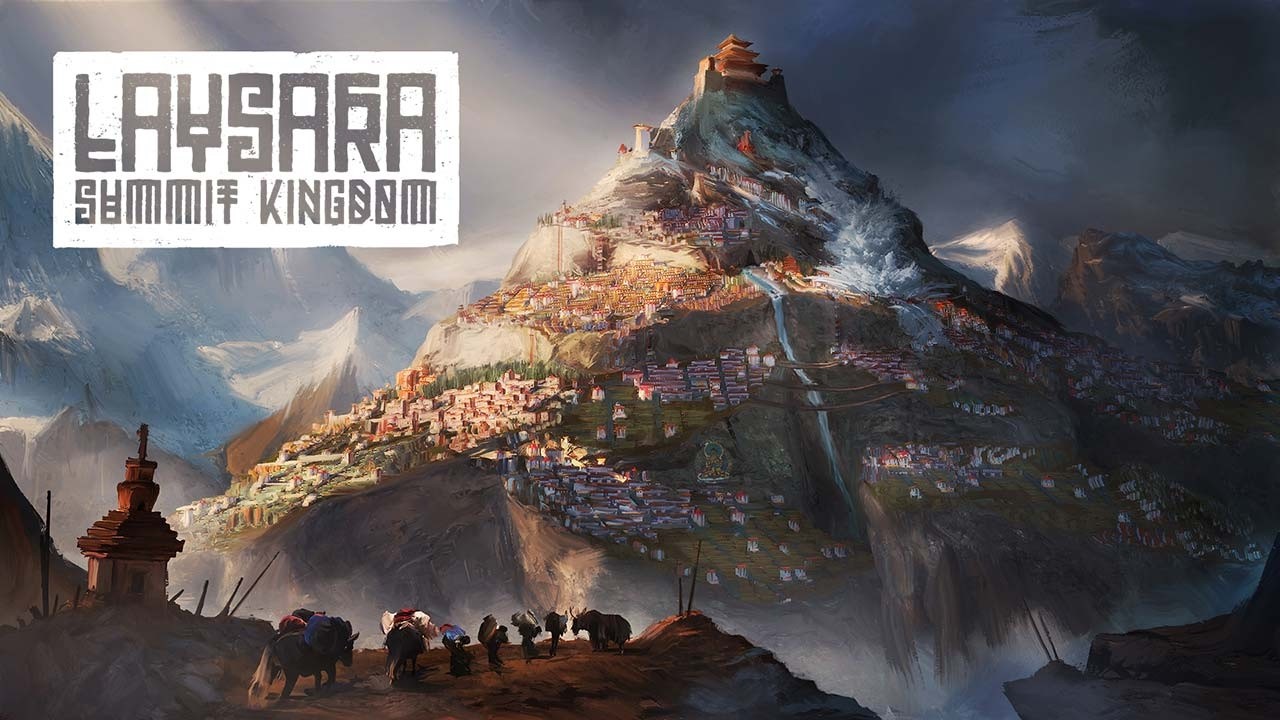
Laysara: Summit Kingdom – Mountain City Builder Strategy (2026)
Quite OK Games’ vertical city builder challenges players with avalanches, caste management, and complex transport networks
Laysara: Summit Kingdom, developed by Quite OK Games and published by Future Friends Games, is a mountain-based strategy city builder focused on production chains, avalanche risk mitigation, and managing a three-caste society across interconnected alpine settlements.
Continue below for a detailed breakdown of Laysara: Summit Kingdom systems, campaign structure, and economic design

Laysara: Summit Kingdom


Mountain Settlement Design and Vertical Expansion Adapting City Building Systems to Harsh Alpine Terrain
Laysara: Summit Kingdom builds its core identity around elevation. Each settlement is founded on a separate mountain defined by distinct slope gradients, vegetation layers, and mineral access. Expansion unfolds upward and outward across narrow terraces rather than open land, which changes how housing, farming, and industry are arranged. Productive space is limited, and every placement decision affects long-term efficiency. The result is a city building structure where geography shapes economic possibility from the opening minutes.
Avalanche Systems and Environmental Risk Management Planning Infrastructure Around Recurring Natural Threats
Avalanches operate as a systemic constraint rather than occasional spectacle. Snow buildup defines potential impact paths, and players respond through forestation, constructed barriers, or controlled early releases. Industrial zones and transport routes must account for these patterns before they are built, since recovery after burial can destabilize multiple production chains at once. The mechanic rewards preventive planning and reinforces the relationship between environmental awareness and economic stability.
Transport Networks and Vertical Logistics Roads, Bridges, Shafts, and Efficient Goods Movement
Resource flow depends on carefully engineered transport infrastructure. Roads connect agricultural terraces, bridges cross ravines, and vertical shafts overcome steep gradients that would otherwise isolate districts. As settlements expand toward higher elevations, travel distance increases and inefficiencies become visible in slowed deliveries and unmet caste needs. Yaks extend carrying capacity across demanding terrain, improving throughput without replacing the underlying logistical design. Stability comes from minimizing friction across altitude layers.
Three-Caste Society and Production Scaling Balancing Lowlanders, Artisans, and Monks Through Supply Chains
Population progression is structured around three castes with escalating requirements. Lowlanders sustain foundational industries, Artisans introduce refined manufacturing, and Monks require consistent access to advanced goods. Growth is therefore conditional on reliable production sequencing. Shortages at any tier ripple upward, slowing expansion or halting advancement. Because needs evolve over time, successful settlements anticipate demand shifts instead of reacting to shortages after they emerge.
Interconnected Mountains and Trade Symbiosis Coordinating Specialized Settlements Across the Kingdom
Mountains rarely provide a complete resource portfolio. Establishing additional towns enables specialization, allowing one settlement to export minerals while another concentrates on agriculture or processed goods. Trade routes integrate these towns into a shared economic network. Revisiting earlier settlements to adjust exports or rebalance supply becomes part of long-term optimization, transforming isolated maps into components of a broader strategic system.
Campaign Structure and Sandbox Flexibility Structured Objectives Versus Open-Ended Development
The 15-mission campaign introduced in the 1.0 release gradually layers complexity, highlighting avalanche mitigation, vertical logistics, and caste management under controlled conditions. Sandbox mode removes scenario constraints and supports open experimentation with settlement layouts and trade configurations. Both modes operate in real time with pause functionality, emphasizing thoughtful planning and iterative refinement rather than rapid reaction.
Summit Temple Construction and End-Game Logistics Sustained Economic Stability at Extreme Elevation
Reaching the mountain peak and constructing the Summit Temple serves as the culminating objective. This phase requires consistent high-volume material transport to exposed elevations where weather conditions intensify risk. Earlier infrastructure decisions determine whether the final ascent is feasible. The challenge lies not in a sudden difficulty spike, but in whether the settlement’s economic systems can sustain prolonged logistical strain.
Systemic Depth and Replay Considerations Optimization Across Changing Terrain Profiles
Variation between mountain layouts ensures that optimal solutions are rarely transferable. Road placement, shaft positioning, and defensive barriers must adapt to new terrain profiles and resource distributions. Efficiency gains often emerge from subtle adjustments rather than dramatic redesigns. Replay value stems from refining these systems and improving structural foresight, aligning engagement with incremental mastery of terrain-aware planning.
Final Verdict A Focused Vertical City Builder Centered on Logistics and Survival
Laysara: Summit Kingdom delivers a deliberate, systems-driven interpretation of the strategy city builder. By centering progression on production chains, avalanche mitigation, and multi-settlement trade rather than combat, it establishes a clearly defined niche within resource management simulation. Its difficulty arises from interconnected logistics and environmental constraints, rewarding careful planning over expansion speed. For players seeking a mountain-based city builder built on structural precision and economic discipline, it offers a cohesive and technically grounded experience.
The VoxOdyssey Project Mission Statement for Feature games
I highlight what makes each game unique by examining gameplay mechanics, design choices, and storytelling. By analyzing systems, level design, and play styles, and referencing official media and assets, I aim to provide accurate, informative, and trustworthy insights. While I strive for accuracy, some details may change or be updated over time. Players can use this information to understand each title’s features and mechanics and make their own judgments.
Laysara: Summit Kingdom – Mountain Settlements, Avalanches, and Resource Management Screenshots Illustrate Vertical Expansion, Caste Systems, Transport Networks, and Summit Temples


Laysara: Summit Kingdom Trailer – Gameplay Preview of Mountain Settlements and Logistics
Watch the Laysara: Summit Kingdom trailer to see gameplay in action, including mountain city building, avalanche management, and transport networks. The video shows how vertical expansion, caste systems, and summit construction come together in a playable environment.