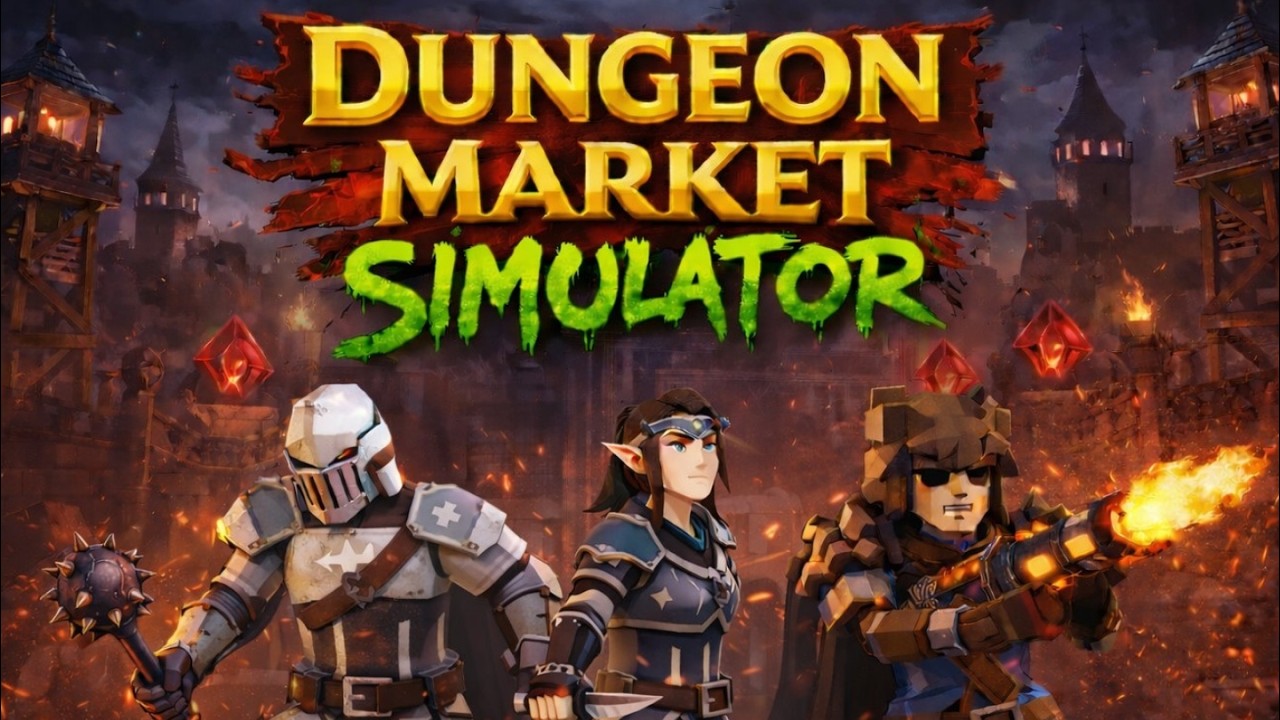
Dungeon Market Simulator – Medieval Economy and Dungeon Strategy Game
Manage a dungeon shop, automate trap systems, and trade upgraded loot in a medieval economy simulator
Dungeon Market Simulator is a strategy simulation by DarkRook Interactive where players build trap-filled dungeons, collect loot from defeated intruders, upgrade items, and manage a dynamic market through inventory control and negotiation systems.
Step inside the dungeon marketplace and see how strategy turns danger into profit

Dungeon Market Simulator


Dungeon Market Simulator Connects Medieval Economy with Dungeon Automation A hybrid system where trap-driven loot feeds a player-controlled trading network
Dungeon Market Simulator, developed by DarkRook Interactive and published with PlayWay S.A., is a medieval economy simulator that merges dungeon strategy with shop management systems. The player operates as a merchant overseeing a trap-filled dungeon designed to capture outcast warriors and convert their defeat into tradable resources. Rather than separating combat and commerce, the game builds a continuous loop where automation, inventory management, and negotiation define progression. Each system feeds into the next, creating a structure where efficiency is shaped by how well the dungeon and market are aligned.
From Trap Placement to Market Value Every encounter in the dungeon influences the strength of the trading economy
The core gameplay revolves around the relationship between dungeon automation and item-based economy. Traps are placed strategically within a confined layout, functioning as a form of base building that determines how effectively intruders are neutralized. These encounters generate mysterious chests, which serve as the primary source of inventory. The variability of these rewards prevents predictable outcomes, encouraging repeated adjustments to dungeon design. What begins as a defensive system quickly becomes an economic engine, where the quality and frequency of loot directly impact the player’s ability to sustain and expand their market presence.
Inventory Management as the Central System Upgrading, pricing, and timing define the path from loot to profit
Inventory management sits at the center of Dungeon Market Simulator’s design. Items obtained through dungeon automation are not immediately optimized for sale; instead, they can be upgraded to increase their value. This introduces a decision-making layer where players weigh immediate returns against long-term profitability. The presence of over one hundred unique items ensures a steady flow of variation, while the upgrade system adds depth to otherwise straightforward transactions. Managing stock, prioritizing enhancements, and determining when to sell becomes a continuous balancing act that shapes the overall pace of progression.
Negotiation and the Dynamics of Trade Customer interaction transforms selling into a strategic process
Trading in Dungeon Market Simulator extends beyond fixed pricing models. Customers interact with the shop in ways that require active negotiation, turning each sale into a small strategic exchange. Pricing too high risks losing a transaction, while undervaluing items limits growth potential. This system reinforces the economic simulation aspect, as success depends on reading demand and adjusting offers accordingly. The market is not static, and the player’s ability to adapt to shifting conditions becomes as important as the quality of the inventory itself.
Automation and System Efficiency Optimized dungeon layouts create a steady flow of resources for trade
Automation plays a defining role in how the game evolves over time. Once traps are configured effectively, the dungeon operates with minimal direct intervention, allowing the player to focus on market activities. This shift from manual control to system oversight reflects a broader trend in simulation design, where efficiency replaces constant input. The more refined the dungeon layout becomes, the more consistent the output of loot, creating a stable foundation for economic growth. This interplay between automated systems and active management forms the backbone of the gameplay loop.
Progression Through Upgrades and Promotions Layered systems expand both the dungeon and the marketplace over time
Progression is structured through a combination of upgrades, promotions, and system enhancements. Totems and other modifiers improve efficiency, while promotions unlock new opportunities within the trading framework. These elements introduce a sense of scale, allowing the player to transition from a modest operation to a more complex network of interconnected systems. Each upgrade influences multiple aspects of gameplay, reinforcing the idea that dungeon performance and market success are inseparable. The result is a progression model that rewards planning and incremental improvement rather than rapid expansion.
A Cohesive Medieval Simulation Environment Dungeon and marketplace exist as a single functional space
The game’s environment supports its systemic design by merging the dungeon and the shop into a unified setting. Rather than isolating these elements, Dungeon Market Simulator treats them as parts of a single operational space. This integration reinforces the immersive sim approach, where the player interacts with systems that coexist within the same environment. The medieval setting provides context without dominating the experience, allowing mechanics such as trap placement, item upgrading, and trading to remain the primary focus.
Position Within Strategy and Simulation Genres A focused blend of economy, automation, and dungeon management systems
Within the broader simulation landscape, Dungeon Market Simulator occupies a niche defined by hybrid mechanics. It combines elements of strategy, economy, and base building with an emphasis on automation and inventory control. This structure differentiates it from traditional shop simulators, which often rely on static systems, and from dungeon games that prioritize direct combat. By connecting these elements through a shared economy, the game establishes a distinct identity within the PC simulation space.
Final Verdict A system-driven medieval economy simulator built on automation and strategic trade
Dungeon Market Simulator delivers a cohesive gameplay loop where dungeon automation, inventory management, and market negotiation function as interconnected systems. Its design prioritizes efficiency and strategic planning, allowing players to shape outcomes through configuration rather than direct control. The combination of trap-based resource generation and dynamic trading creates a balanced structure that supports long-term engagement. As a hybrid simulation, it stands as a clear example of how economy and strategy systems can be integrated into a single, unified experience.
The VoxOdyssey Project Mission Statement for Feature games
I highlight what makes each game unique by examining gameplay mechanics, design choices, and storytelling. By analyzing systems, level design, and play styles, and referencing official media and assets, I aim to provide accurate, informative, and trustworthy insights. While I strive for accuracy, some details may change or be updated over time. Players can use this information to understand each title’s features and mechanics and make their own judgments.
Dungeon Market Simulator Gameplay Screenshots from Dungeon and Trading Systems Trap automation, inventory management, and medieval market simulation scenes


Dungeon Market Simulator Gameplay Trailer – Dungeon Automation and Market Strategy in Action
See how traps generate loot and trading turns it into profit. Watch systems connect, items evolve, and decisions shape your dungeon shop in the gameplay trailer below.