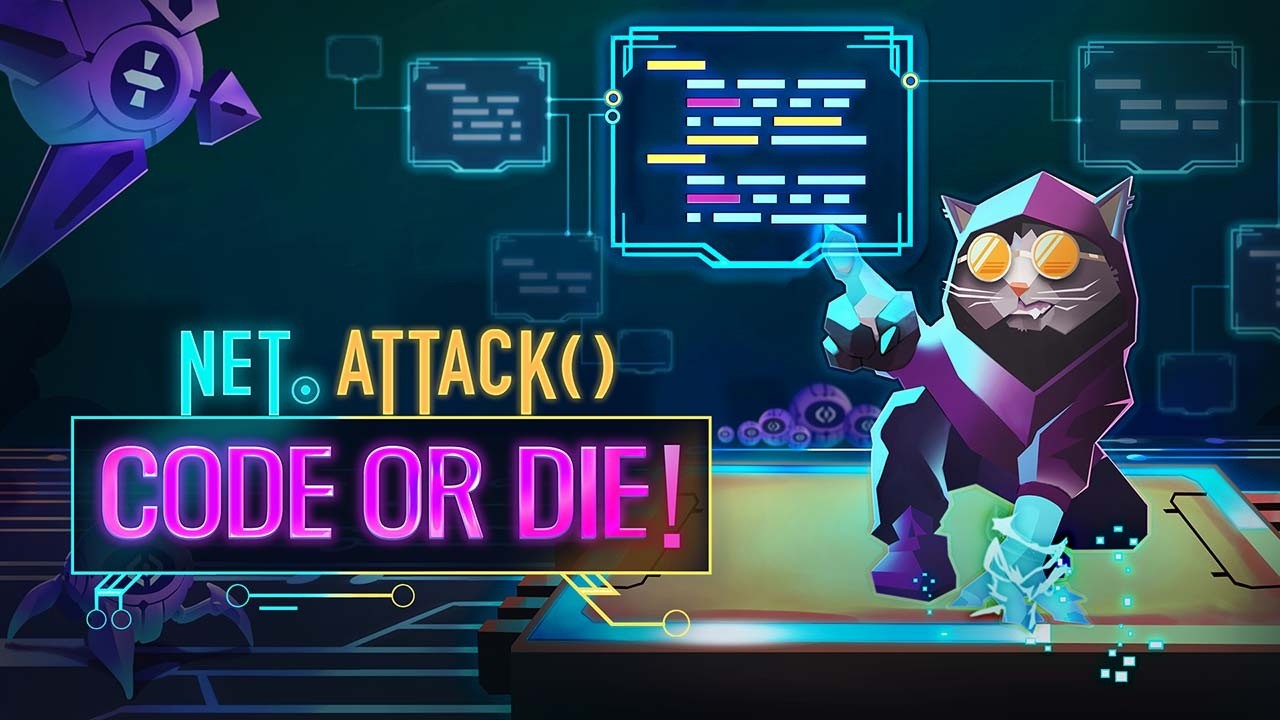
Net.Attack() – Visual Programming Bullet-Heaven Roguelite
Build custom attack algorithms in Net.Attack(), a deterministic roguelite blending coding systems with bullet-heaven combat.
Net.Attack() – Code or Die! is a cyberpunk action roguelite where players design node-based algorithms to automate combat, optimize builds, and survive escalating security systems across layered digital environments.
Dive deeper into how your code becomes your weapon in the systems below.

Net.Attack() - Code or Die!


Engineering Combat Systems in Net.Attack() A Visual Programming Roguelite Built on Algorithmic Warfare
Net.Attack() – Code or Die! centers on constructing combat logic rather than executing attacks directly. Players design node-based algorithms that automate projectile behavior in real time. If an attack chain is poorly optimized, then its inefficiency becomes immediately visible under sustained enemy pressure, reinforcing a system-first approach to survival.
Deterministic Combat Versus Roguelite Constraints Predictable Systems Meet Limited Build Availability
A central tension emerges between deterministic execution and roguelite progression. While each programmed attack behaves consistently, node availability is restricted by progression systems. If a player relies on a specific combination of triggers and loops, then limited access within a run forces adaptation, creating a balance between ideal logic and practical constraints.
Node-Based Architecture and Combat Logic Triggers, Conditionals, and Loops Define Every Encounter
The game’s 190+ nodes can be grouped into functional categories such as triggers, conditionals, and execution loops. If trigger chains are expanded without integrating cooldown controls, then output volume may exceed practical limits during later waves. This creates a requirement for balanced system design where efficiency determines long-term viability.
Scaling Difficulty Across Layered Security Systems Escalating Regions Demand Iterative Optimization
Progression is structured across regions, layers, and difficulty tiers that introduce increasingly complex enemy behaviors. If early builds focus solely on projectile expansion, then later stages expose weaknesses in sustain and control. Each layer effectively tests whether an algorithm can scale under rising computational and spatial demands.
Algorithm Efficiency and System Stability Balancing Output, Cooldowns, and Execution Flow
Complex builds introduce internal strain within the logic system. If recursive loops and chained multipliers are combined without timing controls, then execution flow may become inefficient. Integrating cooldown nodes or conditional checks stabilizes performance, ensuring that high-output builds remain functional during extended combat scenarios.
Meta Progression and Strategic Limitations Dark Market Unlocks Shape Long-Term Build Potential
The Dark Market progression system governs access to new nodes and characters. If key components are locked behind progression, then early experimentation is constrained by available tools. This creates a structured development curve where players gradually expand their capacity to construct more complex and efficient algorithms.
Distinct Strategic Archetypes Emerge From Node Design High Output, Defensive Logic, and Optimized Execution Paths
Different node combinations naturally form strategic archetypes. If multiplier and split nodes dominate a build, then the result is high area coverage with potential stability risks. Alternatively, conditional and defensive nodes prioritize survivability, while recursion-focused builds emphasize sustained output through efficient timing cycles.
Visual Programming as an Interface Layer Readable Systems That Scale in Complexity
The drag-and-drop interface translates abstract logic into visual structures. If node chains remain organized, then players can quickly diagnose inefficiencies during combat. As builds expand, maintaining clarity becomes essential, since misaligned logic paths can reduce overall system performance under pressure.
Performance Scaling and Hardware Demands Projectile Density and Memory Load Define Stability
System requirements indicate a reliance on memory and GPU performance to handle active entities. If a build generates large volumes of projectiles through loop execution, then memory usage increases significantly. Systems operating at minimum specifications may encounter instability during extended high-density encounters.
Replayability Through System Refinement Iterative Optimization Replaces Random Variation
Replayability is driven by refinement rather than randomness. If a previous build fails under specific conditions, then adjustments can be made to improve efficiency in subsequent runs. This iterative process reinforces the deterministic design, where mastery is achieved through system optimization rather than chance.
Final Assessment A Logic-Driven Roguelite Focused on System Mastery
Net.Attack() – Code or Die! positions itself as a system-driven alternative within the action roguelite genre. Its reliance on deterministic logic and visual programming shifts the focus from reflex execution to analytical design. The result is a structured experience where performance is directly tied to the efficiency of player-created algorithms.
The VoxOdyssey Project Mission Statement for Feature games
I highlight what makes each game unique by examining gameplay mechanics, design choices, and storytelling. By analyzing systems, level design, and play styles, and referencing official media and assets, I aim to provide accurate, informative, and trustworthy insights. While I strive for accuracy, some details may change or be updated over time. Players can use this information to understand each title’s features and mechanics and make their own judgments.
Net.Attack() – Visual Programming Combat Screenshots show node based coding, bullet heaven action, and deterministic roguelite systems


Net.Attack() Trailer – Visual Programming Bullet-Heaven Roguelite
Watch your custom algorithms unleash chaos and automated attacks in Net.Attack(). Press play below to see nodes in action and bullet-heaven combat unfold.